
At 11 p.m., a guest opens three hotel listings with similar rates, reviews, and locations. They enlarge the first room photo, check the bathroom, scan the pool, look for the view, and decide whether the property feels as good as the description promises. The hotel with the clearest visual answers usually earns the next click, and often the booking.
That decision happens before a sales manager can explain the service, before a guest reads every amenity, and before a front desk team has any opportunity to build trust. A photographer for hotels therefore needs to do more than make rooms look attractive. The work has to show how the property feels, how spaces connect, and why the stay deserves consideration.
Why the Right Photographer for Hotels Changes Your Bottom Line
A hotel can lose a booking before anyone reads its description. In an OTA search, guests compare listings quickly, open the gallery, and test whether the images support the promised experience. A dark room, blown-out window, crooked vertical, or missing bathroom view creates doubt at the moment the property is being judged.
A 2023 peer-reviewed study of hotel digital imagery identified four measurable traits associated with persuasive hotel photos: light and shooting time, color scheme, human presence, and shooting angle. The research also found that travelers typically click four to five times on average before booking. Only 0.7% of online visits result in an actual booking, according to the hospitality marketing statistics summary. The practical implication is clear: every gallery image must hold up through repeated comparison, not just look polished in isolation.
The commercial effect of visual doubt
Weak photography creates friction at several points. A flat thumbnail can lose the initial click. A poorly proportioned room can make the space feel smaller than expected. An incomplete gallery leaves guests searching for answers about the view, bathroom, amenities, or atmosphere, and another property may win that comparison.
Strong photography supports the direct booking engine alongside OTA visibility. It helps a property communicate quality, defend its positioning, and present a consistent experience across the website, social channels, metasearch listings, and printed sales material.
According to a market overview from MarketIntelo, properties with high-quality photos have generated 63% more bookings. Listings with more than 20 high-quality photos per room type have been associated with 136% higher bookings and 46% better online conversion rates, as reported in this hotel photography services market overview. These are industry benchmarks, not a forecast for every hotel. They still show why image quality deserves commercial scrutiny. For a closer examination of returns, see this analysis of the ROI of professional photography.
Practical rule: Treat every hero image as a sales asset. It should answer a guest question, express the property's positioning, or make the next click feel safer.
The production plan determines whether that value reaches the booking funnel. Choose a photographer who can work around housekeeping, guest flow, daylight, food styling, and platform crops. Hand over a defined shot list and delivery plan, so one production day produces a usable visual library rather than attractive frames with no clear role.
What Hotel Photography Actually Looks Like Today
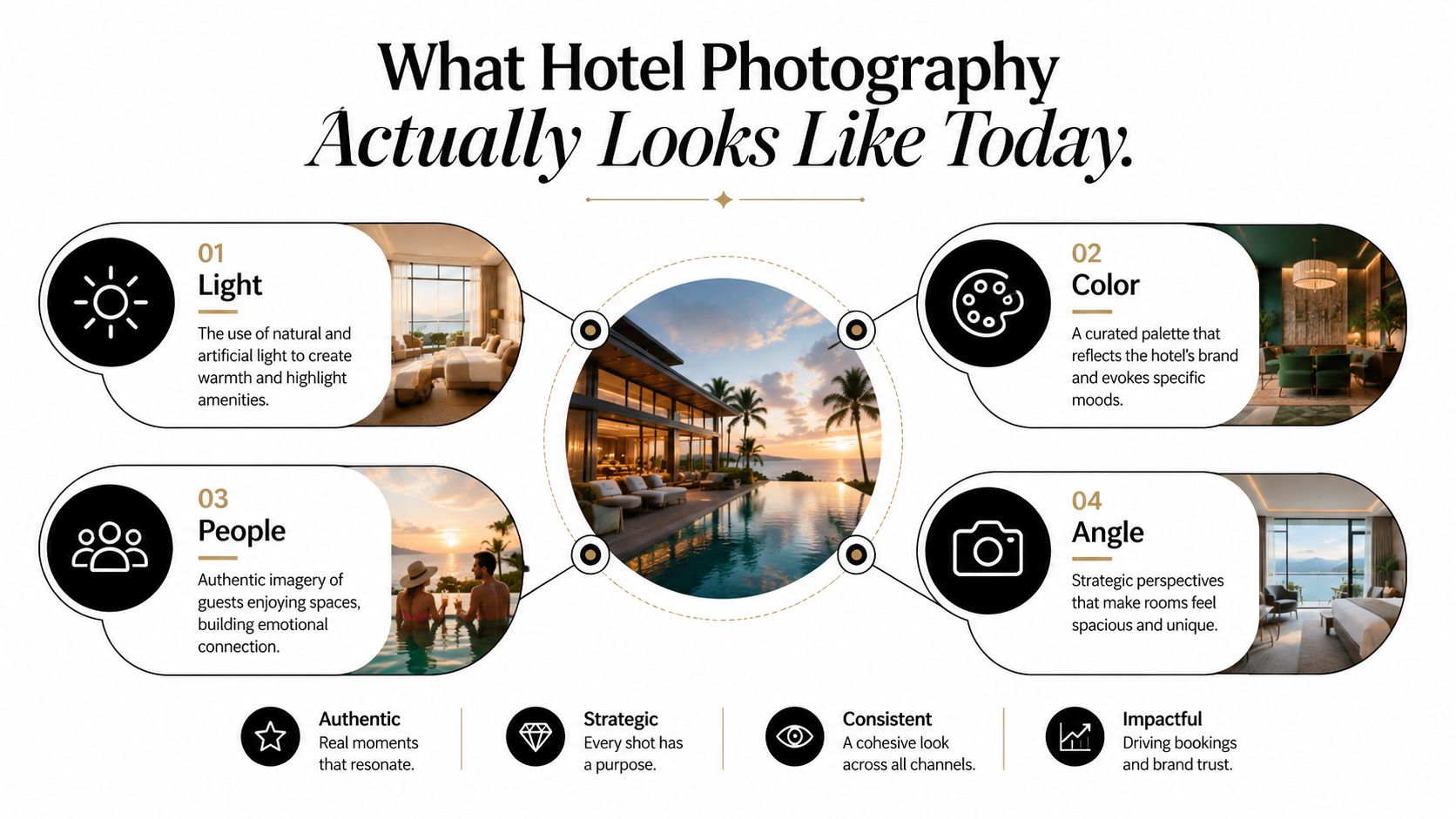
A hotel image can be technically sharp and still fail commercially. The strongest work controls four variables in every frame: light, color, people, and angle. A 2023 study in Humanities and Social Sciences Communications identified those same four properties as selling characteristics in hotel imagery, linking stronger aesthetics and composition with greater online booking likelihood. The peer-reviewed hotel photography study gives hotel teams a useful way to evaluate a portfolio and a shoot plan.
Light sets the promise
Light should describe the space, not disguise it. Soft daylight can reveal bedding, materials, and room depth with a natural feel. A lobby with daylight spilling through glazing may need controlled fill to keep the reception desk and seating areas legible without making the scene look artificially lit.
Exterior timing serves a different purpose. Golden-hour light can add warmth and curb appeal to a façade, while a flatter daytime frame may be better for documenting entry access, signage, or the relationship between the building and its surroundings. The photographer should choose timing based on the message, not habit.
Color protects brand consistency
Hotels often have rooms with different window orientations, lamps, finishes, and renovation histories. Without disciplined white balance, one gallery can make the property look visually fragmented. Color should preserve the actual palette of the room while maintaining a coherent temperature from the first thumbnail through the final detail image.
People add scale and context
A person can show how a lounge works, how wide a corridor feels, or how a pool supports a social experience. People shouldn't appear in every frame, and staged guests shouldn't look like catalog models who have never used a hotel. Staff portraits, dining scenes, and subtle lifestyle moments work best when they reinforce service, comfort, or place.
Angle determines trust
Wide views establish layout, but excessive widening can make a room feel misleadingly large. Eye-level hero frames often feel more credible, while a higher or lower angle may emphasize a ceiling, view, pool edge, or architectural feature. The photographer's job is to select the perspective that helps a guest understand the space without distortion.
How to Read a Hotel Photographer's Portfolio
Don't review a portfolio as a collection of beautiful individual images. Review it as evidence that the photographer can build a coherent hotel gallery under real operating conditions. Ask to see complete property sets, not only the hero frames selected for a website.
Start with interiors. Vertical lines should remain controlled, especially around doors, wall edges, and casework. Check whether the photographer preserves window detail while keeping the room bright enough to understand. A polished frame with a white rectangle where the view should be tells you the exposure strategy wasn't finished. Consistent color across a room set matters just as much. If one image is cool and another is amber, the gallery will feel assembled rather than designed.
Evaluate the whole property story
Exterior work should show intentional timing. Look for a clear distinction between daytime documentation and twilight atmosphere. Check the sky, façade, signage, and practical lights. An exterior shouldn't rely on a dramatic sky while hiding the building's actual condition or access.
People images deserve a separate review. Models should look comfortable in the space, and wardrobe should support the hotel's audience rather than distract from the architecture. Watch for plastic skin, bleached highlights, awkward gestures, and expressions that make the scene feel staged. In F&B work, inspect glassware, table settings, food texture, and the relationship between the subject and the environment.
| Image Category | Look For | Red Flag |
|---|---|---|
| Interior | Straight verticals, balanced windows, consistent color | Heavy HDR halos or distorted room proportions |
| Exterior | Clear time-of-day intent, readable façade, controlled sky | Every hotel shown with the same sunset treatment |
| People | Natural posture, believable interaction, suitable wardrobe | Catalog-style posing or aggressive skin retouching |
| F&B | Clean styling, edible food, purposeful service action | Smeared glassware, clutter, lifeless plates |
| Details | Material texture, hardware, linens, local character | Generic close-ups that could belong anywhere |
| Delivery | Organized files, useful metadata, clear naming | Missing metadata or confusing folder structure |
Watch for templated coverage
Identical compositions across multiple hotels can indicate a stock-style formula. A photographer needs repeatable technique, but not a fixed visual template that ignores the property's architecture and audience. Portfolios dominated by weddings or portraits may show excellent camera skill while offering little evidence of handling room geometry, window contrast, housekeeping coordination, or commercial licensing.
Ask how the photographer manages mixed lighting, removes visual distractions, and prepares images for OTA crops. The answers often reveal more than the portfolio itself.
A Practical Shot List for Every Space in the Property
A hotel shot list should be broad enough to sell the stay and disciplined enough to keep the crew moving. The right frame count depends on property size, room categories, renovation scope, and channel requirements, so the numbers below work as planning ranges rather than promises.
Booking.com guidance cited in hospitality photography resources recommends approximately 24 property-level photos and four photos per room type, including at least one bathroom image, for a positive conversion impact. The hotel photography guidance covering window exposure and platform needs also emphasizes well-lit, pristine, undistorted images with a mix of close-up and perspective views.
Build coverage by decision
| Space | Frame Count | Purpose | Priority Frames |
|---|---|---|---|
| Exterior and arrival | 5 to 8 | Establish identity, access, and first impression | Day hero, twilight, entry, signage, elevated view if permitted |
| Lobby and reception | 5 to 7 | Show atmosphere and guest flow | Wide, vertical mobile frame, reception, seating, signature feature |
| Each room type | 6 to 9 | Explain layout, comfort, and function | Room wide, bed, bathroom, view, amenities, lifestyle frame |
| F&B outlets | 6 to 10 | Sell dining and service experience | Table setting, plated dish, bartender or server, ambient detail |
| Amenities | 5 to 8 per major amenity | Show reasons to choose the property | Pool, spa, fitness, treatment, distinctive experience |
| Details | 8 to 12 across property | Add texture and brand character | Linens, hardware, materials, artwork, local references |
The exterior sequence should answer arrival questions quickly. Include the building in context, the entrance, signage, valet or parking relationship, and a twilight frame if the property's evening identity matters. For a lobby, pair one architectural establishing image with closer frames that show material quality and how guests use the space.
Guest rooms need more than a single wide angle. Include the made-up room, bed detail, bathroom vanity and shower, window view, in-room amenities, and one restrained lifestyle frame. A room image without a bathroom image leaves a practical gap in the booking decision.
F&B coverage should balance product and experience. A plated dish proves capability, while a bartender, server, or guest interaction gives the outlet energy. Amenities need the same balance. A pool wide shows scale, but a detail of loungers, water, treatment materials, or a distinctive activity can make the experience feel specific.
For social channels, finish with a three-image carousel sequence that combines a place, a detail, and a human or experiential moment. a structured photography shot list keeps creative coverage tied to actual publishing needs rather than leaving the photographer to guess.
Questions to Ask Before You Sign the Contract
The pre-booking call should function like a production meeting. A photographer can have an impressive portfolio and still be a poor fit if the agreement doesn't define usage, delivery, retouching, and contingencies.
Start with rights and deliverables
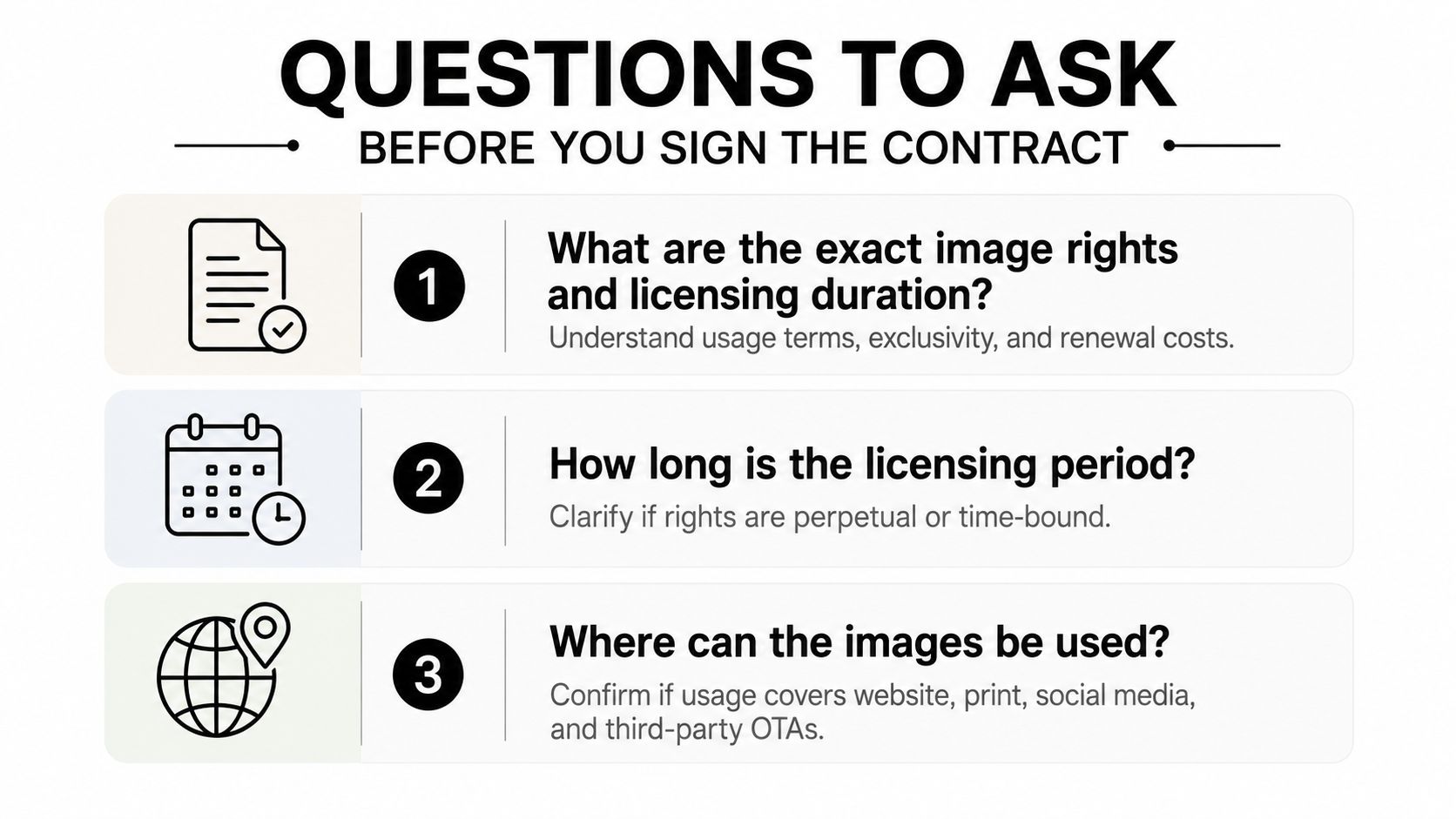
Ask whether the hotel receives rights for its website, direct booking engine, social media, email, print, paid media, and third-party OTAs. Clarify the licensing duration, territory, exclusivity, renewal terms, and what happens if ownership or branding changes. Image rights and model releases need to work together. If a person appears in a campaign, the hotel should know whether the intended channels and duration are covered.
Confirm what arrives at delivery. Most hotel teams need edited JPEGs prepared for web and high-resolution use, but the contract should state file dimensions, color profile, naming conventions, crops, and whether RAW files are included. Ask how long the photographer archives the project and whether a future re-export is possible.
Define post-production before the shoot
Retouching can mean basic color correction, window blending, object removal, architectural cleanup, or extensive image reconstruction. Put the scope in writing. Ask whether window pulls, sky replacement, reflection cleanup, people retouching, and revision rounds are included or billed separately.
Contract checkpoint: If a requested edit could change what a guest reasonably expects to see, define it before production.
Operational questions matter just as much. Confirm crew size, equipment, insurance certificates, drone permissions if needed, food or prop styling, model sourcing, and weather rescheduling. Ask for a delivery schedule, backup plan for photographer illness, and references from comparable hotel assignments. A photographer who asks detailed questions about room access, occupancy, housekeeping, and brand positioning is usually thinking like a production partner rather than a drop-in vendor.
On-Site Logistics and a Realistic Day-Of Schedule
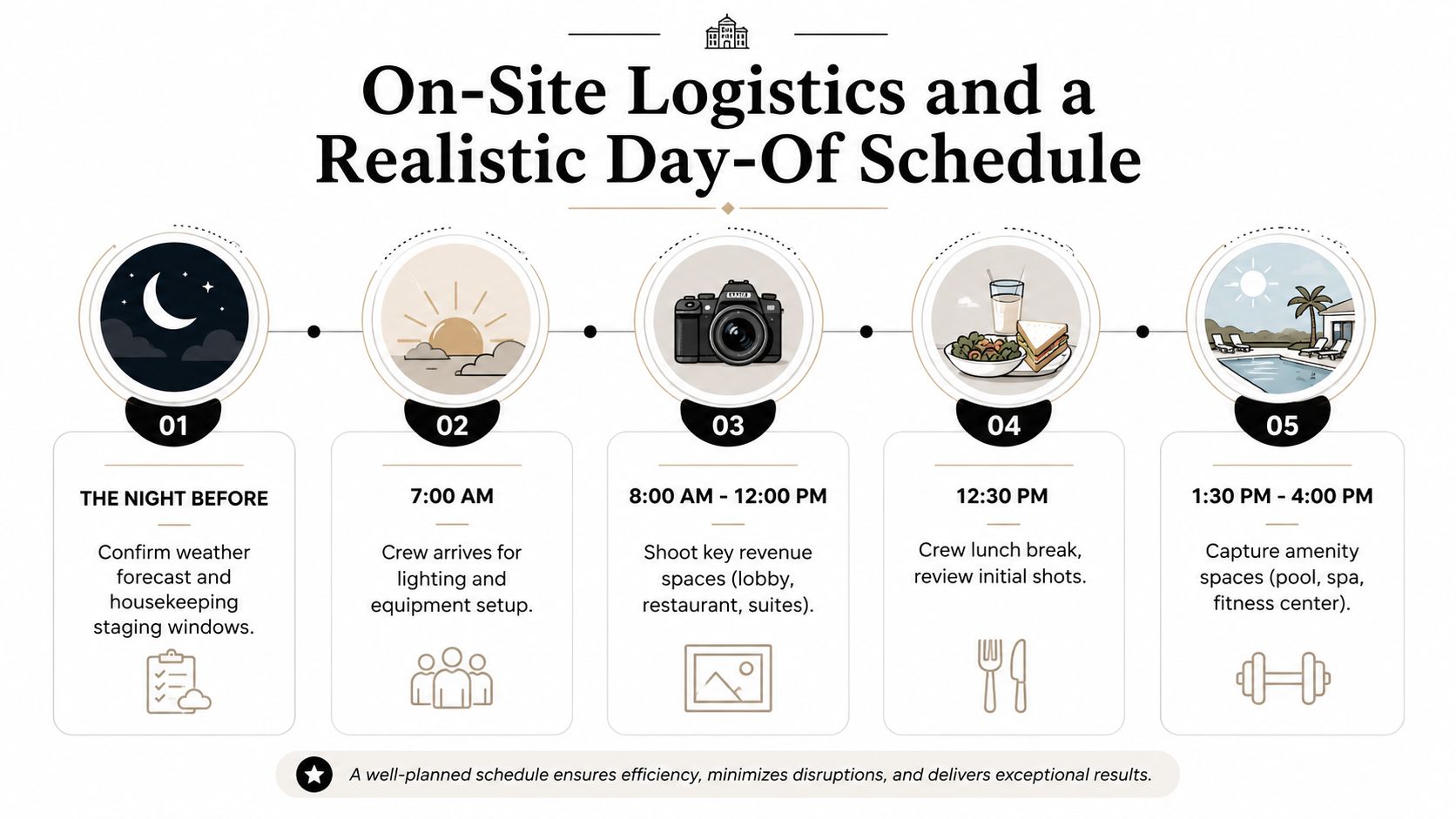
A successful hotel shoot is coordinated before the camera comes out. The night before, the marketing lead should confirm the weather, housekeeping staging windows, rooms taken out of service, food preparation timing, amenity access, and the single person authorized to approve styling decisions. A site preparation guide for a photography production can help the property turn those decisions into an actionable checklist.
A workable production rhythm
The night before: Confirm forecasts, access, room assignments, housekeeping resets, staff call times, and any guest privacy restrictions. Mark spaces that need special clearance, such as pools, spas, restaurants, and meeting rooms.
7:00 a.m.: The crew arrives, unloads away from guest traffic, and sets up equipment. Stands and cables should be flagged for safety. The photographer and hotel contact walk the property together, checking the shot list against current conditions.
8:00 a.m. to noon: Photograph guest rooms and suites while housekeeping can reset them in sequence. Move floor by floor where possible. The hotel contact manages blinds, clears stray items, confirms amenities, and keeps the next room ready. Morning light is often useful for clean room documentation, but the photographer should choose each exposure based on the room's orientation.
12:30 p.m.: Break for lunch and review the first selects. This is the right time to identify a missing room feature, a distracting reflection, or an exposure problem before the crew leaves the property.
1:30 p.m. to 4:00 p.m.: Move to indoor amenities, F&B, spa, fitness, meeting rooms, and service scenes. Food should be plated close to capture time. Staff or talent should have approved wardrobe and a clear action rather than vague instructions to “look natural.”
Late afternoon and evening: Capture exterior, arrival, pool, and lobby frames as the light changes. Mixed interior and exterior exposure needs careful control. A tripod with bracketed or dual-exposure frames can preserve both the interior fixtures and the outside view, followed by a controlled merge in post-production. The photographer should avoid brute-force flash and excessive distortion, both of which can make a room feel less authentic.
A short twilight session can finish the day with a façade or lobby hero. Before leaving, the photographer should check backups, note any reshoot requirements, and break down equipment away from guest flow.
The production schedule should remain flexible. A pool may be unavailable, a delivery may block the entrance, or weather may flatten the exterior. Build priorities into the shot list so the crew can protect revenue-critical spaces first rather than lose the entire day to one delayed setup.
Sample Brief Template and Your Next Steps
A useful hotel photography brief gives the photographer enough commercial context to make good decisions without requiring the hotel team to direct every frame. Copy, adapt, and send the following structure before requesting proposals.
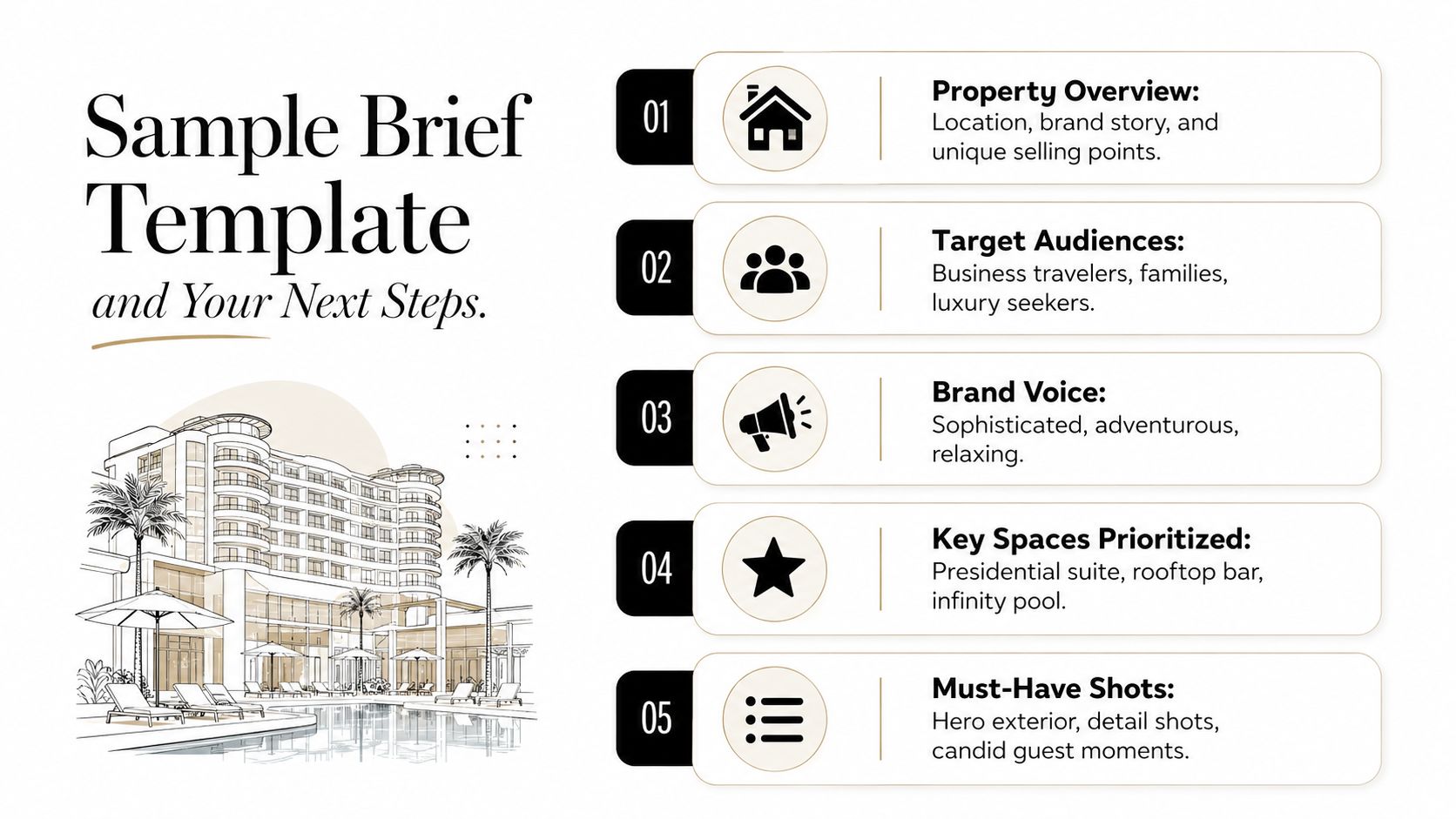
Copy-paste brief
Property overview:
Property name, location, room categories, renovation status, signature amenities, nearby attractions, and the experience the hotel wants guests to understand.
Target audiences:
Business travelers, families, couples, luxury travelers, event planners, or another defined audience. Explain what each audience needs to see before booking.
Brand voice:
Adventurous, relaxed, design-led, family-friendly, or another approved direction. Include a mood board or reference gallery if available.
Priority spaces:
Rank the spaces by commercial importance. Identify the room types, restaurant, lobby, pool, spa, meeting areas, views, and experiences that need the strongest coverage.
Must-have images:
List the required hero, wide, vertical, detail, bathroom, view, lifestyle, F&B, amenity, and social frames for each space.
Deliverables and rights:
Specify edited file types, web and print requirements, social crops, metadata, delivery folders, usage channels, licensing duration, territory, and revision process.
Timeline:
State the booking date, pre-production call, shoot dates, first proof date, review deadline, final delivery, and any launch deadline.
Approval process:
Name one hotel contact who can approve styling and selects. Define how feedback will be consolidated so the photographer doesn't receive conflicting requests.
Ten-point pre-shoot checklist
- Housekeeping: Confirm room staging and reset order.
- Room access: Identify rooms out of service and backup options.
- Windows: Record preferred blind positions and view priorities.
- F&B: Schedule chefs, plates, drinks, and service staff.
- Amenities: Confirm pool, spa, fitness, and treatment access.
- Talent: Approve casting, wardrobe, releases, and call times.
- Styling: Remove clutter and prepare approved props.
- Contacts: Assign one on-site decision maker and one backup.
- Weather: Set an exterior reshoot or alternate indoor plan.
- Delivery: Confirm file specs, archive policy, rights, and review dates.
After the first production, treat the library as a living sales system. Schedule quarterly refreshes for operational changes, seasonal detail updates, social cutdowns, and an annual hero-image review across OTA and direct booking channels. The objective isn't to create more files for their own sake. It's to keep the visual answers accurate wherever a guest compares the property.
If you need a photographer for hotels who can combine architectural precision, controlled lighting, lifestyle direction, and organized commercial delivery, visit Jimmy Clemmons Photographer. Share your property priorities and booking goals to discuss a focused image library built for hotel websites, OTAs, social channels, and sales teams.