
A marketing director opens three proposals for the same brand shoot. One is $4,500, another is $12,000, and the third is $28,000. The instinct is to assume that two photographers are overcharging, or that one has misunderstood the brief.
That spread can be perfectly reasonable. Each quote may cover a different combination of production, image delivery, licensing, crew, post-production, travel, and risk. Brand photography pricing rarely describes the photographer's time alone. It describes the usable commercial system built around the shoot.
For small-business assignments, public market guides commonly place a mini session at $450–$850, a half-day at $950–$1,800, and a full-day at $1,800–$3,500, with multi-day or destination productions reaching $3,500–$8,000 or more when travel and additional production are involved (brand photography pricing benchmarks). Commercial buyers, however, often need a different lens. The relevant question isn't, "What's the day rate?" It's, “What will each usable, rights-cleared asset cost across the campaign?”
Why Three Brand Photo Quotes Never Match
A quote becomes comparable only after you unpack what it contains. Photography isn't a commodity like a standardized print run or software subscription. Two suppliers can photograph the same location and still deliver radically different commercial value.
Four reasons the spread exists
Deliverables change the workload. One proposal might hand over lightly edited JPEGs, while another includes a defined number of fully retouched images, web-ready exports, high-resolution files, crops for different placements, and organized delivery folders. A photographer who owns the final edit is pricing selection, color consistency, retouching, file preparation, and quality control, not just camera time.
Licensing changes what the client can do. Internal communications, a website, organic social posts, paid advertising, print collateral, outdoor advertising, and global campaign use aren't interchangeable rights. A proposal that includes a narrow internal license may look inexpensive beside one that permits paid media or broader commercial distribution.
Production scale changes the risk. A solo photographer with a camera and assistant has a different cost structure from a production involving a producer, stylist, hair and makeup artist, digital technician, lighting assistant, location manager, and second photographer. Crew members reduce operational risk and increase control, but they also add fees and coordination.
Overhead is part of professional delivery. Insurance, backup equipment, studio access, gear maintenance, software, transportation, and equipment depreciation all sit behind the visible shoot day. Experienced studios also price the time spent preparing shot lists, scouting locations, coordinating stakeholders, and protecting the schedule from avoidable failure.
Practical rule: Never compare the top line until the proposal identifies the final image count, retouching standard, usage rights, crew, expenses, and delivery schedule.
The wider commercial market reflects this complexity. A 2026 guide places commercial shoot day rates between $800 and $5,000, while commercial and brand images may be quoted from $300 to $5,000 depending on experience and complexity (commercial photography pricing guidance). The figures aren't contradictory. They describe different pricing units.
The Four Pricing Models Explained
Most professional proposals use one of four structures. Each can work, but each creates a different risk for the buyer.
| Model | How It Works | Best Fit | Where It Breaks |
|---|---|---|---|
| Day rate | You pay for the photographer's production time, with deliverables and licensing added or defined separately. | A one-off campaign with a clear schedule and controlled scope. | The day rate can hide post-production, usage, and expense exposure. |
| Per-image | You pay for each selected or finished image. | Product catalogs, stock-style libraries, and repeatable asset creation. | Iterative selection becomes expensive, and the team may avoid useful variations. |
| Package | A fixed bundle combines shoot time, deliverables, and selected services. | Repeatable shoots with predictable outputs. | Preset limits can force a larger package than the brief requires. |
| Retainer | You commit to recurring work over an agreed period in exchange for planned access and defined output. | In-house marketing teams that need content every month. | It requires trust, consistent volume, and disciplined scheduling. |
Day rates
A day rate is cleanest when the production has one location, a defined shot list, and a small number of decision-makers. It gives the team a clear way to reserve time, but it doesn't automatically explain how many finished assets will arrive afterward. Ask whether editing, assistants, travel, and licensing sit inside or outside the rate.
Per-image pricing
Per-image pricing makes sense when every asset follows a consistent formula, such as a product on a controlled background. It becomes less useful when the campaign needs creative exploration, multiple selects, alternate crops, or several versions of the same scene. Charging for every selected image can punish the client for wanting a useful library.
Packages and retainers
Packages offer convenience when the same brief repeats. Retainers go further by reserving ongoing capacity, but they shouldn't become a vague promise of “content.” Define shoot dates, asset categories, usage, editing standards, and rollover rules.
A simple decision rule works well: choose a day rate for a one-off event, per-image pricing for a catalog of products, a package when the brief repeats quarterly, and a retainer when marketing needs content every month.
What Actually Drives the Number
A quote for one executive portrait can sit beside a quote for a full campaign and still show the same day rate. The invoice changes because the usable-asset plan, production risk, and commercial rights change. For architecture, corporate, and commercial buyers, the useful comparison is cost per finished asset across the campaign, not the day rate alone.
Scope comes first
Count setups, locations, subjects, wardrobe changes, lighting changes, and required compositions. One executive portrait in a single room requires a different production plan from a leadership team photographed across several offices, even if both use one calendar day. A larger shot list can lower the cost per usable asset when the crew and location are already booked, provided the brief stays disciplined.
Licensing can change the quote without changing the shot list. Define channels, duration, territory, and exclusivity. Internal use, paid media, and a broad buyout carry different commercial value. Buyers who need a clearer explanation of usage rights can review this guide to licensing a photo for commercial use.
Crew, travel, post-production, and speed
Crew size follows the production problem. A photographer may handle a straightforward portrait session alone. A location campaign may require a producer, stylist, digital technician, assistants, hair and makeup, or a second shooter. Each role can improve the result or reduce risk, while adding people to an unclear brief increases waste.
Travel adds flights, accommodation, ground transportation, per-diems, location fees, and schedule exposure. Multi-city work also requires consistent lighting, composition, and color across teams.
Post-production may mean culling and basic correction, or detailed skin, product, architecture, and environmental retouching. RAW delivery shifts editing to the client or agency. Rush delivery compresses the workflow and can require extra editing capacity, whereas a normal schedule gives the studio time to finish carefully.
A licensing extension can raise a proposal substantially without changing a single frame. The image stays the same, but broader commercial permission makes each usable asset more valuable.
Real Budget Ranges for 2026
Public pricing guides don't produce one universal rate card, and they shouldn't. A buyer can still use available benchmarks to create a sensible starting budget before requesting proposals.
For small-business work, a mini session commonly falls at $450–$850 for about two hours and 20–35 images, a half-day at $950–$1,800 for four hours and 50–80 images, and a full-day at $1,800–$3,500 for eight hours and roughly 100–150 images (published brand photography package benchmarks). A practical U.S. benchmark also places finished brand imagery around $15–$35 per image, with mid-range commercial assignments commonly reaching $1,500–$10,000 as production and editing requirements expand (U.S. brand photography cost guidance).
| Engagement Type | Typical Use | Low Range | Mid Range | High Range |
|---|---|---|---|---|
| Mini session | Small-business refresh, limited portraits, or a focused product need | $450 | $650 | $850 |
| Half-day | Defined campaign with a controlled number of setups | $950 | $1,375 | $1,800 |
| Full-day | Broader brand library with multiple scenes and deliverables | $1,800 | $2,650 | $3,500 |
| Multi-day or destination | Multiple locations, travel, and expanded production | $3,500 | $5,750 | $8,000+ |
How to use the ranges
Treat these figures as planning benchmarks, not promises. Licensing, talent, studio rental, travel, styling, advanced retouching, and crew can move the quote beyond the base band. Commercial photography guides also report much wider pricing for complex work, including commercial shoot days at $800–$5,000 and commercial or brand images at $300–$5,000 (commercial rate context).
The mistake is using a small-business session as a proxy for an architecture, corporate, or product campaign. A marketing team should first define the usable asset list, channels, rights period, and approval process. Then it can judge whether a package, day rate, per-image model, or retainer reflects the actual work.
Matching Budget to Project Type
Project type gives you a better starting point than a photographer's headline rate. A product launch with several SKUs, hero images, detail views, ecommerce cutouts, and lifestyle scenes needs more planning and post-production than a simple executive refresh.
A corporate culture shoot typically centers on team candids, workspace interactions, and a small set of posed portraits. The production challenge is often coordination, not elaborate styling. Architecture, interiors, and hospitality work can require careful scouting, lighting control, permitting, time on location, and compositional consistency across spaces. Executive portraits add another layer when the client expects hair and makeup, styling, multiple backgrounds, and a polished leadership set.
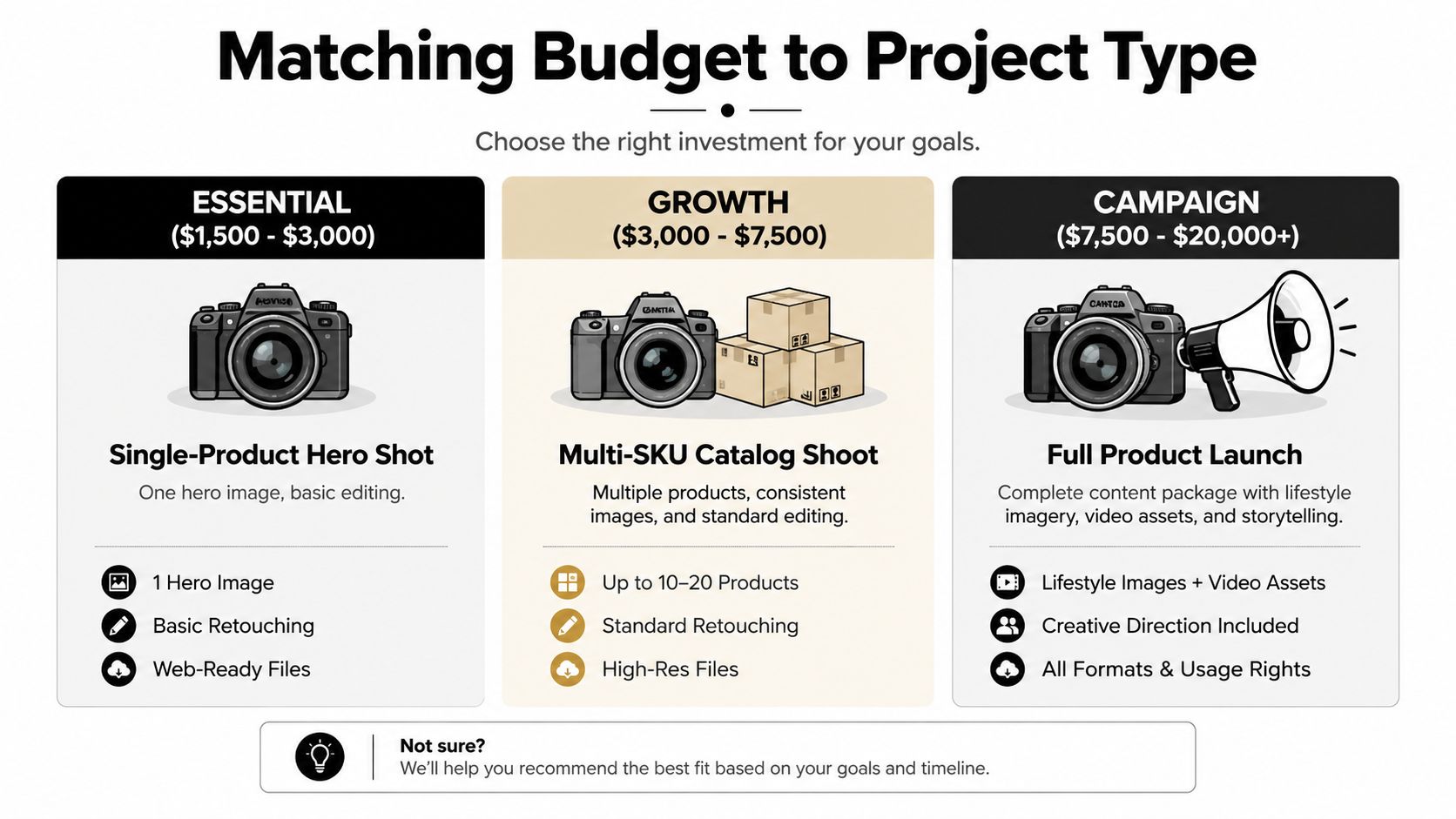
Use the asset count to test the budget:
- Product campaigns: Budget for hero, detail, cutout, and lifestyle variations, then confirm whether post-production is priced per image or included.
- Corporate culture: Define the required teams, locations, portraits, and candid scenes before booking a day.
- Architecture and interiors: Allow for scouting, lighting design, access windows, permitting, and the number of finished views needed per space.
- Executive portraits: Confirm the number of people, backgrounds, wardrobe changes, hair and makeup, and final retouching depth.
The brand photography examples you review should help you judge the visual complexity, not just the editing style. Two projects can have similar image counts but very different production demands.
Evaluating Value Beyond the Line Item
The largest number on a proposal is often the least useful number. A $8,000 shoot can produce a much stronger commercial result than another $8,000 shoot if it delivers more usable assets, clearer rights, better retouching, and fewer restrictions.
A practical comparison starts with the total project cost. Add the value of the licensing window as a separate consideration, then divide the investment by the number of fully edited, rights-cleared images the team expects to use. The resulting cost per usable asset gives marketing, communications, and procurement a common language.
| Quote | Total Cost | Finished Images | Licensing Window | Cost Per Usable Asset |
|---|---|---|---|---|
| A | $9,000 | 40 | Broad usage | $225 |
| B | $5,500 | 12 | Tightly limited | About $458 |
| C | $14,000 | 150 | Annual retainer usage | About $93 |
Quote A costs more at the outset than Quote B, but it creates a larger library with broader commercial flexibility. Quote C requires a bigger commitment, yet its asset economics can be attractive when the images are useful throughout the year. The calculation doesn't make licensing interchangeable with image count, but it stops teams from treating all final files as equal.
What to normalize
Before comparing photographers, place these items in a single worksheet:
- Finished image count: Exclude proofs and unedited selects.
- Retouching standard: Define whether the job includes color correction, cleanup, compositing, or detailed architectural and product work.
- Usage rights: Record channels, territory, duration, exclusivity, and paid media permissions.
- Delivery format: Include high-resolution files, web exports, crops, naming conventions, and archival responsibility.
- Revision process: Clarify how many rounds of feedback are included and who approves the final gallery.
The ROI of professional photography matters only when the images support real marketing activity. A large gallery that nobody can deploy isn't efficient, while a smaller set with the right rights and formats may carry a campaign much further.
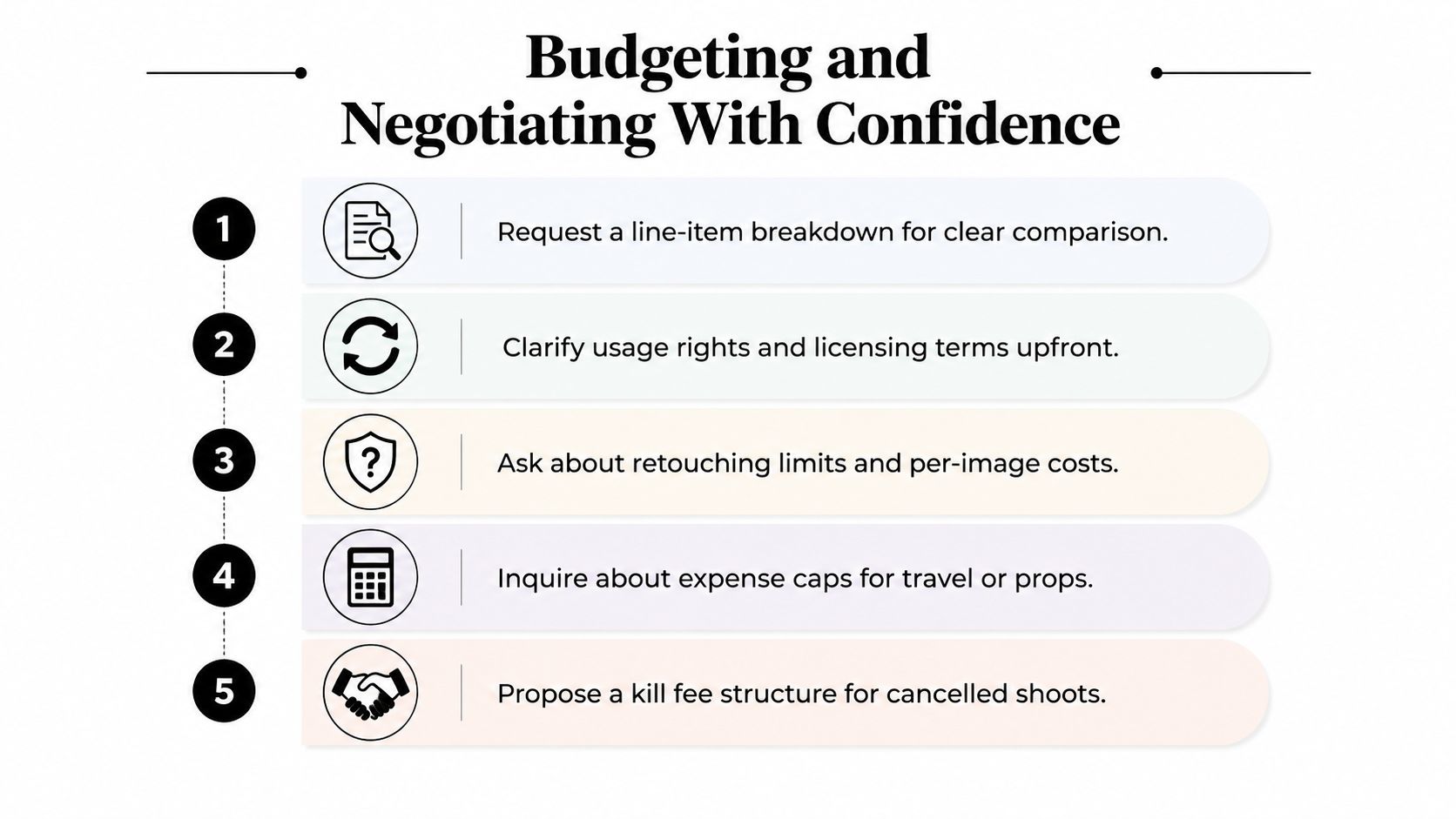
Budgeting and Negotiating With Confidence
Strong negotiation doesn't begin with “Can you lower the rate?” It begins with a brief that lets both sides see where the money goes. Photographers can usually adjust scope, crew, deliverables, or licensing more intelligently than they can absorb an arbitrary discount.
Five moves before signing
Request a line-item breakdown. Ask for production fees, usage, retouching, assistants, travel, location expenses, and taxes or other applicable charges. A single day rate makes it impossible to compare two proposals fairly.
Separate licensing from production. Ask for tiered rights, such as internal use, web and organic social, paid media, print, or broader campaign use. A perpetual global license may be unnecessary if the campaign has a defined life. Published market commentary identifies licensing and usage rights as major reasons commercial pricing scales beyond shoot time (commercial pricing and usage context).
Protect the contingency. Set aside a contingency for weather changes, reshoots, access problems, and urgent edits. Don't remove essential planning or backup coverage just to make the proposal fit a preliminary number.
Negotiate scope, not skill. Reduce locations, shorten the shot list, trim unnecessary crew, choose a standard delivery schedule, or license fewer channels. Those changes alter the work. Asking an experienced photographer to perform the same production for less only transfers pressure into preparation or post-production.
Lock deliverables in writing. The contract should identify the image count, retouching depth, file types, delivery date, licensing window, approval process, cancellation terms, and expense limits. If the brief changes, the change order should identify the new cost before production continues.
What not to cut
Don't cut the preproduction that prevents missed shots. Don't remove color management or professional retouching when the images represent a premium property, product, or leadership team. Don't accept vague language such as “edited images” without defining what edited means.
Ask for expense caps on travel, props, studio hire, and location fees. Confirm who handles permits and releases. If the shoot could be cancelled, negotiate a clear kill-fee structure that recognizes dates reserved, crew booked, and costs already incurred.
A photographer may also offer different service levels. Jimmy Clemmons Photographer provides architectural imagery, commercial brand content, and professional portraits, with services that include location scouting, lighting design, on-set direction, and professional editing. Those capabilities are particularly relevant when a corporate or built-environment project needs consistent, purposeful images rather than a simple camera-day booking.
The quote you approve should make the business case visible. It should show what the team will receive, where the images can appear, how long the rights last, who is responsible for each production task, and what happens when the brief changes. That clarity protects the buyer and gives the photographer enough room to deliver the work properly.
If your architecture, corporate, or commercial team needs brand photography priced around usable assets, licensing, and production scope, Jimmy Clemmons Photographer can develop a focused proposal for the actual brief. Visit Jimmy Clemmons Photographer to review the studio's architectural imagery, commercial brand content, and professional portrait services, then request a project-specific conversation.