
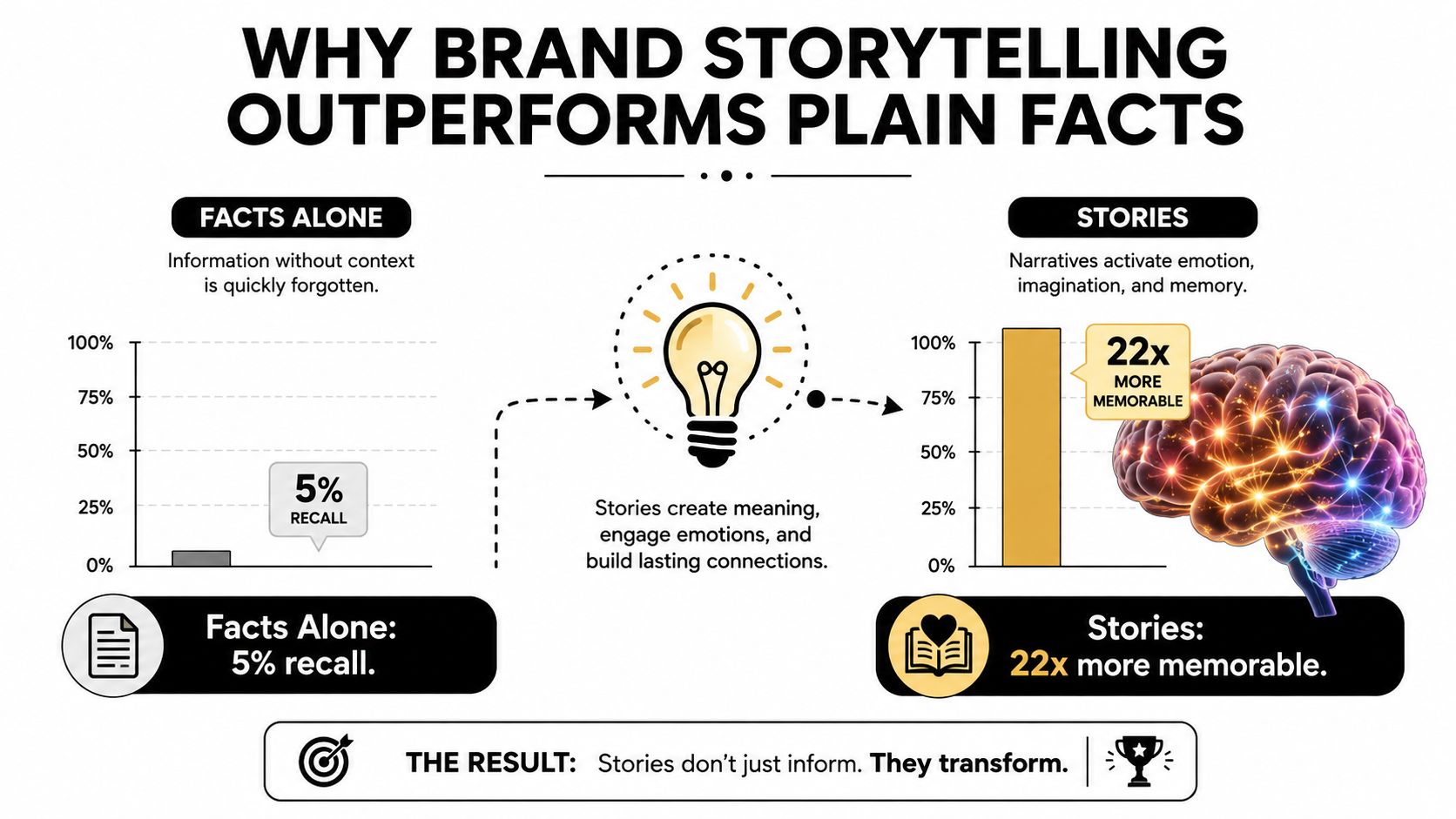
Facts are easier to say than stories, but stories are what people keep. Research cited in marketing literature says facts are 22 times more likely to be remembered when they're embedded in a story, while plain statistics alone tend to stick at just 5% to 10% recall, compared with 65% to 70% when the same information is delivered through narrative as summarized in this storytelling research overview. That is why brand storytelling isn't a decorative idea. It's a practical way to make a brand easier to remember, easier to trust, and easier to act on.
For architecture firms, corporate teams, and design-forward brands, that matters because audiences are already flooded with polished claims. They don't need another vague promise about quality, craft, or partnership. They need a story that quickly signals what a brand stands for, who it serves, and how it helps people get to a better outcome.
Why Brand Storytelling Outperforms Plain Facts
Facts are easier to state than stories, but stories are what people keep. Brand storytelling works because memory and persuasion are built differently. A list of features asks people to process information cold. A story gives those details a human shape, which makes them easier to retrieve later and harder to ignore in the moment.
The memory gap is only part of the case. Consumer research summarized in the same source says 55% of people are more likely to buy a product if they love the brand story, 44% would share it, and 15% would buy immediately same source. Those numbers do not mean every story sells on contact, but they do show a pattern that marketers see in real campaigns. When the message feels like a narrative, people are more likely to pay attention, remember it, and act on it.
Why the brain keeps a story longer
Story gives information sequence, tension, and resolution. That structure helps the audience organize what they are hearing around meaning instead of sorting through isolated claims. In practice, a project photo, a team portrait, or a short case study can carry more weight than a page of adjectives because each one shows how the work affects a real client, site, or outcome.
Practical rule: if a piece of content can be understood as a list, it is probably not finished yet. Good brand storytelling gives the viewer a reason to care about the information, not just a reason to notice it.
That matters most in saturated markets. Architecture firms and corporate brands are not only competing on polish, they are competing on clarity. Audiences do not have time to compare every offer line by line, so they use faster emotional signals. A strong story helps a brand feel distinct before the details even land, and visual work often carries that load first, especially in sectors where the finished environment, the team, and the client result are the clearest proof of value.
The Core Elements of a Brand Narrative
Brand storytelling becomes usable when it stops being abstract. For architecture firms and corporate brands, the clearest framework is People, Places, Purpose, and Plot, a structure used in business storytelling as outlined in Harvard Business School's note on storytelling frameworks. Each part answers a different question, and each one should show up in both copy and visuals. If one piece is missing, the story may sound polished but it will not feel specific enough to support a sales conversation or a pitch deck.
People and Places make the story believable
People are the humans the audience can recognize. In a corporate setting, that can mean leadership portraits, on-site teams, or candid workplace interactions. For a law firm redesign project, the right people are often the partners who need to signal trust, the project manager coordinating the rollout, and the client team who will work in the space every day.
Places ground the story in a specific environment. For an architecture firm, that might be a finished lobby, a construction site, a hospitality interior, or a campus building. For a corporate brand, it could be a headquarters reception area, a lab, a manufacturing floor, or a conference room where decisions get made. The place does more than decorate the story. It proves where the work lives and what kind of business it supports.
A strong location shot can do a lot of work fast. A bright lobby shot says the firm understands arrival and first impression. A portrait of an engineering team on site says the brand is close to the details, not just the renderings.
Purpose and Plot give the narrative direction
Purpose is the reason the brand exists beyond making money. It should be visible in decisions, not just stated on the about page. A corporate real estate group that talks about long-term workplace health needs imagery that shows real use, not empty interiors. An architecture studio that says it designs for community impact should show how a school, civic project, or public-facing building serves the people inside it.
Plot is the movement from challenge to outcome, which is what turns a slogan into a story people can follow. In practice, that often looks like a client with a hard constraint, a design team solving it, and a result that makes the organization easier to trust, work in, or grow within. A headquarters relocation, a tenant improvement rollout, or a branded environment refresh all have a plot if the story follows the problem, the process, and the result.
The easiest way to test a brand narrative is to ask whether someone outside the company can repeat it after one pass. If they can't, the structure is probably too vague.
A good story framework stays portable across channels. Website copy, recruiting pages, proposal decks, and photography briefs all become easier when the brand knows which people, places, purpose, and plot it is trying to express. For teams working with visual content, that framework also keeps the shoot focused on outcome, not just aesthetics.
Making the Customer the Hero of Your Story
The most common mistake in brand storytelling is centering the founder biography. That can work for some brands, but it often turns into a self-portrait instead of a customer story. For B2B and design-led companies, the audience usually cares less about who started the business than about what the partnership helps them achieve.
The better frame is straightforward. The customer is the hero, and the brand is the guide. That shift changes the content immediately. Instead of “here's who we are,” the story becomes “here's the problem you're facing, and here's how we help you move through it.”
What customer-led storytelling sounds like in practice
A heritage-heavy company doesn't need to abandon its origin. It needs to translate that origin into relevance. A firm can still mention how it began, but the emphasis should land on what clients get from that experience, such as clearer communication, smoother delivery, or a stronger visual case for trust.
For an architecture studio, the hero is often the client who needs to win approval, lease a space, or communicate design intent. For a corporate brand, the hero might be the marketing lead who needs usable imagery that feels authentic instead of staged. That customer-outcome framing is more useful than retelling the company's biography because it connects the story to an actual decision.
Useful check: if your story spends more time describing the brand's past than the customer's future, it's probably off balance.
Authenticity matters most here. The brand still needs a real point of view, but it has to show up as help, not performance. When the customer sees their own obstacle and their own success in the narrative, the brand earns a role in the story instead of claiming one.
Visual Storytelling in Architecture and Corporate Brands
In visually driven businesses, photography often carries the story before the copy does. A strong architectural image communicates scale, materiality, light, and intent in one frame. A weak one turns a space into a brochure shot that says very little about how the environment feels or functions.
That difference matters in the market. Editorial-style images of built environments can show how a project supports real use, not just how it looks in a portfolio. The same is true for corporate photography. Candid team portraits, workplace scenes, and leadership imagery can reveal culture, process, and confidence faster than a paragraph of brand language.
When I shoot for architecture or commercial clients, the most effective images usually answer a question the viewer already has. Will this firm handle a complex project well. Will this team look credible in front of stakeholders. Will this space support the experience the brand promises. Those are narrative questions, not aesthetic ones.
A good frame does more than document the subject. It gives decision-makers evidence they can trust.
Why visuals do the heavy lifting
A photograph can make abstract claims feel concrete. That is why visual storytelling becomes the main narrative vehicle for design-forward and B2B brands. Visual storytelling is the primary way those brands communicate through materials people can assess quickly.
For a closer look at how photography storytelling works in practice for brands, that framework fits companies that need to communicate trust, operational strength, and design intent in one sitting.
Strong brand imagery doesn't just show what something looks like. It shows what it means to the people who rely on it.
The strongest visual systems stay consistent because the story stays consistent. If the images show calm precision, the copy should sound calm and precise too. If the brand claims collaboration, the photography should show collaboration, not just polished surfaces.
In architecture and corporate work, that consistency has a trade-off. The visuals need to be polished enough to support the brand, but they also have to feel believable to clients who know the difference between a staged scene and a working environment.
Planning a Brand Storytelling Photoshoot
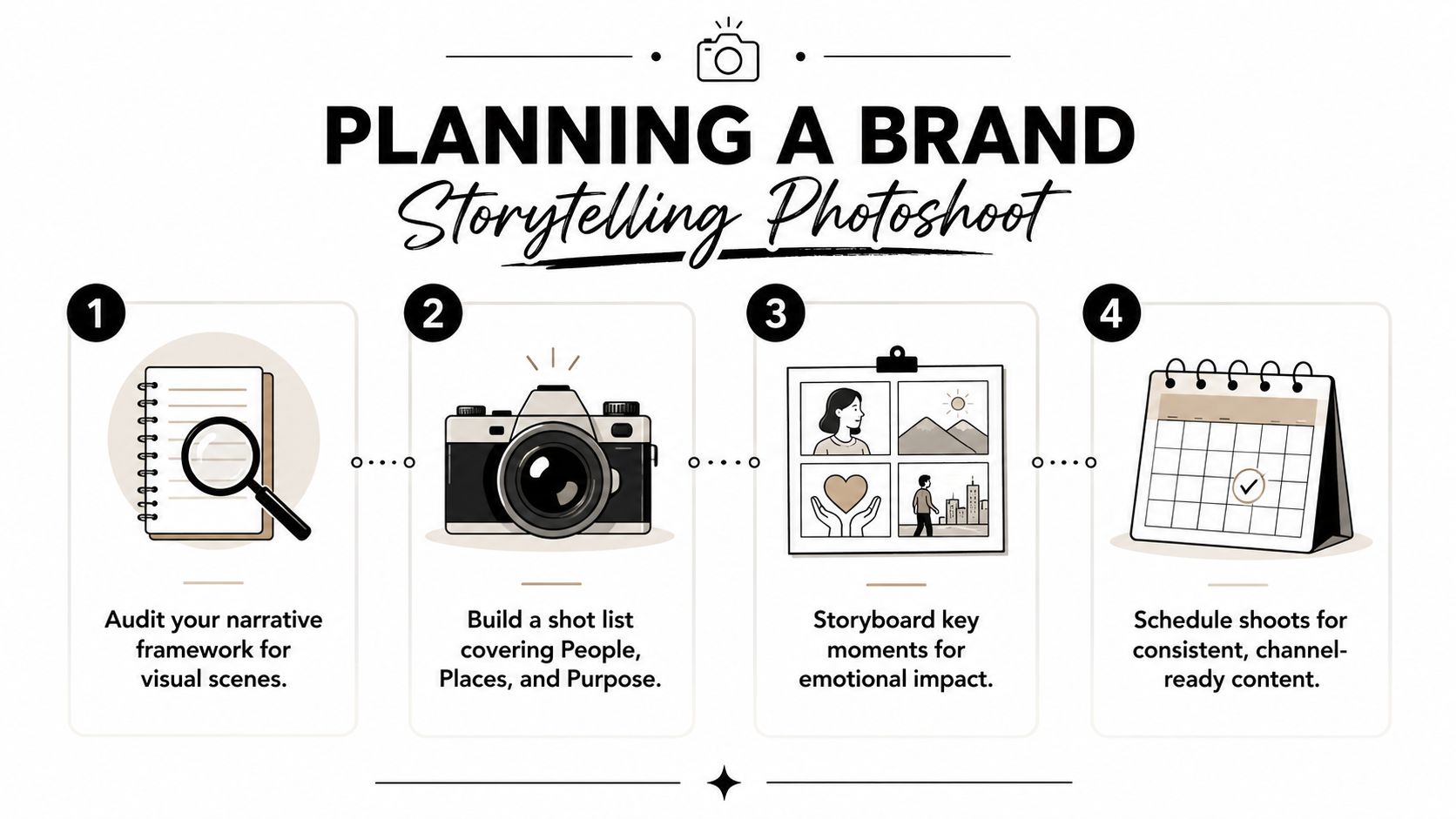
A storytelling shoot starts before the camera comes out of the bag. The first step is to turn the narrative framework into a visual plan, so the final images support the brand instead of existing as isolated nice pictures. That means deciding which people, places, and outcomes need to appear on purpose.
The brief should name the scenes that matter most. For one client, that may mean a leadership portrait that feels approachable instead of stiff. For another, it may mean a wide environmental frame that shows how people move through a space. The shoot should be built around those scenes, not around a generic checklist of angles.
What to lock before shoot day
Start with location. A place should support the message, not compete with it. Then build the shot list around narrative beats, such as introduction, process, collaboration, and outcome. That sequence gives the edit a story arc later.
Lighting matters because it shapes tone. Soft daylight reads differently from hard directional light, and both send different signals about the brand. Edit for consistency as well, because a mixed visual language makes even good images feel disconnected.
If you want a practical planning aid, use this photo shoot checklist to keep the production side clean. A structured shoot brief saves time on set and makes the final gallery easier to deploy across web, social, and proposal materials.
The strongest brand shoots don't chase variety for its own sake. They create a repeatable visual language that makes the brand recognizable across touchpoints.
Measuring Storytelling Impact in a Fragmented Media Landscape
Measurement matters because storytelling now lands across fragmented channels. People may see a brand in a short video, skim an AI summary, scroll past a social post, then visit the website later. In that environment, a story has to be clear enough to survive partial exposure and consistent enough to feel familiar when the audience comes back.
Views and likes don't tell you much on their own. Better signals include direct website visits after campaign exposure, time spent with the story-rich pages, repeat visits, inquiry quality, and whether people reuse the brand's language in sales conversations. If the story is working, the audience should remember the message, not just the post.
What to watch instead of vanity metrics
Look for evidence that the narrative is moving people closer to trust. That can show up in stronger proposal response, more informed inbound leads, or better alignment between marketing, sales, and recruiting content. For visually led brands, it can also show up in which images get reused internally because teams find them credible and useful.
The media environment also puts pressure on consistency. Short-form formats reward speed, but speed without narrative discipline creates noise. Production polish still helps, but it isn't the differentiator it once was. What matters more is whether every image, caption, and landing page carries the same underlying story.
Measure whether the audience can repeat your point of view in their own words. If they can, the story is landing.
For brands that want to connect story to business outcomes, this discussion of photography ROI is a useful complement. It frames photography as a business asset, which is the right lens for teams that need more than aesthetic approval.
Your Action Plan for Visual Brand Storytelling
Start with the story you already have, then strip it down to the parts a customer would remember. If the current narrative leads with founder history, shift the emphasis toward the client's challenge, the environment they operate in, and the outcome they want. That one move makes the story more usable across website copy, proposal decks, and image selection.
Next, audit your visuals. Ask whether your current photography shows real people, real places, and a real process, or just polished surfaces. A homepage hero image, a leadership portrait series, and a project gallery can do a lot of work if they all speak the same visual language.
Then plan your next shoot around the story, not around content volume. Build a shot list that includes context, interaction, detail, and result. That gives you a library that supports the brand over time instead of forcing you to invent meaning later.
A practical rollout often looks like this:
- Update the highest-traffic landing pages first. Replace generic stock or filler images with visuals that show the brand in its actual environment.
- Standardize team portraits. Keep lighting, framing, and background choices consistent so leadership and staff images feel like one system.
- Document one live project or work session. Real process images usually carry more narrative weight than staged filler.
- Review every caption and headline for customer focus. If the language describes only the brand, rewrite it around the viewer's goal.
For architecture firms and corporate teams, the fastest wins usually come from better hero images and more credible team photography. Longer-term, documentary-style coverage creates a deeper archive of proof that can support recruiting, sales, and reputation building across the year.
Jimmy Clemmons Photographer creates architectural, commercial, and portrait imagery that helps brands turn their identity into a clear visual narrative. If you need photography that shows your spaces, your people, and the outcomes your clients care about, visit Jimmy Clemmons Photographer and start planning visuals that do more than decorate the page.