
If you've ever walked into a YMCA in Buckhead, Decatur, or somewhere in between and thought, “This place looks great, but where do I even start?”, you're not alone. The Metro Atlanta YMCA can feel simple from the outside, then turn surprisingly complex once you're trying to decide which branch fits your routine, which membership option covers what you need, and whether a program is included or billed separately.
That's the challenge with the Y in Atlanta. It's not just a gym, it's a network of branches, early learning sites, aquatics programs, youth sports, family support, and community services that all work a little differently depending on where you go. If you understand how the system is set up, you can choose a branch that fits your life instead of settling for the closest front door.
What the YMCA of Metro Atlanta Is All About
The first thing people notice at the front desk is that the Metro Atlanta YMCA doesn't operate like a commercial health club. You're not just paying for treadmills and a lap pool, you're stepping into an organization that pairs wellness with youth development, family support, and community access. That distinction matters when you're deciding whether the Y is the right fit, because you're choosing a membership inside a mission-driven system, not just renting time in a facility.
The Y's own handbook says members are part of something bigger than a gym, and that framing shows up in how the branches feel day to day. A parent may be there for childcare while another member comes for coaching support, and someone else might be signing up for a class or a swim lesson. Those different uses can all happen under the same roof, which is why a new member can feel overwhelmed the first time in.
Practical rule: If you want a place that only does fitness, the Y may feel broader than you need. If you want a place where wellness, family life, and community service overlap, it makes a lot more sense.
That broader role also explains why the Y has so much staying power in Atlanta. Its local roots go back to 1858, and the organization says it has served the region for more than 165 years. For a lot of families, that history is part of the trust factor. It's not a newcomer trying to buy attention, it's a long-standing civic institution that has grown with the city and kept adapting to how Atlanta moves, lives, and raises children.
A Rich History of Community Service in Atlanta
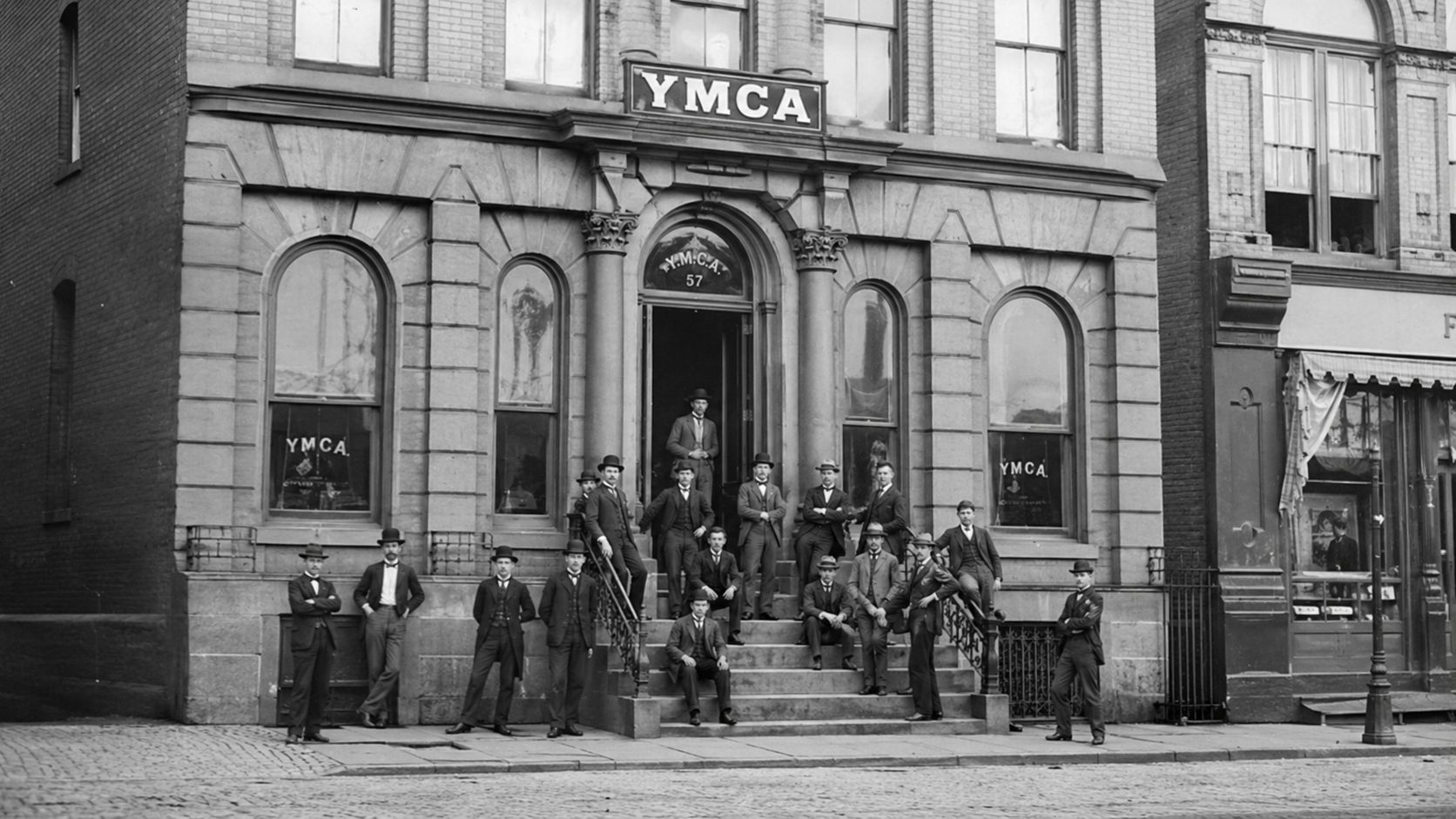
The Metro Atlanta YMCA starts in 1858, and that date matters because it places the organization among the region's oldest civic institutions. The Atlanta History Center's records show that what began as a local association eventually became a metropolitan network, and that shift wasn't cosmetic. It was a response to the way Atlanta itself changed, especially as the city expanded beyond one compact core and into a larger suburban pattern. Atlanta History Center records on the YMCA of Metro Atlanta
The turning point came in the early 1940s. Independent historical records say the organization began a four-year decentralization effort in 1942 and gained national recognition in 1946 for making its programs and locations easier to access across a rapidly growing city. That was a practical move, not just an administrative one. Atlanta was spreading, transportation habits were changing, and a single downtown-centered model no longer fit how families lived.
Why decentralization still matters
That mid-century shift helps explain why the Y today functions as a multi-site network instead of one flagship building. The Atlanta History Center notes that the organization was once known as the “YMCA of Metropolitan Atlanta,” which is a useful clue about how the brand and service footprint grew alongside the metro area. If you've ever compared branches and noticed that one site feels very neighborhood-focused while another serves a broader family crowd, you're seeing the legacy of that change in real life.
One branch in particular shows how central the Y has been to Atlanta's social history. The Butler Street YMCA, built in 1920 as a 10,000-square-foot facility, became known as the “black city hall.” It included a swimming pool, restaurant, running track, lunch counter, game room, gymnasium, and dormitories, which made it much more than a recreation center. The building's place in Black communal life, along with former members like Martin Luther King Jr. and Maynard Jackson, gives Atlanta's Y story an importance that goes beyond exercise.
Here's the part that matters for today's member: this history is why the Y still feels local even though it operates at scale. It was built to serve neighborhoods, then reorganized to reach more of them. If you're choosing a branch now, you're picking from a system that has been shaped for access for decades, not a chain that rolled in recently and stamped the same format everywhere.
How to Choose the Right Metro Atlanta YMCA Branch
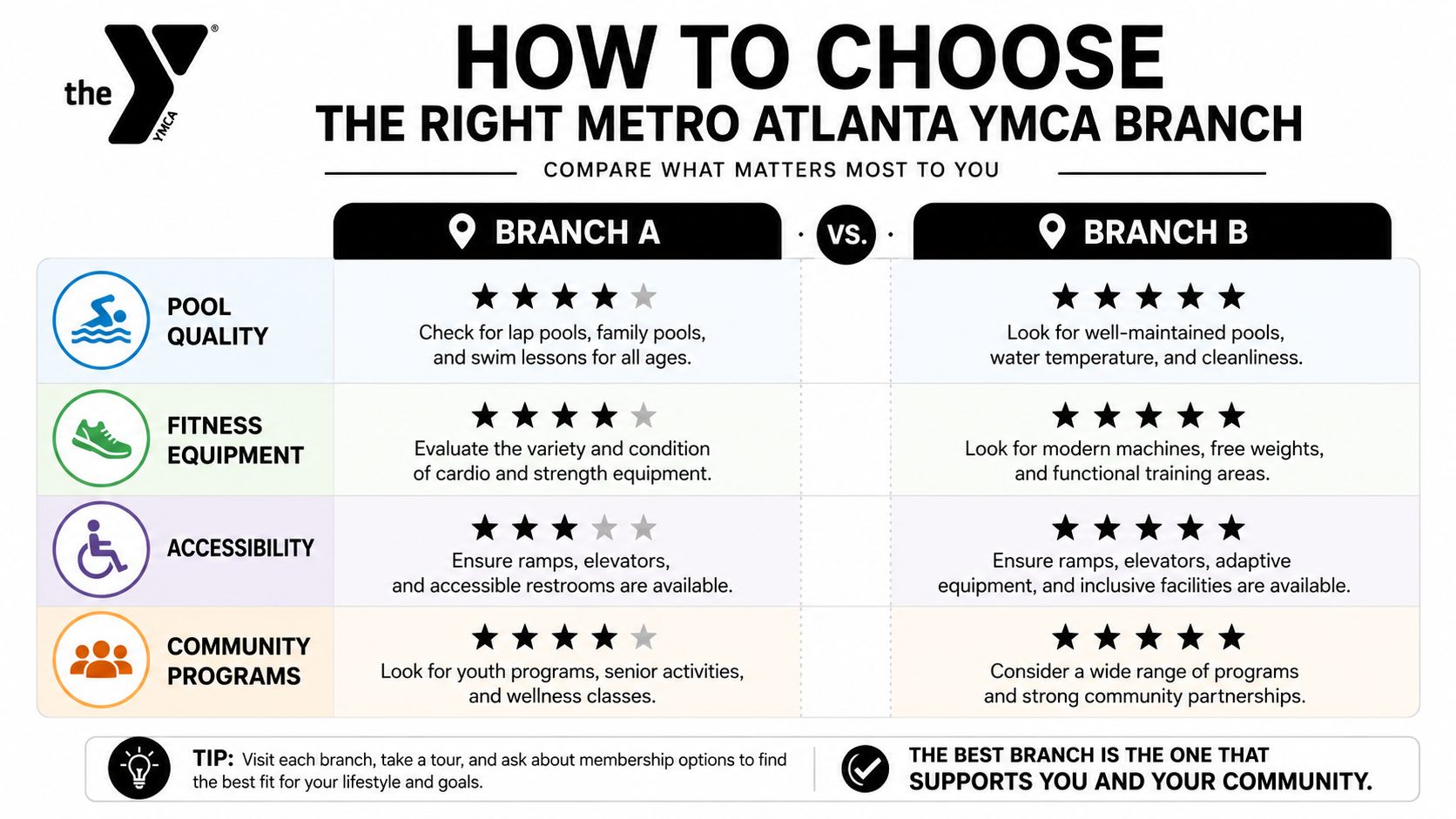
With 32 locations in Georgia as of January 2026, the most important decision isn't just whether to join, it's which branch will fit your life. A family in one part of town may care most about childcare and parking. A swimmer may care about lane access and pool setup. Someone managing a tight schedule may care less about amenities on paper and more about the branch that's easiest to reach three times a week.
The smartest way to compare branches is to think in trade-offs. A bigger, busier site may have more options but also more traffic at peak hours. A smaller neighborhood branch may feel calmer and more personal, but it might not have the same range of courts, programs, or equipment.
Start with your weekly reality
Before touring, rank your needs in plain language. If you're likely to use the Y before work, proximity and parking rise to the top. If you're joining for children's activities, ask about the age group served, the schedule, and whether the branch runs programs that match your calendar. If aquatics matter, ask specifically about lane availability, swim instruction, and how crowded the pool gets.
Compare branches by use, not by hype
The branch that looks best in photos is not always the branch you'll use most consistently. A good tour should answer a few practical questions:
- Pool access: Check whether the branch offers lap swimming, lessons, or family-friendly hours.
- Fitness floor: Look at how much room there is between machines, whether the equipment feels well maintained, and whether the layout suits your workouts.
- Accessibility: Notice entrances, parking, changing areas, and whether moving through the building feels straightforward.
- Community fit: Ask who uses the branch most, families, older adults, teens, or mixed-age members.
If you want a broader look at how Atlanta facilities are evaluated from an architectural and user-experience perspective, this guide to top architectural landscapes in Atlanta is a helpful companion when you're weighing building quality against convenience.
A branch should fit your week, not just your first impression. The best YMCA choice is usually the one you can reach easily, use comfortably, and return to without friction.
One more practical point. If you're torn between two branches, visit both during the time you'd work out. A quiet weekday morning can fool you. The test is whether the branch still works when you show up at your normal hour.
Membership Plans and Program Breakdown
The membership decision usually comes down to one question, what do you need access to? The Metro Atlanta YMCA draws a real line between facility membership and program membership, and that split changes what you can use. Facility members get access to branches and core amenities. Program members pay a yearly registration fee and then a program rate for each activity, but they do not get general use of group exercise classes, wellness areas, swimming pools, or gymnasiums.
That difference matters more than the brochure language suggests. If you want to work out, swim, use childcare while you are at the branch, and move between locations, a facility membership usually fits better. If you only need one class or one activity and do not need broader facility access, program membership is the lighter option.
What membership access really includes
The handbook says members get full use of the 19 membership facility locations, plus access to outdoor pools and climbing walls. It also points to member benefits such as the Y app, YMCA360 virtual classes, personal wellness coaching, and group exercise. On the family side, childcare is available for facility members at the Family Membership level while they use the facility, with Play Center care designed for children from three months through 12 years old, subject to time limits. Metro Atlanta YMCA member handbook
A few practical details matter when you compare value. There are no membership contracts required, which gives you room to adjust if your schedule changes. The Y also uses a one-time joining fee, which it describes as support for its mission and building upkeep. Credit card payments carry a 3% fee, while bank draft and debit options avoid that charge. Metro Atlanta YMCA member handbook
How programs differ from membership
Many new members get tripped up here. Swim lessons, sports, child care programs, and camps are not bundled the same way. Some are open to members at a reduced rate, some are tied to facility membership only, and some are available through program membership with separate fees. If you are joining because your child needs swimming instruction, read the fine print before you assume any membership tier covers it.
The Y's financial support matters here too. The organization says one in four participants needs financial assistance, and it does not turn people away for inability to pay. That tells you something important about how it works in practice. It is not just selling access, it is using a sliding support model to keep families involved when finances get tight.
If you want a closer look at indoor sports and training space while comparing branch amenities, the overview at indoor athletic facilities is a useful way to judge how layout affects the member experience.
Facility Features, Accessibility, and Community Impact
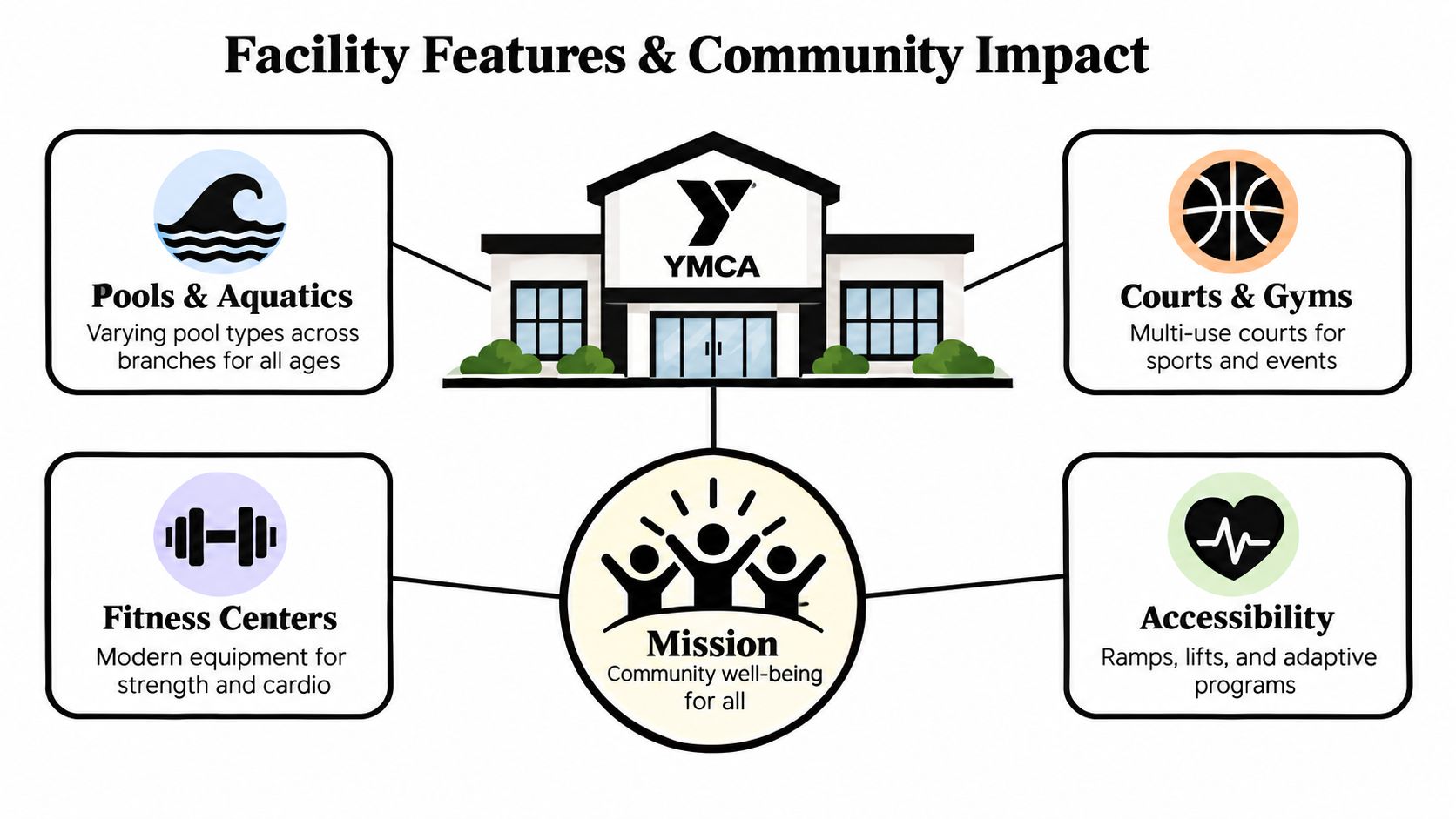
What makes the Metro Atlanta YMCA different from a typical fitness chain is that its buildings are part workout space, part community infrastructure. A branch might draw you in with a pool or fitness center, but the organization's value shows up just as clearly in how it handles access, safety, and service to people who may never think of themselves as gym-goers.
The 2023 impact report says the Y operated across more than 30 branches and early learning centers, engaged 173,477 members, served 15,063 seniors, delivered 8,616 youth swim lessons, reached 10,239 youth sports participants, provided $9.2 million in financial assistance, and served 490,000 meals to food-insecure children and families. Those numbers show a network that isn't limited to exercise. It runs on high-volume community delivery. YMCA of Metro Atlanta 2023 impact report
Facilities matter because they shape who can participate
In practical terms, pool design, court availability, and the layout of the wellness floor all affect whether a member can use the branch. Accessibility is not a side issue. Ramps, lifts, changing options, and the ability to move through the building without friction change whether families, older adults, and people with disabilities can stay engaged.
The organization's 2021 IRS Form 990 adds another layer. It reported it was supporting more than 8,000 families weekly through hunger-relief partnerships and provided nearly 465,142 meals and snacks that year. That scale suggests that site operations, delivery timing, and distribution capacity matter just as much as treadmills or court lines when you're looking at the Y as an institution. 2021 IRS Form 990.pdf)
Community impact is built into the program mix
The more interesting story is how the Y uses its facilities to reach people who can't always come through the front door. The organization says it does not turn people away for inability to pay, and it describes mobile outreach, food delivery, and meal distribution that extend beyond branch walls. That's why the Y is often more useful than a standard gym for families dealing with transportation barriers, unstable housing, or uneven schedules.
A separate, very important piece of the mission is water safety. In its 2024 annual report, the Y says it provided 1,885 free swim lessons and set a strategic goal of serving 10,000 children through Safety Around Water while reducing drowning disparities between racial and socioeconomic groups. That frames aquatics as public health, not just recreation. YMCA of Metro Atlanta 2024 annual report
The result is a system where facility quality and community impact are tied together. A clean pool, a usable court, and a staffed wellness center matter. So do food access, swim instruction, and the ability to support families beyond what a membership card alone would suggest.
Getting Started as a New YMCA Member
The smoothest first visit starts before you walk in. The Y's handbook says members can use the app to check in, view schedules, sign up for classes, and manage accounts, and the first check-in typically requires a photo ID and a picture for the database. It also says physical membership cards are available for members without smartphones, which is helpful if you prefer the old-school route.
Hours can vary by branch and by holiday, so don't assume one location mirrors another. The Y closes on only a few days each year in Atlanta, but some hours are adjusted for holidays and the app is used to notify members. That makes the app and branch contact info the two most reliable tools when you're planning a first visit.
What to bring and what to ask
Bring a photo ID, workout clothes, a water bottle, and if you're touring with family, a short list of what matters most to you. If you're interested in childcare, ask about age limits and how long care is available during your visit. If you're joining for fitness, ask for a quick orientation with a wellness coach so you're not left guessing on day one.
A few questions are worth asking every time:
- Where do members park and enter?
- Which hours are busiest for the branch you're considering?
- What's included in the fee you're about to pay, and what costs extra?
- How do cancellations work if your schedule changes?
Make the first tour count
Go during an off-peak window if you want a better feel for the branch. A crowded evening can hide things that matter, like how easy it is to find a locker, whether the pool deck feels manageable, or how staff handle check-in when the front desk is busy. If you can, compare two branches on the same day so the differences stay fresh in your mind.
One more thing, read the membership rules before you sign. The handbook covers payment methods, cancellation notice, and facility conduct in enough detail to prevent surprises later. That's the unglamorous part, but it's the part that saves people the most frustration.
For families who want a smoother routine once they start, it also helps to think about how the Y fits into a broader Atlanta day, much like a good outing planned around the Children's Museum of Atlanta. The easier your schedule is to repeat, the more likely you are to use the membership.
If you're evaluating a YMCA branch, a program, or a facility for a future write-up, Jimmy Clemmons Photographer can help you show it the way members experience it, with clean architectural coverage, thoughtful interiors, and people-centered imagery that feels grounded in place. Visit Jimmy Clemmons Photographer to see how Atlanta spaces and organizations can be documented with clarity and trust.