
You've probably seen it already. One photographer quotes a modest per-person rate, another sends a day rate that looks high at first glance, and a third packages everything into a polished proposal that seems hard to compare line by line.
That confusion is normal. Corporate headshots pricing isn't inconsistent because photographers are making up numbers. It varies because clients often ask for “headshots” when they're buying very different things: speed, direction, retouching depth, on-site convenience, licensing, team coordination, and brand consistency.
A strong quote should tell you what kind of production you're funding, not just what one person costs to photograph. That's the difference between buying a commodity and commissioning brand assets your team will use across your website, proposals, LinkedIn profiles, recruiting materials, and press opportunities.
Decoding the Numbers in Your Headshot Quote
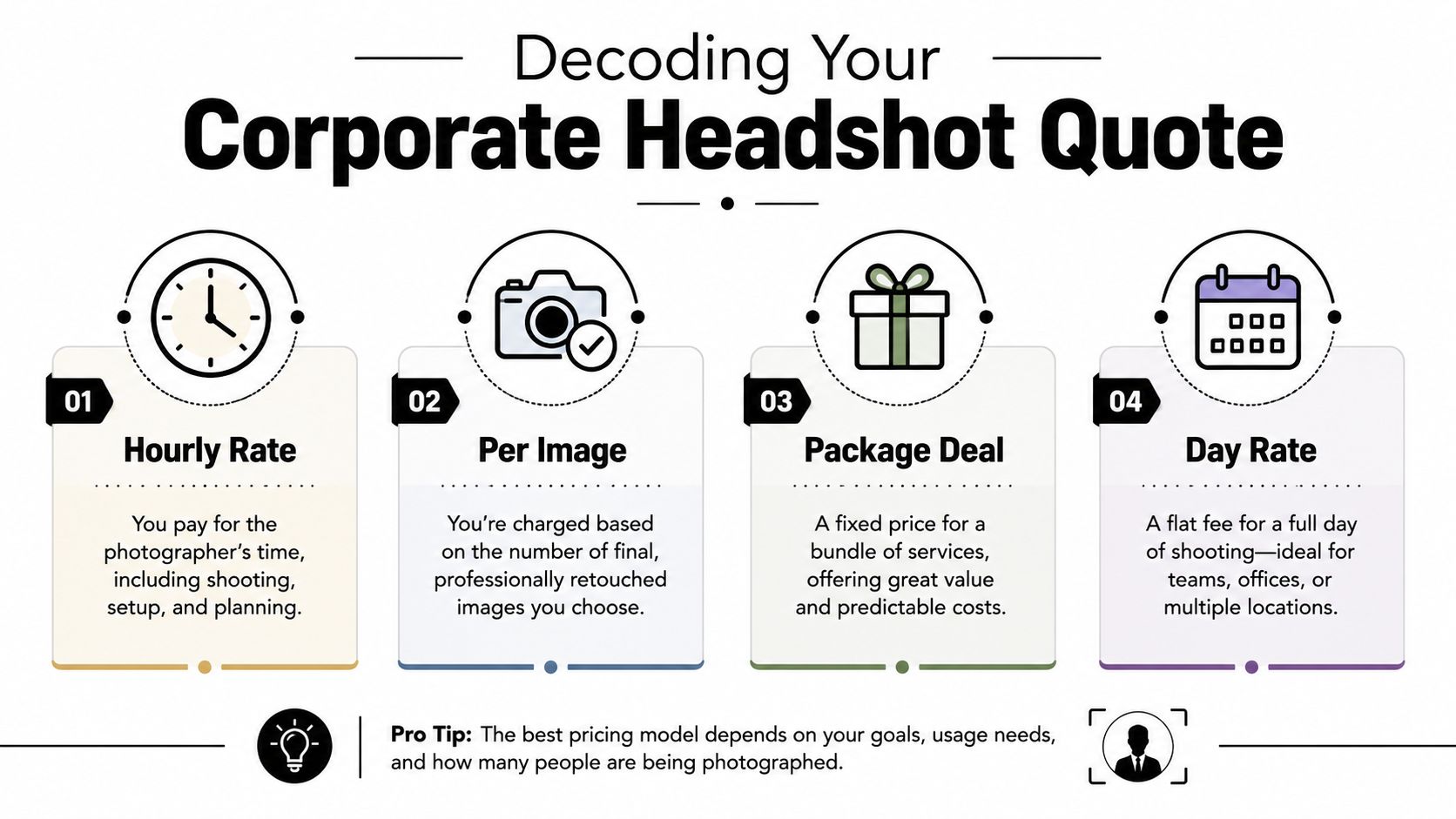
The cleanest way to understand a headshot proposal resembles transportation pricing. Sometimes a metered ride makes sense. Sometimes a flat-rate car service is smarter. Photography works the same way.
A small leadership team may benefit from per-person pricing because each subject needs more time, more coaching, and more image selection. A large office shoot usually works better on a day rate because efficiency changes the math once the set is built, lighting is dialed in, and people rotate through.
Per-person pricing
This is the easiest model to compare at first glance. It's common for smaller teams, new hires, executive portraits, or companies that need headshots on an ongoing basis rather than all at once.
For group work, pricing typically falls as volume increases. In major markets, 5 to 10 people often run $200 to $300 per person, while groups over 50 often drop to $100 to $150 per person, and many projects shift to a fixed day rate at that point, according to Luminous Space's breakdown of corporate headshot pricing.
Per-person pricing works well when:
- Your roster is small: A boutique firm with a handful of partners can budget clearly.
- You need flexibility: New team members can be photographed later under the same structure.
- Individuals need attention: Executives, attorneys, architects, and principals often need more directed time.
Day rates and half-day rates
Day rates make more sense when logistics become the primary job. Once a photographer brings lights, stands, backgrounds, tethering gear, and a production rhythm into your office, the value isn't tied only to each click of the camera. It's tied to how many people can be photographed well in a controlled window.
Practical rule: If your project involves a large headcount, multiple departments, or a narrow production day, a day rate often gives you better predictability than multiplying a per-person fee.
The trade-off is that a day rate requires sharper planning. If your team isn't ready, people arrive late, or leadership adds extra requests midstream, the day can get expensive in a hurry.
Project fees
Some photographers bundle the entire assignment into a project fee. That quote may include pre-production, on-site setup, photographing the team, retouching, file delivery, and basic internal use licensing.
This is often the easiest format for marketing teams because it aligns to a campaign budget rather than a line-item puzzle. It also reduces the temptation to compare only one number while missing the support behind it. If you want a useful benchmark for how photographers structure broader service pricing, it helps to review a working photographer price list.
A project fee is strongest when the brief is clear. If the scope is still moving, expect revisions to the quote.
Key Factors That Influence Your Final Cost
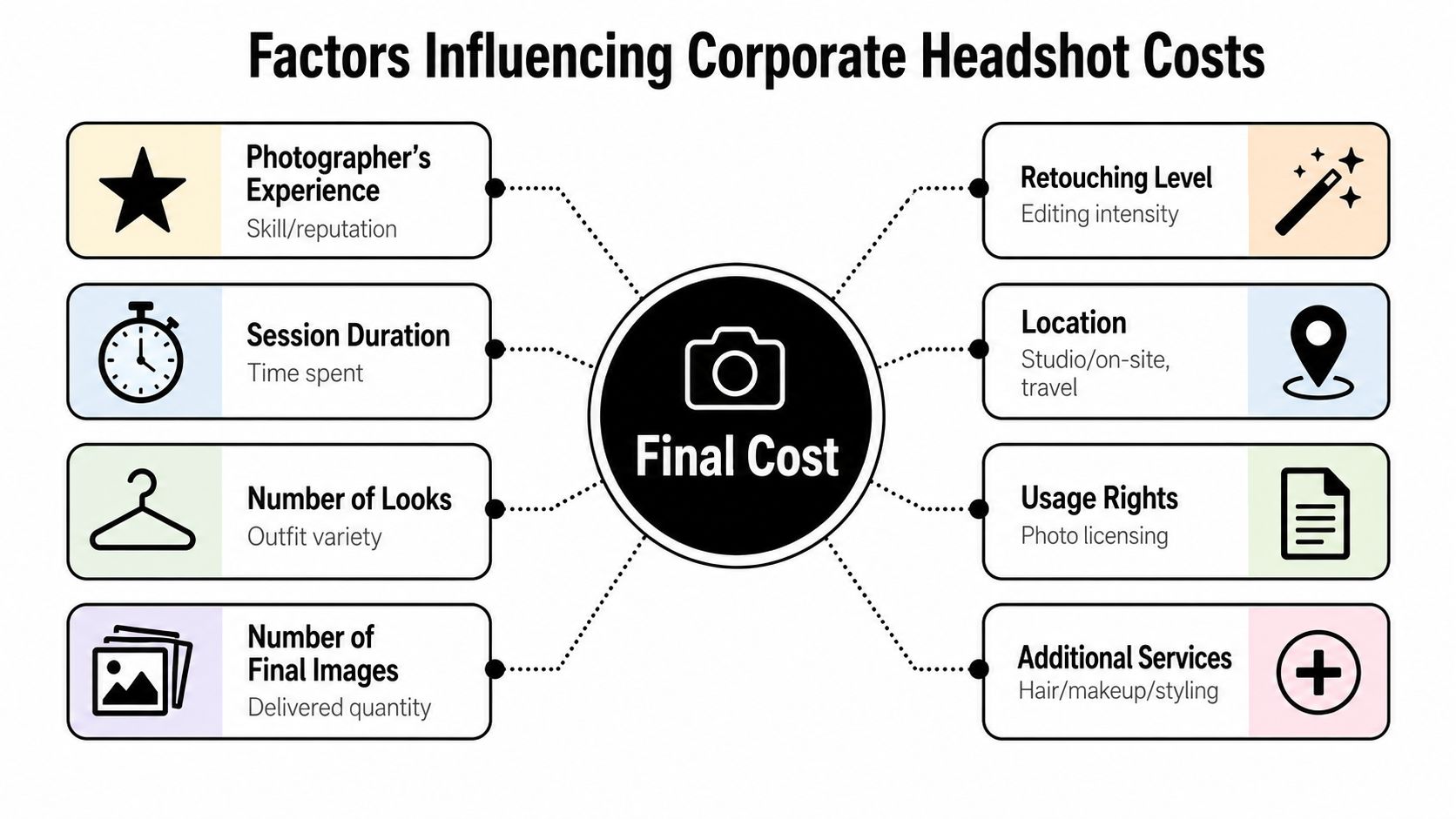
Two quotes can describe the same assignment and still price it very differently because several cost drivers sit underneath the headline number. The easiest way to think about them is as sliders. Move one up, and the total changes. Move several up together, and the project becomes a different production.
Geography and market level
Location affects corporate headshots pricing more than many buyers expect. According to Capturely's 2026 professional headshot cost analysis, the national median studio session is $250, New York City averages $924, and Indiana averages $176, which reflects a 5.4x difference across markets. The same source notes that professional-grade pricing of $275 to $1,500+ carries a 3x to 5x premium over mid-level ranges.
That gap isn't arbitrary. In high-cost markets, photographers absorb more expensive studios, assistants, insurance, parking, and production overhead. Clients also tend to expect tighter turnaround, more polished retouching, and a smoother on-set experience.
Experience and direction
The camera and lights matter. Direction matters more.
An experienced corporate photographer knows how to fix posture, jaw tension, hand placement, jacket fit, eyeglass glare, and expression fatigue quickly. That's what saves time on set and reduces the number of almost-good frames that never get used.
A premium fee often reflects:
- Faster subject coaching: Especially for camera-shy professionals.
- More consistent lighting: Across different skin tones, heights, and wardrobe choices.
- Better selection discipline: Fewer unusable images, stronger finals.
- A more controlled set: Which keeps team sessions moving.
Session length, looks, and retouching depth
A quick, uniform staff headshot day costs less than a session with wardrobe changes, executive coaching, and multiple background options. More time usually means more refinement, not just more images.
Retouching is another major slider. Basic cleanup is one thing. Detailed skin work, fabric cleanup, flyaway hair control, background rebuilding, and image compositing are different jobs entirely.
A low quote can still be the wrong fit if it assumes fast capture, minimal finishing, and no room for anyone who needs extra direction.
Location, support, and licensing
Studio work offers control. On-site work offers convenience. Neither is automatically better. The right choice depends on whether your priority is maximum polish, minimal staff disruption, or a balance of both.
Additional support also changes the budget:
- Hair and makeup: Helpful when the team needs a polished, uniform finish.
- Digital tech or assistant support: Useful on larger days to keep flow and file handling clean.
- Licensing: Internal website use is one thing. Paid advertising, print campaigns, and broader commercial use can require a different agreement.
If you want to manage cost intelligently, decide which sliders affect brand quality and which ones are nice to have.
Sample Headshot Packages and Price Ranges
Companies don't buy headshots in the abstract. They buy a solution that matches company size, schedule, and how polished the final brand presence needs to feel.
In the Bay Area, group pricing gives a practical framework. According to Dataintelo's market report on professional headshot photography services, 5 to 10 people often cost $200 to $300 per person, 11 to 25 drop to $150 to $225, 26 to 50 fall to $125 to $175, and groups over 50 typically land at $100 to $150 per person or move to day rates of $3,000 to $6,000. The same report notes that enterprise packages for 50 to 100+ people can range from $7,500 to $15,000+ total.
Three common buying scenarios
A small design firm usually wants consistency without turning the day into a production marathon. Per-person pricing often fits because each principal or team lead benefits from a little more coaching and image review.
A growing company with several departments usually wants speed, clean logistics, and files that look uniform across the website and recruiting materials, making structured on-site shooting and stronger production flow important.
A larger enterprise often needs more than a photographer. It needs scheduling discipline, a repeatable visual standard, and clear delivery rules so files stay usable after the shoot is over. If you're comparing options, this broader portrait photography cost guide can help you benchmark what's typically included at different service levels.
Sample Corporate Headshot Packages 2026 Estimates
| Package Tier | Ideal For | Estimated Per-Person Rate | Typical Inclusions |
|---|---|---|---|
| Startup Special | 5 to 10 people | $200 to $300 per person | Short individual sessions, one consistent setup, basic retouching, streamlined delivery |
| Mid-Size Corporate | 25 to 50 people | $125 to $175 per person | On-site team workflow, efficient rotation, consistent lighting across staff, selected retouched finals |
| Enterprise Solution | 50+ people or multi-location teams | $100 to $150 per person, or day-rate/project pricing | High-volume production, pre-planned scheduling, scalable file delivery, broader coordination support |
The smartest package isn't the cheapest one. It's the one that matches the way your company actually works on photo day.
The Hidden Costs That Can Inflate Your Budget
The quote that looks cheapest on page one often stops being the cheapest once the full scope shows up. That's where clients get frustrated, not because add-ons are illegitimate, but because many proposals don't surface them clearly enough.

According to James Connell's headshot photography FAQ breakdown, 20 to 30% of total headshot costs often come from add-ons like advanced retouching at $125 to $250 per person or an on-site setup fee with a $500 base. Those aren't trivial extras. They can materially change your approval process, especially when multiple stakeholders assume the original quote was all-inclusive.
Add-ons worth asking about early
Ask these questions before you sign, not after the gallery arrives:
- Retouching scope: Does the quote include basic cleanup only, or more detailed finishing?
- Setup and travel: On-site convenience usually carries real production costs.
- File handling: Large companies often need custom naming conventions, department folders, or export versions for different platforms.
- Licensing: Website use, earned media, internal collateral, and paid campaigns aren't always covered the same way.
- Rush delivery: Fast turnaround can require schedule reshuffling in post-production.
What transparent proposals do better
A good proposal separates creative fee, production costs, retouching assumptions, and licensing terms. That doesn't make the estimate longer for the sake of it. It makes decision-making cleaner.
If commercial use is part of the job, it helps to review how photo licensing for commercial use is typically structured before the project starts. That conversation is much easier when it happens early.
Hidden fees usually aren't the problem. Hidden scope is.
Budgeting for Brand Value Not Just Price Per Head
A company approves a low per-person rate, then uploads the finished headshots across its website, proposal templates, LinkedIn profiles, and press materials. That is usually when the crucial question arises. Do these images support the brand, or did the company merely fill empty profile boxes?
Corporate headshots affect more than identification. They shape first impressions in places where trust is built fast and often in subtle ways. A leadership page with consistent portraits signals order, professionalism, and attention to detail. A team page filled with mismatched lighting, uneven crops, and outdated photos signals the opposite.
That gap has business value.
What you are actually buying
The useful way to budget for headshots is to look at lifespan and usage, not only price per head. A stronger set of portraits can serve a company across its website, recruiting materials, speaker bios, sales decks, press requests, and internal communications for years. A weak set often gets replaced early, patched with one-off updates, or used selectively because nobody wants to put the images in front of clients.
That is where the cheaper quote often stops being cheaper.
Brand value tends to show up in a few predictable places:
- Website credibility: Team and leadership pages look current and coordinated.
- Recruiting presentation: Candidates see a company that appears organized and established.
- Sales and PR use: Bios, proposals, and media kits feel consistent instead of assembled from different eras.
- Employee confidence: Staff are more willing to use the images when they feel accurate and well produced.
Where low-cost options make sense, and where they do not
AI headshots and very low-cost portrait options have a place. They can work for internal directories, short-term needs, or early-stage teams that need coverage fast and have limited budget.
But they solve a narrower problem.
They do not direct expression in real time. They do not correct posture before the frame is made. They do not catch how fabric bunches under a jacket, how eyewear is reflecting overhead fixtures, or how a nervous executive needs a different pace to look credible on camera. Those details are not cosmetic. They affect whether the final image feels believable and on-brand.
Professional photography earns its cost through control. Control of lighting, consistency, subject direction, file standards, and how the final set holds together across an entire organization.
For companies that care about visual consistency, that difference matters. This approach, treating portraits as part of a brand system, is a focus for studios like Jimmy Clemmons Photographer.
How to Hire a High-End Corporate Photographer
A polished portfolio isn't enough. You need to know whether the photographer can produce that quality consistently under business conditions, with a real schedule, real staff, and real constraints.

What to look for in the portfolio
Look for consistency before style. One dramatic portrait doesn't tell you much. A sequence of twenty people photographed well tells you a lot.
Check for these signs:
- Lighting control: Skin tones look natural, glasses are managed, and shadows feel intentional.
- Expression quality: Subjects look present, not stiff or over-rehearsed.
- Wardrobe handling: Jackets, collars, ties, and drape are managed carefully.
- Background discipline: The environment supports the brand instead of distracting from it.
If the portfolio jumps wildly from one treatment to another, ask whether that reflects versatility or inconsistency.
Questions that reveal how they work
The proposal matters, but process matters more. Ask practical questions that expose how the day will run.
How do you prep for an on-site corporate session?
You want to hear about scouting, setup planning, scheduling, and traffic flow.How do you handle camera-shy staff?
The answer should include coaching, pacing, and efficient image review.What's included in retouching?
This avoids confusion later.How are files delivered and organized?
Marketing teams need usable naming and sorting, not a digital pile.What licensing is included?
The answer should be specific enough that legal or brand teams can review it.
Hire the photographer whose process reduces friction for your staff, not just the one whose sample images look expensive.
How to read the proposal
A strong proposal should tell you what happens before, during, and after the shoot. It should show where the money goes and what assumptions the price depends on.
If a quote feels vague, ask for clarity on timing, retouching volume, delivery format, and usage terms. A serious photographer won't resist that. They'll welcome it, because clean expectations usually lead to better work and fewer surprises.
Corporate Headshot Pricing FAQs
How often should a company update team headshots
Update them whenever the existing portraits no longer reflect the team accurately or the brand has visibly shifted. In practice, companies usually revisit headshots after a website redesign, a rebrand, leadership changes, a major hiring phase, or when image quality varies too much across departments.
The better question is whether the current portraits still look intentional when viewed together. If they don't, it's time.
What's the difference between standard use and commercial use
Standard use usually covers common business needs such as team pages, LinkedIn profiles, internal documents, and basic company materials. Commercial use can extend into broader advertising, paid campaigns, product marketing, sponsorship creative, and other promotional distribution.
That distinction matters because reach, duration, and media placement affect the value of the image asset. If your marketing team plans to reuse portraits beyond routine profile placement, ask for that in writing before the shoot.
Should we shoot in a studio or at our office
Choose a studio when you want maximum control over lighting, background consistency, and executive-level polish. Choose your office when convenience, staff participation, and schedule efficiency matter more.
Neither option is automatically superior. The right choice depends on whether the project priority is production control or operational ease.
How should employees prepare for photo day
Keep preparation simple and specific. Ask employees to bring wrinkle-free clothing that fits well, avoid distracting patterns, and choose outfits aligned with how the company presents itself publicly.
Also build a schedule with small buffers. The more rushed the line feels, the more tension shows on faces. Good portraits need direction, but they also need a few unhurried minutes.
Is it worth paying more for a high-end photographer
Sometimes yes, sometimes no. If the images will be stored in an internal directory, a simpler solution may be fine. If they'll represent leadership, support business development, appear on your website, or anchor a refreshed brand presence, paying for better direction, consistency, and finishing usually makes sense.
The deciding factor isn't status. It's usage.
If your team needs headshots that feel consistent with a refined brand presence, Jimmy Clemmons Photographer offers corporate portrait work alongside architectural and commercial imagery, with an emphasis on clear direction, careful lighting, and polished delivery for marketing-driven businesses.