
The client has arrived. Facilities is asking how long you'll need the lobby clear. The sun is moving fast across the glass façade, and the one angle that makes the space look expensive will disappear soon. In that moment, talent matters, but production matters more.
That's why a photo shoot checklist can't be treated like a casual packing note. On professional assignments, especially in commercial and architectural photography, the checklist is the production system. It controls timing, access, gear, approvals, file handling, and the sequence of decisions that determine whether the day feels calm or chaotic.
That distinction matters because the shoot itself is only one slice of the job. One industry checklist estimates 1 to 3 hours for gear prep, setup, and breakdown, 1 to 2 hours for client communication, 1 to 2 hours for travel, 2 hours for the shoot, 4 to 8 hours for editing, and 1 to 4 hours for retouching, which makes one thing clear: post-production can easily outlast the session itself, as outlined in this working photographer's checklist breakdown. If your planning stops at “camera, lenses, batteries,” you're not managing a production. You're gambling.
In editorial and film environments, nobody survives on memory alone. The same standard should apply to architecture firms, developers, hotel groups, marketing teams, and portrait clients who need repeatable results. A strong photo shoot checklist turns taste into process. It gives the team a shared script before anyone touches a light stand.
1. Location Scouting and Site Assessment
A location scout sets the shoot's operating conditions before a case gets opened. In commercial and architectural photography, that makes it less of a courtesy walk-through and more of a production pass. The goal is to identify what the space can give you, what it will fight you on, and what needs to change before shoot day.
Editorial and film crews treat scouting this way for a reason. They are not just collecting references. They are locking the sequence of decisions that protects schedule, continuity, and image quality. The same discipline applies here. If the scout is weak, the crew solves preventable problems on the clock.
For architectural assignments, a scout has to cover both visual potential and operational friction. In a downtown office, that can mean tracking when direct sun starts streaking across conference tables, finding the angle that keeps verticals clean without forcing a lens that distorts the room, and learning when elevator traffic makes long exposures unrealistic. In a hotel renovation, it often means spotting unfinished trim, temporary signage, or staging gaps early enough for the property team to fix them before the camera arrives.
What to record on the scout
A useful scout produces decisions, not just observations.
- Camera positions: Identify corners, thresholds, mezzanines, and exterior vantage points that give the strongest structure and the cleanest lines.
- Light behavior: Record window orientation, mixed color temperatures, reflections, glare points, and the surfaces that will create exposure problems.
- Operational constraints: Confirm parking, load-in route, freight elevator access, power availability, security procedures, and who can open restricted spaces.
- Visual clutter: Flag exit signage, loose cables, temporary furniture, taped notices, cleaning tools, and maintenance items that should be removed or hidden.
Time of day belongs on the scout report, too. A lobby that feels balanced at 10 a.m. can become a contrast problem by noon. An exterior that looks flat on an overcast scout may become unusable once hard sun hits the façade. If the planned shoot window and the scout window do not match, assumptions replace evidence.
I use the scout to make framing decisions in advance, but also to define what the client or property team needs to do before call time. That prep work often determines whether the day runs cleanly or burns half the schedule on avoidable fixes. For site-facing preparation, Jimmy Clemmons' guide to preparing a site for a photoshoot is a practical reference to share with teams responsible for cleaning, staging, access, and concealment.
Practical rule: If you have not seen the space in the same conditions you plan to photograph, the scout is incomplete.
2. Lighting Design and Equipment Planning
Lighting plans separate polished commercial work from reactive on-site improvisation. You can wing a portrait in a pinch. You can't reliably wing a glass-heavy lobby, a hospitality interior, or a boardroom portrait setup that has to match a brand's visual language.
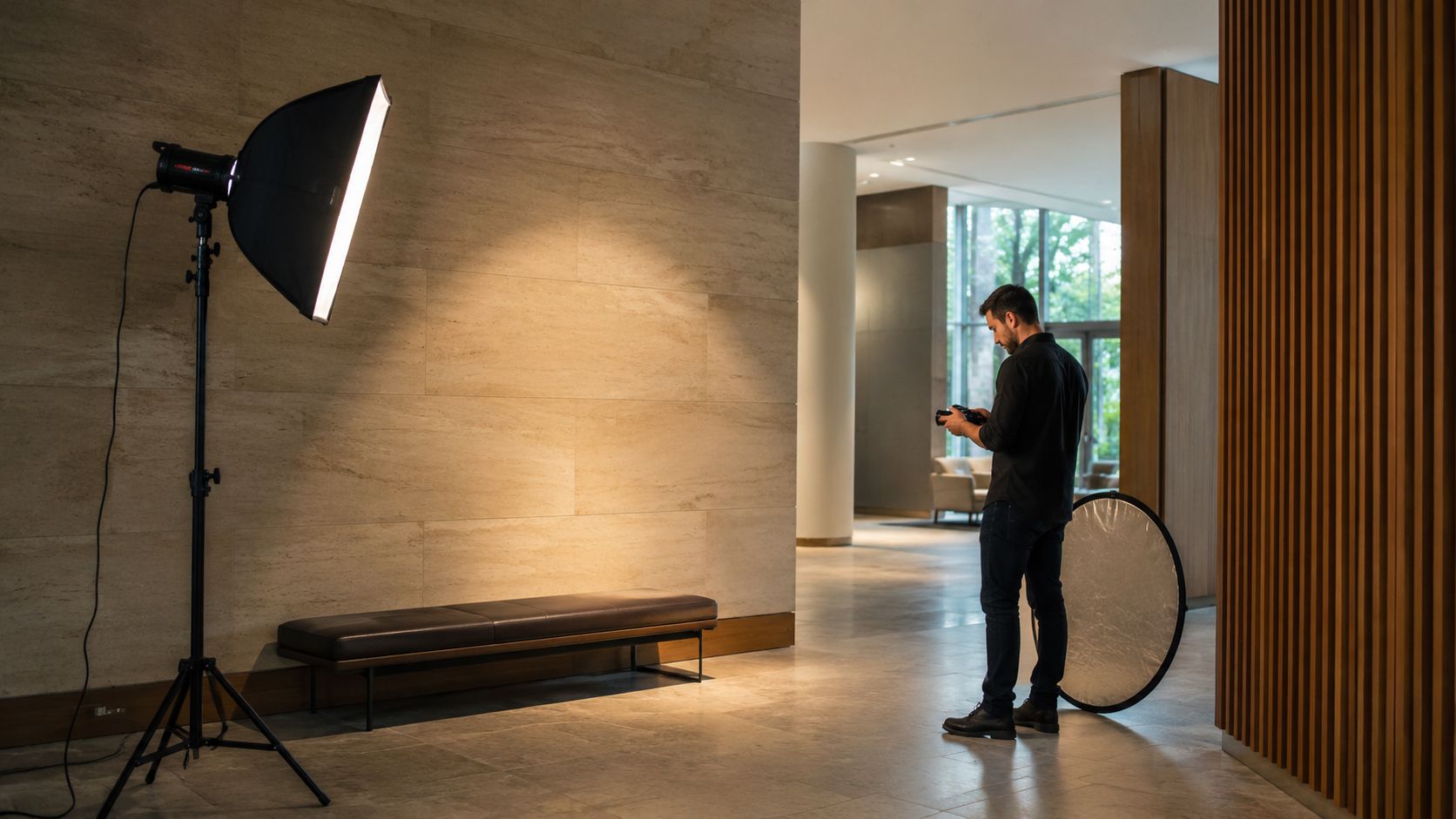
Architectural lighting design starts with restraint. Most spaces look best when the light feels motivated by the environment itself. That usually means preserving ambient direction, controlling contrast, and adding support only where the camera needs help. In a corporate lobby, balanced strobes can lift dark seating areas while leaving the window light believable. In a hospitality suite, continuous lights may be the better choice when you need consistency across multiple frames and subtle refinements in reflective finishes.
Build the setup before you pack the cases
A lighting plan should live on paper before it lives on set.
- Choose the light strategy: Decide whether the scene needs strobes, continuous lights, bounce, negative fill, diffusion, or no artificial support at all.
- Map placements: Sketch stand positions, modifier sizes, and cable paths so the crew isn't solving traffic flow in real time.
- Match color intentionally: Mixed daylight, tungsten practicals, and LED fixtures can make a room fall apart fast if you don't plan white balance and gels.
- Pack for failure points: The backup battery, spare sync cable, extra trigger, and second diffusion option matter more than the exotic modifier.
What doesn't work is over-lighting a space until it looks detached from reality. Clients in architecture and design usually want the room to feel enhanced, not fabricated. Clean light should reveal material, depth, and design intent without flattening the character of the space.
A short visual walkthrough can help when you're planning your own setup sequence:
On commercial sets, the crew moves faster when lighting decisions are already made. The camera team knows the intended angle. The assistant knows which case opens first. The client sees purpose instead of experimentation.
3. Client Brief Review and Creative Direction Alignment
Most shoot-day friction starts long before anyone unloads gear. It starts when the photographer, marketer, designer, and on-site decision maker are all using the same words but meaning different things.
“Editorial.” “Natural.” “Premium.” “Authentic.” Those terms are useless until they're pinned to reference images, framing choices, lighting behavior, and deliverables. For an architecture firm, “editorial” might mean layered compositions with a strong sense of movement through space. For a corporate team, it might mean portraits that feel polished but not stiff. For a hotel group, it could mean guest-perspective storytelling that highlights atmosphere over symmetry.
Questions that remove ambiguity
Before the shoot, lock down the answers that shape every creative decision.
- What is the job of the images? Website refresh, investor deck, press outreach, leasing campaign, award submission, social rollout, or all of the above.
- What must be visible? Specific materials, branded moments, sight lines, amenities, occupancy, signage, or featured design interventions.
- What must be avoided? Construction scars, confidential areas, trademark conflicts, staff who can't appear, or styling choices that date the work.
- Who approves on set? One decision maker is a workflow. Five decision makers are a delay.
This is also where the checklist expands beyond gear and schedule into narrative control. The strongest commercial shoots borrow from magazine and film production. Every frame should answer a brief, not just fill a gallery. If the client needs the same production day to support web banners, vertical crops, print use, and internal communications, that should shape lens choice, negative space, orientation, and staging from the start.
A good brief review ends with written alignment. Mood boards, shot priorities, brand constraints, turnaround expectations, and approval authority should all be documented. When that's done well, the set feels quieter because fewer decisions are being made under pressure.
4. Equipment Inventory and Functionality Check
A gear list is not enough. Equipment has to be verified, tested, packed in working order, and matched to the assignment.
That matters even more now because operational tooling around photography is becoming more structured. The photography studio software market is estimated at USD 0.72 billion in 2025 and is forecast to reach USD 1.36 billion by 2030 at a 13.56% CAGR, according to Mordor Intelligence's photography studio software market report. The takeaway isn't software hype. It's that studios are increasingly treating checklists, assignments, client communication, and workflow control as part of one system.
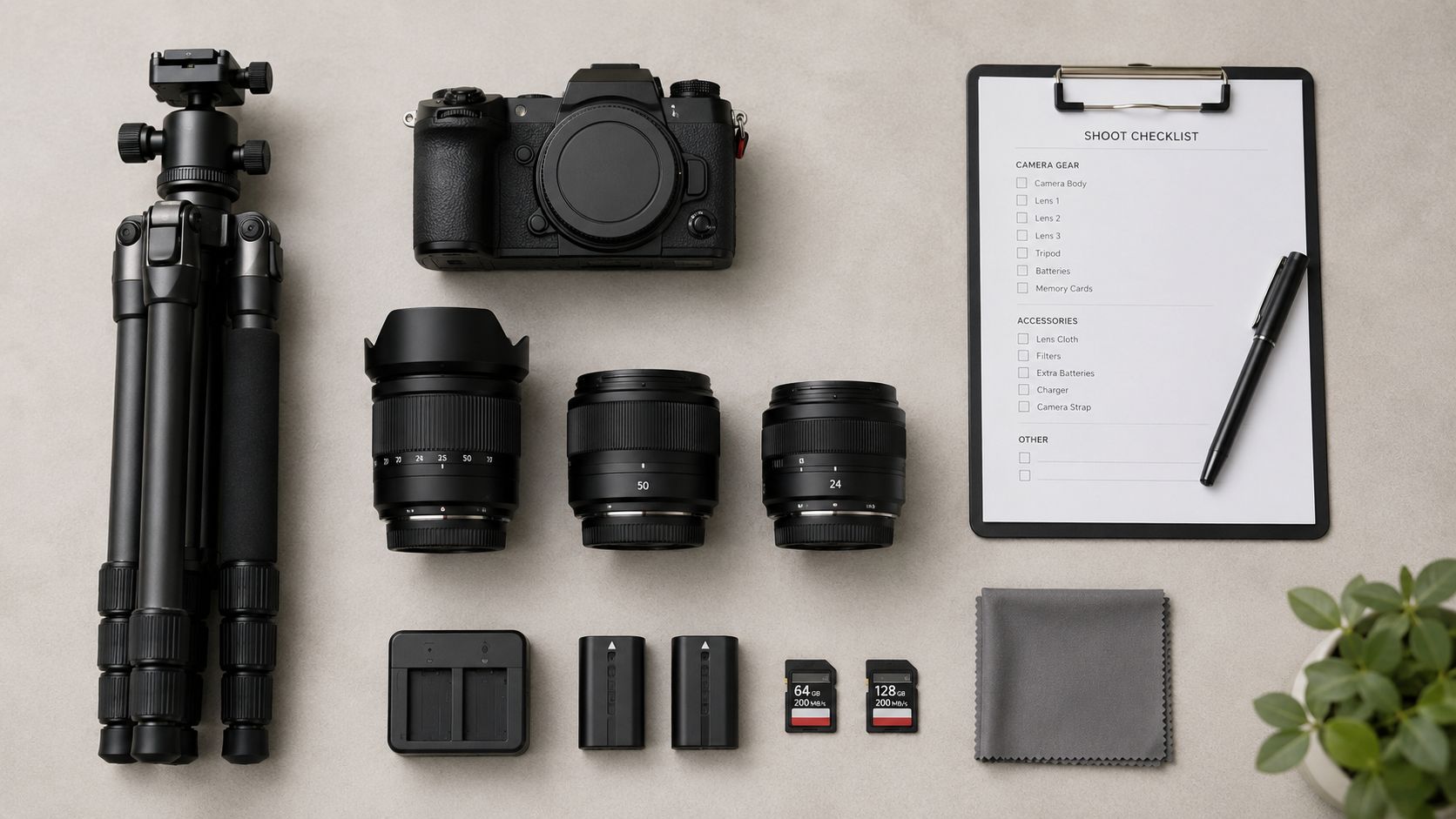
A practical equipment check goes beyond “do I own it?” It asks whether each item is the right tool for this property, this schedule, and this shot list. A tilt-shift lens may be essential for clean architectural lines. A heavy tripod may be worth the inconvenience if the building demands perfect framing. A lightweight travel stand that's fine for portraits may be the wrong choice on stone flooring in a high-traffic lobby.
Check the weak points, not just the hero gear
The failures that derail a day are rarely glamorous.
- Power chain: Camera batteries, strobe batteries, trigger batteries, chargers, extension cords, and outlet adapters.
- Capture chain: Card health, card formatting, tether cable integrity, laptop ports, and backup body readiness.
- Support gear: Tripod plates, leveling base, lens cloths, clamps, sandbags, gaffer tape, and gray card or color target.
- Optics: Lens cleanliness, focus accuracy, filter condition, and whether the lens profile suits the required perspective.
On commercial jobs, the missing cable is often more dangerous than the missing lens. You can change a composition. You can't improvise a broken tether if the client expects live review.
What doesn't work is checking gear the night before and hoping rental inventory will save you. Test early enough that you still have time to repair, replace, or reconfigure.
5. Weather Forecast and Contingency Planning
Weather planning isn't just for exterior work. It affects interiors, travel time, crew comfort, window light quality, condensation risk, and the order in which you should shoot a property.
On a mixed interior-exterior assignment, overcast conditions might soften an exterior façade beautifully while turning a daylight-heavy lobby flat and lifeless. Bright sun can give the exterior energy and force the interior schedule to shift until the contrast at the windows becomes manageable. The point isn't to fight the weather. It's to pre-decide what kind of day works for which images.
Build the alternate plan before you need it
A useful weather contingency plan includes more than “reschedule if rain.”
- Reorder the shot sequence: Exterior first if the morning is clear. Interior first if late-day clouds will help balance the façade.
- Identify protected options: Porticos, covered terraces, parking decks, atriums, and sheltered transitions can preserve the look of an exterior day.
- Protect the gear: Rain covers, towels, sealed cases, lens hoods, and dry staging areas matter when humidity and precipitation change quickly.
- Set the decision point: The client and crew should know who decides whether to proceed, delay, or pivot.
In practice, weather planning often reveals whether the schedule is realistic. If the assignment only works under one narrow lighting condition and there's no alternate sequence, the plan is fragile. Strong productions have fallback frames, fallback timing, and fallback access.
For portraits on corporate campuses, weather also affects the human side of the job. Wind can destroy hair and wardrobe continuity. Heat changes posture and patience. Cold shortens attention spans. If people are part of the imagery, build their comfort into the checklist rather than treating it as an afterthought.
The trade-off is simple. Flexibility costs some planning time up front, but it protects the day. Rigidity feels efficient until conditions shift and the whole schedule starts to crack.
6. Shot List Development and Compositional Planning
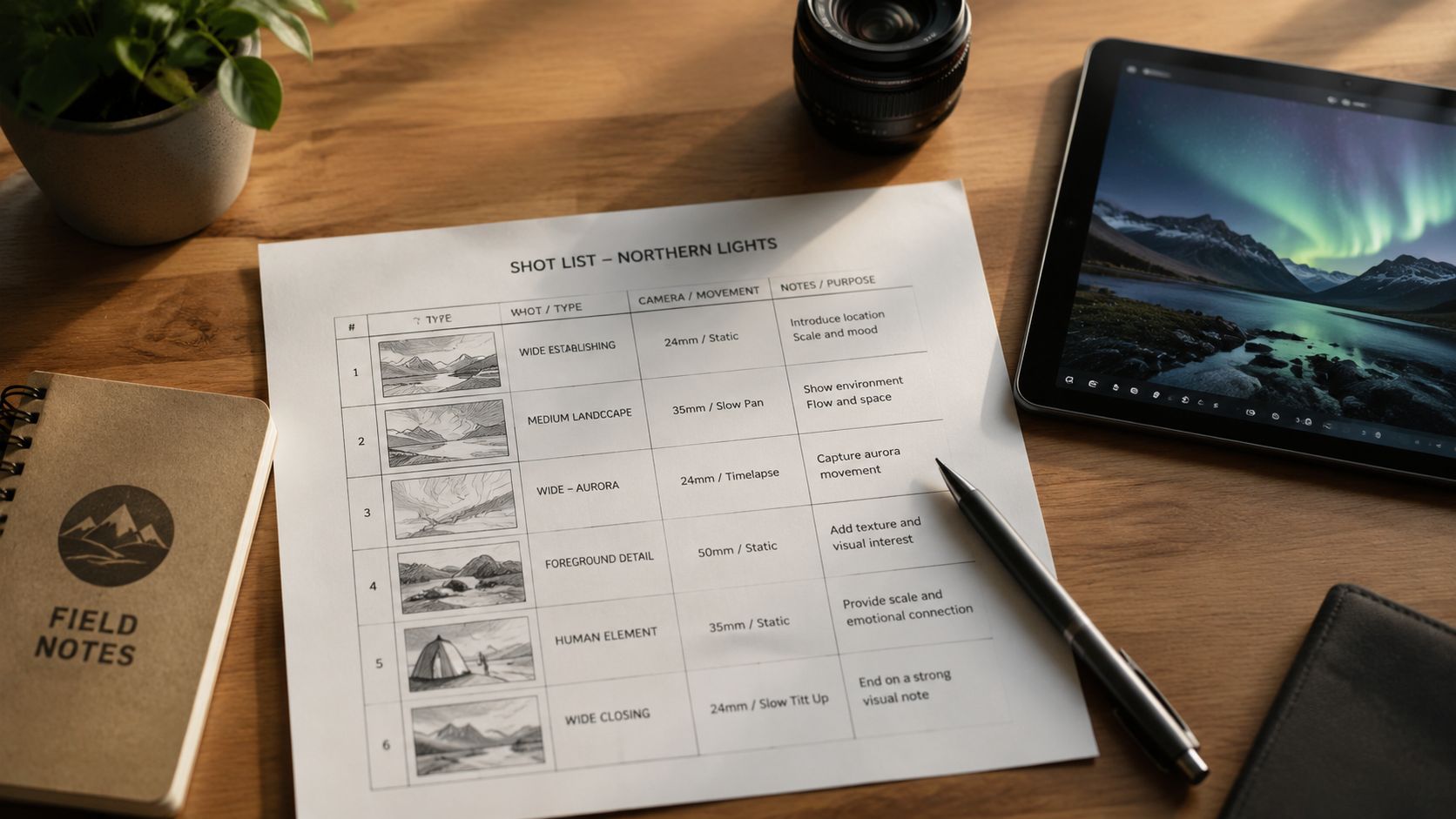
A shot list should read like a production document, not a wish list. If it's vague, the team will improvise. If it's too bloated, the day will collapse under its own ambition.
For architectural and commercial work, the best shot lists combine hierarchy and intent. Start with must-have frames that satisfy the client's business need. Then layer in supporting views, details, and alternates that add narrative range. A developer may need the hero exterior, lobby overview, amenity spaces, and circulation details. An interior designer may care more about material transitions, custom millwork, lighting moments, and the way one room leads into the next.
What a professional shot list should include
A working list needs enough detail to drive sequencing and enough flexibility to adapt on site.
- Priority level: Mark hero shots, required support shots, and optional frames.
- Location grouping: Organize by room, elevation, or zone so the crew doesn't keep leapfrogging across the property.
- Compositional notes: Include lens intent, camera height, orientation, key design element, and whether people or styling are needed.
- Usage notes: Flag if a frame needs copy space, vertical delivery, wide crop tolerance, or clean background for layout use.
Many photographers are often too casual. They trust memory, then discover on set that the client expected one more angle of the entry sequence or a cleaner contextual shot of the building in its streetscape. That's avoidable.
A useful way to pressure-test your own list is to compare it against a proven image framework like these must-have portfolio shots. Even if the assignment differs, the exercise exposes gaps in coverage and helps separate essential images from vanity images.
Field note: If a shot sounds important but nobody can explain where it will be used, it probably belongs in the optional column.
7. Crew Coordination and Client Communication
The day usually goes sideways in the same moment. The client notices a detail in frame, an assistant is waiting for direction, facilities needs the hallway cleared, and three opinions hit the camera position at once. At that point, talent and gear matter less than production control.
Magazine editorial and film crews solved this long ago with a simple rule. Communication follows a chain, and approval follows a sequence. Commercial and architectural photography benefits from the same system because the pressure is similar. Time is limited, stakeholders have different priorities, and small delays ripple through the whole schedule.
Set that structure before call time.
Set the chain of communication before the first frame
A professional crew does not run on group chat energy. It runs on defined authority, review timing, and clear handoffs.
- Assign one client decision-maker: One person gathers feedback from marketing, design, ownership, or the architect and delivers a single direction to the set.
- Assign one production lead: The photographer or producer controls pacing, approves when a setup is complete, and decides when to move on.
- Set review windows: Review tethered captures at planned checkpoints instead of inviting constant live commentary at the camera.
- Define crew lanes: Lighting, styling support, movement, digital tech, and logistics should each have an owner when the scale of the job calls for it.
That structure protects the work. It also protects the client from their own internal noise.
I have seen strong sets lose an hour because every stakeholder was allowed to direct independently. The architect asks for cleaner lines. Marketing wants a warmer feel. The property manager needs the crew out of an access route. None of those requests are unreasonable. The problem is concurrency. Without a communication lane, the photographer stops directing and starts translating.
Planned review moments fix much of this. Bring the client to a larger monitor, confirm composition, styling, and brand fit, then lock the frame and proceed. That rhythm keeps the client involved without turning every setup into an open committee meeting.
Crew coordination also affects deliverables after the shoot. If the client contact understands who can approve framing, styling changes, occupancy issues, and usage questions on site, fewer disputes show up later in post or licensing. That matters on commercial assignments where image use often extends across campaigns, web, print, and property marketing. Clear approval notes on set make commercial photo licensing decisions easier to document and defend.
The checklist item here is not "text the team." It is building a production system. Call times, contacts, review points, role ownership, and approval authority should all be written down before anyone unloads a case. That is how high-stakes editorial and film crews keep momentum. The same discipline gives commercial and architectural shoots a calmer set, faster decisions, and cleaner results.
8. Permits, Access, and Legal Documentation
Nothing makes a professional set feel amateur faster than discovering, on arrival, that nobody cleared the loading dock, the lobby manager didn't approve tripods, or the building requires proof of insurance before a case can cross the threshold.
Legal and access prep isn't glamorous, but it protects the day. On commercial properties, that often means written authorization, insurance certificates, parking instructions, elevator reservations, and after-hours access notes. On public-facing exteriors, it can also mean permits, restricted zones, and rules about staging on sidewalks or in traffic-adjacent areas. If people are identifiable, model releases may also be necessary.
Documents that should be settled early
These items shouldn't be chased by text message the morning of the shoot.
- Property permission: Written confirmation from the owner, manager, or authorized representative.
- Insurance paperwork: Certificates that meet the site's stated requirements.
- Access details: Entry instructions, loading route, parking clearance, service elevator rules, and contact numbers.
- Usage terms: Licensing scope, exclusivity expectations, and any confidentiality restrictions.
Some locations require permission and fees, and that's exactly why paperwork belongs inside the checklist rather than outside it, as noted in the earlier planning guidance. The checklist is where legal reality meets creative ambition.
For the usage side of the job, Jimmy Clemmons' overview of licensing a photo for commercial use is a relevant reference. It helps frame the part clients often overlook: access gets you the image, but licensing defines how that image can be used after delivery.
What doesn't work is assuming internal stakeholders have aligned among themselves. Always verify. The person who hired you may not be the person who controls the property.
9. Backup Systems and Data Management Protocol
Data management is where a lot of photo shoot checklists stay too shallow. They mention spare cards and maybe an external drive. That's not a protocol. That's a hope.
For professional work, especially high-volume commercial content, the stronger approach is to define deliverables before the shoot starts. One underserved angle in checklist planning is post-shoot and efficiency control. Existing checklists often over-focus on pre-shoot prep and on-set gear checks, while more valuable planning can sit in a pre-approved delivery matrix that includes crops, platform uses, file naming, retouch levels, and backup rules, as discussed in this workflow-focused video on photo planning and delivery. That's the smarter way to prevent reshoots and turnaround friction.
Treat files like deliverables, not leftovers
A professional data plan answers four questions.
- How are files protected on set? Dual-card recording, scheduled offloads, and verified copies.
- How are files named and organized? Client, date, location, RAW, selects, working edits, finals.
- Who owns the handoff? One person should be responsible for backup execution, not “the team.”
- What is the final output structure? Crops, color profiles, retouch tiers, export naming, and delivery folders should already be agreed.
The most expensive data mistake isn't losing a file. It's delivering the wrong version, the wrong crop, or the wrong naming convention after the client has already built a campaign around your timeline.
Production discipline pays off long after the cameras are packed. If the client needs architecture images for web, print, social, awards, and leasing collateral, the backup and delivery structure should reflect that complexity from day one. Clean file handling is part of the creative service.
10. Safety Assessment and Risk Mitigation
Safety planning isn't bureaucracy. It's basic production intelligence.
In architecture, commercial, and construction-adjacent photography, the environment can change fast. Wet stone, active trades, rooftop access, unsecured cables, vehicle movement, temporary power, and crowded public areas all affect how you position people and gear. If the crew is distracted by avoidable hazards, image quality drops with everything else.
Risks worth checking during the scout
The hazard review should be visual, practical, and specific to the job.
- Movement hazards: Slippery floors, stair transitions, loading routes, and public traffic patterns.
- Equipment hazards: Cables across walkways, unstable stand positions, overhead rigging risks, and crowded staging areas.
- Site hazards: Construction zones, restricted areas, exposed edges, active machinery, and temporary lighting or power.
- Human factors: Heat, cold, hydration, fatigue, and the effect of long days on judgment.
The safest sets are usually the calmest sets because people know where to stand, where not to stand, and when to pause work. That matters even on polished corporate jobs. A clean office can still become risky once tripods, sandbags, power cords, and rolling cases enter the space.
The broader market is also moving toward more professionalized operations. The global photography services market is projected to grow from USD 37.21 billion in 2025 to USD 56.85 billion by 2031, implying a 7.32% CAGR, according to TechSci Research's photography services market outlook. As workflows become more structured, safety belongs in the same category as scheduling and approvals. It's part of how serious teams operate.
A final safety note. If conditions feel unstable, stop and reset. No frame is worth an injury, damaged property, or a preventable incident.
Photo Shoot Checklist: 10-Point Comparison
| Task | 🔄 Implementation Complexity | ⚡ Resource Requirements | 📊 Expected Outcomes (⭐ Quality) | 💡 Ideal Use Cases & Key Advantages |
|---|---|---|---|---|
| Location Scouting and Site Assessment | Medium 🔄, travel, measurements, multi-angle documentation | Low–Medium ⚡, time, vehicle, camera, light meter, access coordination | Prevents surprises; enables optimal framing and lighting plans; ⭐⭐⭐⭐ | Architectural/commercial shoots, reduces setup time, clarifies creative vision |
| Lighting Design and Equipment Planning | High 🔄, technical diagrams, color matching, backup plans | High ⚡, strobes/continuous lights, modifiers, crew, power/generator, meters | Controlled, publication-ready images; consistent material rendering; ⭐⭐⭐⭐⭐ | Editorial, hospitality, brand shoots, reveals materiality, ensures consistency |
| Client Brief Review and Creative Direction Alignment | Medium 🔄, meetings, documentation, approvals | Low–Medium ⚡, time, briefs, mood boards, communication tools | Aligned deliverables, fewer revisions, strategic imagery; ⭐⭐⭐⭐ | Brand-driven projects and corporate campaigns, prevents miscommunication, saves revision time |
| Equipment Inventory and Functionality Check | Medium 🔄, systematic testing, calibration | Medium ⚡, full gear lineup, spare parts, test time, possible rentals | Reliable performance on shoot day; consistent technical quality; ⭐⭐⭐⭐ | Any location shoot, prevents failures, demonstrates professionalism |
| Weather Forecast and Contingency Planning | Low–Medium 🔄, monitoring and alternative plans | Low ⚡, forecasting tools, protective gear, backup locations | Reduced schedule risk; ability to leverage or mitigate conditions; ⭐⭐⭐ | Outdoor/exterior and mixed shoots, protects equipment and timeline |
| Shot List Development and Compositional Planning | Medium 🔄, creative and logistical sequencing | Low–Medium ⚡, time, reference images, sketches, shot timing | Comprehensive deliverables and efficient workflow; minimizes missed images; ⭐⭐⭐⭐ | Architectural/editorial shoots, ensures required images, optimizes crew movement |
| Crew Coordination and Client Communication | High 🔄, role assignments, decision protocols | Medium–High ⚡, personnel, comms devices, on-set review monitors | Smooth on-set execution, clearer approvals, improved safety; ⭐⭐⭐⭐ | Large productions and multi-stakeholder shoots, enables real-time adjustments and accountability |
| Permits, Access, and Legal Documentation | Medium–High 🔄, administrative and legal steps | Medium ⚡, time, fees, insurance, legal forms | Legal protection and uninterrupted site access; clear usage rights; ⭐⭐⭐⭐ | Urban/public locations, commercial assignments, prevents legal disputes and denied access |
| Backup Systems and Data Management Protocol | Medium 🔄, procedures, redundancy, version control | Medium ⚡, dual cards, portable drives, cloud, software, trained operator | Prevents catastrophic data loss; organized collaboration and retrieval; ⭐⭐⭐⭐⭐ | High-value commercial/editorial work, non-negotiable protection of deliverables |
| Safety Assessment and Risk Mitigation | Medium 🔄, hazard identification and protocols | Low–Medium ⚡, PPE, briefings, signage, emergency plans | Reduces injuries and liability; maintains schedule and morale; ⭐⭐⭐⭐ | Construction sites, rooftops, crowded locations, protects crew and client, ensures compliance |
From Checklist to Masterpiece Integrating Precision into Your Workflow
A shoot day can look calm on the surface and still fall apart underneath. The client is on site, talent is ready, the building has a narrow access window, and one missed approval can force a reshoot weeks later. A photo shoot checklist earns its keep by preventing that chain reaction before the first frame is made.
Its primary value is not organization for its own sake. It is production control. In magazine editorial and film work, prep exists to protect the story, the schedule, and the final deliverables. Commercial and architectural photography benefits from the same discipline. The assignment runs better because the photographer is free to judge light, timing, framing, and sequence instead of solving avoidable problems in real time.
That distinction matters on jobs with competing demands. One set of images may need to satisfy marketing, leasing, editorial, investor relations, and internal communications at once. If the production system is weak, those competing uses show up later as missing orientations, inconsistent coverage, avoidable retouching issues, or a second shoot nobody budgeted for. Good prep handles that complexity while it is still inexpensive to fix.
Clients notice the difference quickly.
They see it in how approvals are staged, how the crew moves through a location, how decisions get made, and how clearly delivery expectations are set before anyone packs a case. The checklist becomes an operating standard, not a piece of paper.
That is why the strongest checklists are revised after every assignment. Keep what prevents delays. Add what protects image quality. Remove steps that never affect the outcome. Over time, the document stops being a generic reminder and becomes a repeatable production system shaped by your actual work, your clients, and the kind of errors you refuse to make twice.
Jimmy Clemmons Photographer applies that editorial-minded production approach to architectural, commercial, and portrait assignments in Atlanta. If you need a photo shoot checklist that works like a real production system instead of a last-minute packing note, Jimmy Clemmons Photographer offers planning, lighting precision, and on-set discipline built for high-value deliverables.