
You've finished the install. The styling is dialed in. The light is finally right. Now comes the part that often feels strangely harder than the project itself. Hiring a photographer and making sense of the quote.
That confusion is normal. Interior design photography pricing can look inconsistent from the outside because two proposals may describe the same house or commercial space in completely different ways. One photographer quotes a package. Another quotes a day rate. A third separates creative fee, retouching, and licensing. None of that means someone is hiding the ball. It usually means they're pricing for different outcomes.
The question isn't only what the shoot costs. It's what the images need to do once they exist. A portfolio update, an awards submission, a press pitch, a hospitality launch, and a regional ad campaign may all involve the same room, but they rarely carry the same production needs or usage value. That's why strong photography pricing is less like buying a commodity and more like planning a project with a clear purpose.
Clients who get the best result usually stop asking for a number in isolation. They start with goals. If you want a useful frame for thinking about value before you request estimates, this perspective on the ROI of professional photography is a good place to start.
Investing in Your Vision Why Photography Pricing Is Complex
A finished interior has layers that don't show up on a floor plan. Texture, rhythm, color balance, negative space, sightlines, and the way one room opens into the next all need interpretation. Photography is where those decisions become visible to everyone who wasn't in the room.
That's why pricing gets complex fast. You're not only paying for time with a camera. You're paying for someone to translate design intent into images that hold up on a website, in a features pitch, inside a lookbook, or across a brand refresh. The same kitchen can be photographed as a quick listing image or as a polished brand asset. The difference is substantial, and the price usually reflects that difference.
Great interior photography doesn't just record a room. It decides what the viewer should notice first, second, and last.
Some projects are straightforward. A compact residential portfolio update with a short shot list and simple usage is easier to scope. Others involve layered lighting, multiple stakeholders, location constraints, tight styling, and a need for both hero images and detail studies. A quote has to account for that reality.
Why sticker shock happens
Most sticker shock comes from a mismatch between expectation and scope. A client may think, “It's one property.” The photographer may see scouting, schedule coordination, on-site styling decisions, tethered review, retouching, file prep, and licensing for several kinds of use.
That isn't padding. It's production.
What a useful quote actually does
A useful quote should help both sides make decisions. It should clarify what's being created, how the shoot will run, what files are delivered, and how the images can be used. Good pricing creates alignment. Weak pricing creates confusion, revision loops, and disappointment.
When pricing works well, it becomes a planning tool. It helps you decide whether the job calls for a small editorial-style session, a full production day, or a broader content build that supports your business for months or years.
Decoding Common Photography Pricing Models
Most interior design photography pricing falls into a few recognizable structures. The model matters because it affects how the day is planned, how images are selected, and what happens if scope changes.
Hourly rate
An hourly rate is the simplest model to understand. The client pays for time spent shooting and sometimes for post-production time as well.
This model can work for very limited jobs, especially when the assignment is narrow and the deliverables are modest. It's easy to start with and easy to explain. The problem is that it can reward speed over craft, and it often doesn't fit the stop-and-start nature of interiors, where styling tweaks, weather shifts, and lighting adjustments are part of the job.
For clients, hourly pricing can also create anxiety. Every extra request feels like the meter is running.
Day rate
A day rate is common for architectural and interior assignments because it reflects how these shoots happen. A room may take time to prep, refine, and light. The best frame may come after several small adjustments that aren't visible in a final image but matter enormously.
In North America, approximately 35% of experienced architectural and interior design photographers charge a day rate between $1,500 and $5,000+, with rates depending on scope, number of spaces, and styling complexity. The same industry benchmark notes that basic residential projects involving 10 to 20 images typically range from $2,200 to $5,000, while luxury or large-scale commercial assignments can exceed $10,000 to $19,000. It also points to licensing, post-production, and specialization as major reasons for the spread in cost (North American A&D photography pricing benchmark).
The strength of a day rate is clarity. Everyone knows the production window. The downside is that clients sometimes assume the day rate includes unlimited images or unlimited usage, which usually isn't the case.
Per-image licensing
This model separates capture from the value of the final selected images. The client pays for the images they license and use.
That structure makes sense when a client needs a short list of hero images rather than broad coverage. It's also useful when one image may carry more commercial value than another. A portfolio detail shot and a campaign image shouldn't always be priced the same way if their business purpose is different.
Practical rule: If the final edit quality and the intended usage matter more than sheer shoot time, per-image licensing often produces a cleaner quote.
Project-based fee
A project fee rolls the scope into one number. For many clients, this is the easiest proposal to compare and approve. It can include pre-production, the shoot, editing, and a defined usage license.
The risk is hidden assumptions. If the shot list grows or the client's usage expands after approval, the “all-in” price can stop being all-in very quickly.
A strong project fee works best when the scope is well defined, the decision-makers are aligned, and the deliverables are unlikely to shift.
Key Factors That Drive Your Final Cost
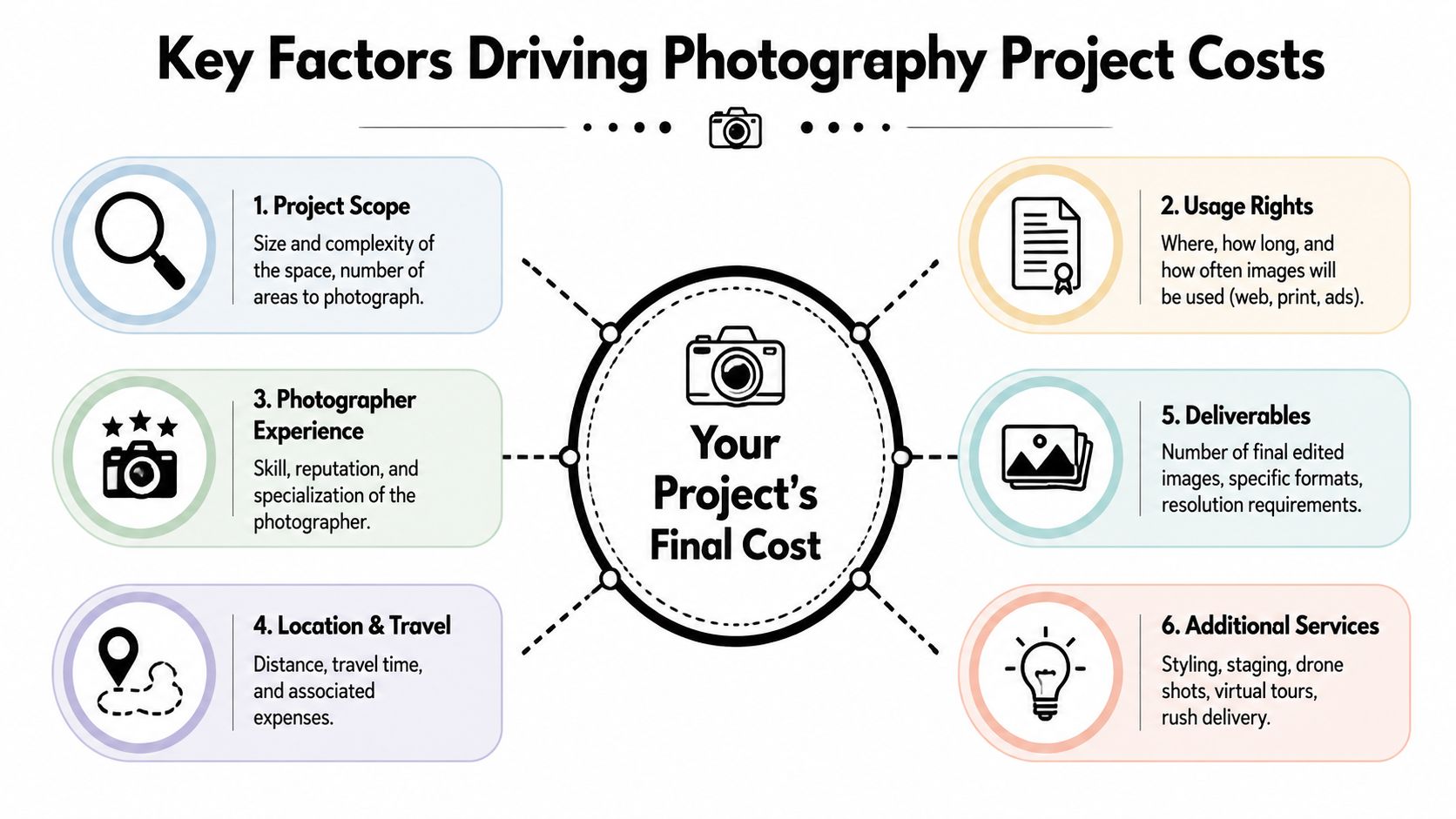
Two shoots can use the same pricing model and still land at very different totals. That difference usually comes from project variables, not arbitrary markup.
Scope changes everything
The first driver is scope. A single room photographed for one purpose is different from a whole-home story that needs wide compositions, verticals, details, transitions, and exterior support. Complexity matters as much as size.
A kitchen and a powder room are not equal in production effort. One may require layered lighting, appliance reflection control, surface cleanup, and precise perspective control. The other may be smaller but compositionally difficult. A quote has to account for the actual work each space demands.
Prep and production decisions
Clients sometimes focus on the shoot day and forget the planning around it. Pre-production can include schedule coordination, shot-list review, location evaluation, staging input, and sequencing the day around available light.
Then there's the on-site reality:
- Styling refinement: Pillows shift, florals get adjusted, cords disappear, and distracting objects get moved.
- Lighting control: Mixed color temperatures, hot windows, and dark corners often require more than available light.
- Review workflow: Tethered capture, collaborative review, and on-set approvals take time, but they reduce surprises later.
These choices affect quality directly. They also affect cost.
Retouching is not a minor line item
Interior images often need selective cleanup, exposure balancing, color correction, and detailed finishing. Some frames require compositing to control reflections, preserve window detail, or present the room at its best without looking artificial.
Retouching is where many “cheaper” quotes tend to fall apart. If the edit standard is low, the image won't support a premium brand no matter how good the room looked in person.
Licensing is where business use becomes visible
Licensing is the part many clients understand last, even though it often explains the biggest price differences. If you want a clean explanation, this guide to licensing a photo for commercial use lays out the logic well.
Think of licensing like access rights, not object ownership. A website gallery, an awards submission, a printed brochure, and a long-term brand campaign are different uses. The broader and more commercially valuable the use, the more the images are worth.
Licensing isn't a surcharge. It's the agreement that defines how the image works for your business.
Here's a simple comparison:
| Use case | Pricing pressure |
|---|---|
| Portfolio or limited editorial support | Lower complexity on usage |
| Website and standard marketing collateral | Moderate usage value |
| Print advertising or campaign use | Higher commercial value |
| Perpetual collateral or broad brand usage | Highest usage value |
If a quote seems higher than expected, check the usage language before assuming the photographer is expensive. You may be comparing limited-use pricing to long-term commercial pricing.
Real-World Interior Photography Rates and Examples
A designer calls with a finished project that needs three things at once. Fresh portfolio work, a submission set for editors, and a few polished images the firm can keep using in proposals. The price only makes sense once those goals are clear, because each one pulls the scope in a different direction.
Public benchmarks are useful for setting expectations, but they usually describe real-estate-oriented production rather than design marketing. For example, this interior photography pricing guide from PhotoUp outlines lower-cost packages tied to property size, image count, and fast turnaround. Those numbers fit listing coverage. They are less useful for a styled residential project where the client needs stronger composition, tighter color control, and files that can support long-term brand use.
Those are different assignments.
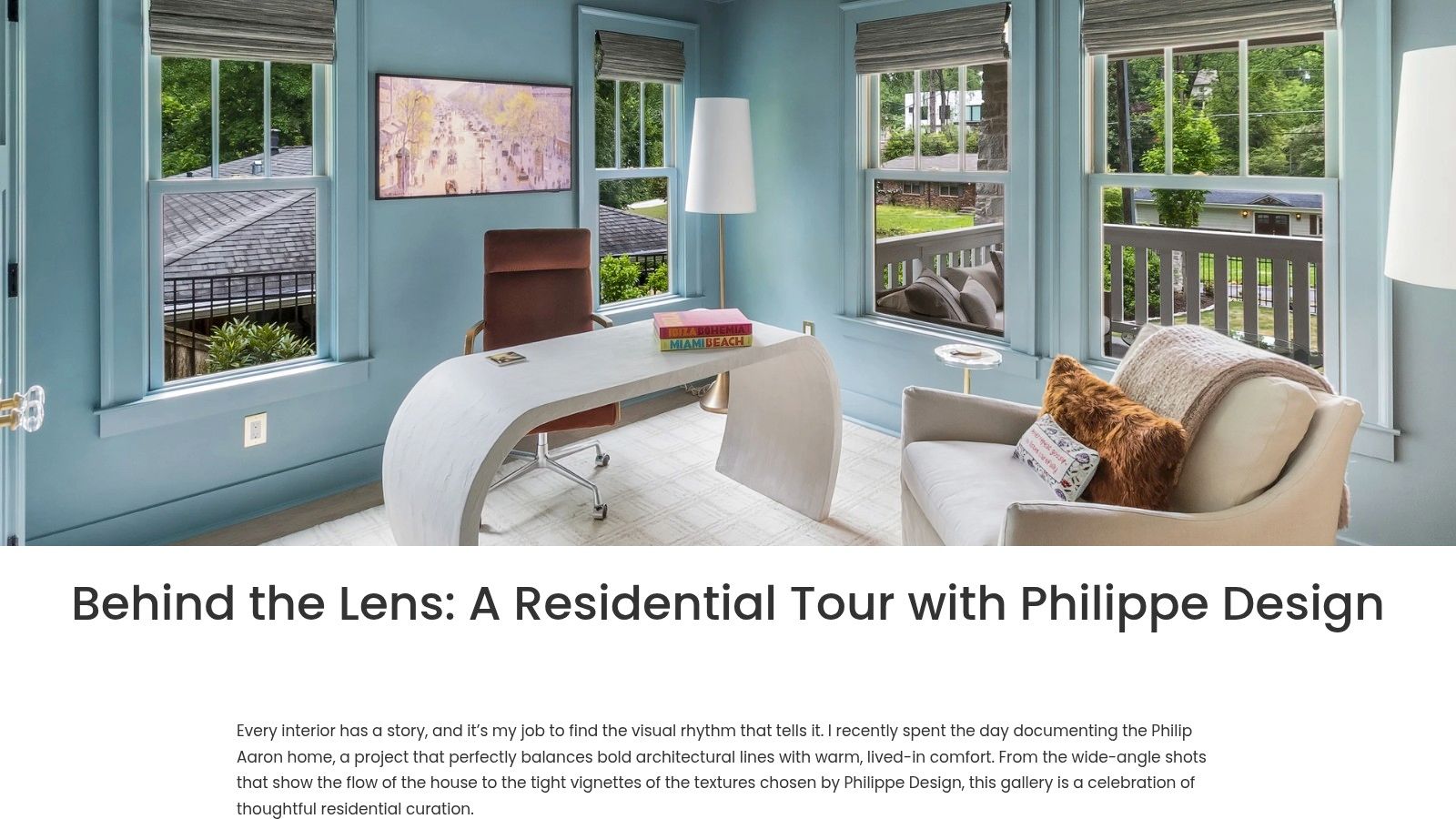
Where professional interior sessions often begin
For design firms, the conversation usually starts with the business outcome, then the pricing model follows. A compact portfolio update may call for a half day and a small licensed image set. A multi-room shoot intended for website headers, award entries, print pieces, and PR outreach often needs a full production day, tighter shot planning, and more finishing work.
If you want a reference point from a working architectural and interiors practice, this page on commercial architectural photography services reflects the kind of custom scoping that is common once the work moves beyond listing coverage.
The gap between those two project types is where confusion usually starts. One quote may be built to document a space efficiently. Another may be built to create signature brand assets with broader usage rights and higher retouching standards. Comparing them line by line without accounting for the intended use leads to bad decisions.
A high-end pricing structure in practice
One published estimate for a 12-image interior-design project used a day rate plus per-image licensing structure that totaled $14,400, including $700 per image for perpetual collateral use, a $1,000 first edit for client review, and $800 per additional image with up to 1 hour of retouching (published interior-design estimate breakdown).
That estimate is useful because it shows how serious interior design photography pricing is often assembled in practice:
- Creative day rate plus editing: Covers production time, on-site problem solving, and the technical control required to photograph interiors well.
- First edit for review: Gives the client a shaped selection to review instead of a large batch of near-duplicates.
- Per-image licensing: Ties image cost to business use, which is often fairer than forcing every project into one flat package.
- Additional image finishing: Accounts for the labor involved in polishing final selects to a publication or campaign standard.
I often tell clients to read an estimate by asking one question. What result is this quote built to produce?
A lower quote can be the right fit for a straightforward archive shoot or a quick website refresh. A higher quote often makes sense when the images need to carry a launch, support PR outreach, or stay in circulation for years across multiple channels. Pricing works best when it helps both sides match the production to the outcome, instead of treating every interior shoot like the same job.
How to Brief Your Photographer for an Accurate Quote
A vague inquiry usually gets a vague estimate. A clear brief gets a useful quote.
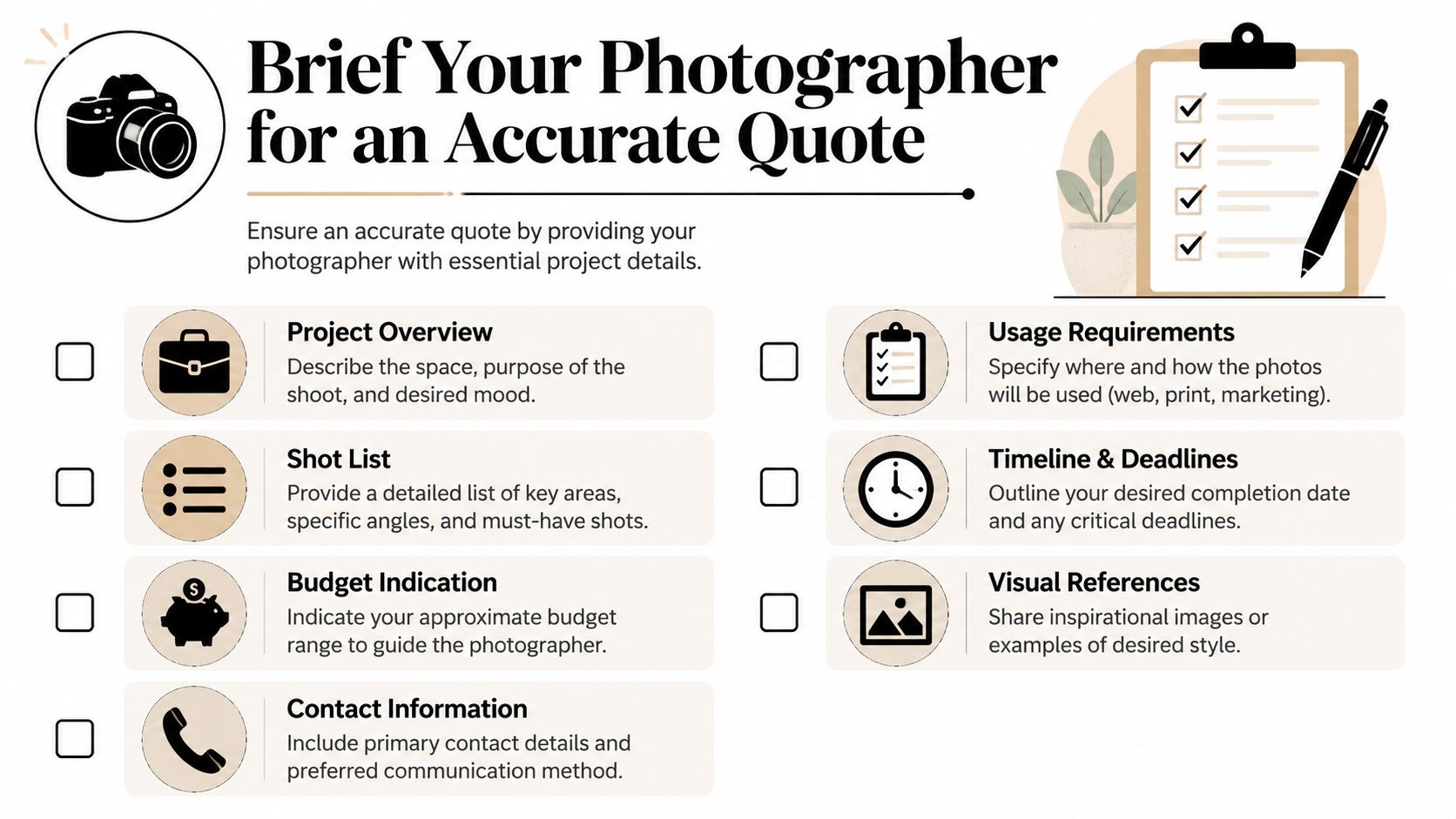
The fastest way to improve interior design photography pricing conversations is to give your photographer enough information to scope the job properly. That doesn't mean writing a formal creative deck for every project. It means being specific about goals, spaces, usage, and timing.
What to include in the first email
Send enough context that the photographer can picture the assignment before they start pricing it.
- Project type and purpose: Is this a residential portfolio shoot, a hospitality launch, a builder archive, or a brand campaign?
- Spaces to be photographed: List the rooms or areas that matter most.
- Visual priorities: Mention hero shots, vignettes, detail images, exteriors, or portraits if needed.
- Timeline: Include install date, shoot window, and any publication or launch deadline.
- Decision-makers: Say who approves the creative and who will be on site.
If you already have references, attach them. A few targeted examples communicate taste much faster than broad mood language.
For firms that need polished commercial imagery rather than listing coverage, it also helps to review how a commercial architectural photographer typically approaches scope, production, and deliverables.
A brief video overview can also help clients think through the process before they request estimates:
The detail that changes the quote most often
Usage. Say where the images will live.
A photographer can't price accurately if they don't know whether the files are for your website portfolio, social media, printed lookbooks, awards entries, editorial pitching, or a long-term marketing library. Even if you aren't fully certain, sharing your likely use gives the estimate structure.
A simple client-side checklist
Before you request pricing, gather these items internally:
- Your must-have spaces
- Your intended uses
- Any deadline that can't move
- The on-site contact
- A realistic budget range, if you have one
- A short list of essential images
That last point matters. If there are only three images that really need to carry the whole project, your photographer can build the day around making those exceptional instead of trying to cover everything lightly.
Maximizing Your Photography Investment
The cheapest estimate rarely delivers the best value. The strongest value usually comes from planning the shoot so the images stay useful long after launch week.
One of the best ways to stretch a budget is to think in asset families rather than isolated shots. If a room is already styled and lit, capture the wide hero, then a vertical version, then a detail grouping, then a tighter material vignette. That gives your team options for web banners, social posts, press requests, and proposals without rebuilding the set later.
Plan for reuse, not just delivery
A smart shot list serves more than one channel. Ask for orientation variety where it makes sense. Think about how a horizontal hero might live on your website while a vertical frame supports mobile, social, or publication needs.
Bundling also helps. If several spaces are ready at once, it may be more efficient to photograph them within the same production window than to split them across separate small shoots. That's especially true when the shoot is being priced around a day-based structure.
Negotiate scope, not quality
If the proposal feels beyond budget, don't default to “Can you do it cheaper?” Ask which levers can move without hurting the outcome.
For example:
- Reduce the number of final licensed images
- Limit the initial usage to current channels
- Prioritize hero rooms now and secondary spaces later
- Simplify add-ons that aren't essential for this phase
That's a productive conversation. It keeps quality intact while aligning the assignment with the business need.
A good photographer won't just defend the price. They'll help shape the scope so the money goes where the images will work hardest.
Frequently Asked Questions About Photography Pricing
A common scenario: a design firm asks for “a day rate,” then gets three estimates that are nowhere near each other. The gap usually comes down to scope, usage, and production approach. Pricing works best when it helps both sides match the assignment to the outcome, whether that outcome is a portfolio update, a press-ready project feature, or a campaign asset library.
What's typically included in a photographer's day rate
A day rate usually covers the shoot day itself, pre-production time, and the photographer's creative and technical work on set. Some proposals also include a defined round of basic post-production, file prep, and delivery of a set number of final images.
What varies is everything around that core. Assistants, stylists, prop sourcing, advanced retouching, travel, location scouting, rush turnaround, and licensing are often separate line items. That structure is useful because it lets the scope fit the job instead of forcing every project into the same package.
Why does advertising usage cost more than portfolio use
Usage changes the value of the images. If a firm needs photographs for its website, social channels, awards entries, and editorial outreach, that license is different from a regional ad buy or a long-term national brand campaign.
The question is not only “How many photos?” It is also “What business role will these photos play?” A tighter license can make sense for a portfolio-driven project. Broader usage makes sense when the images are expected to generate leads, support paid media, or anchor a brand launch.
Can I get the RAW files
Usually, no. RAW files are working files, and they do not reflect the finished standard a client is hiring for.
Interior photography depends on selection, color balancing, exposure blending, perspective control, cleanup, and final finishing. Handing over RAWs skips the part of the process that creates consistency across the set. If a client needs expanded flexibility, it is better to discuss layered deliverables, alternate crops, or a wider licensed image set.
Why do quotes vary so much between photographers
Because the estimates may describe very different jobs.
One photographer may be quoting a straightforward half-day with minimal lighting and a small set of delivered files. Another may be pricing a full production day with assistants, styling coordination, detailed retouching, and commercial licensing. The total only makes sense once the scope is clear.
This is why I encourage clients to compare proposals line by line. A lower number is not automatically a better value if it leaves out the pieces needed to get the images your team needs.
Is there a realistic floor for professional interior work
Yes, but it depends on the market and the assignment. In major markets, professionally produced interior work usually has a practical pricing floor that reflects prep, shoot time, post-production, and a limited license, even before a project expands into advertising or larger production support.
At the lower end, you will also see real-estate-style packages built for speed and volume. Those can be appropriate for listing coverage. They are priced for a different outcome than design portfolio work, hospitality branding, or national campaign imagery.
That distinction matters. A good quote should tell you what kind of assignment is being priced, what result it is built to deliver, and which options can shift if priorities change.
The right photographer makes pricing easier to understand and easier to use. Look for someone whose quoting process is as clear as their visual style. If you're evaluating options in Atlanta or need design-forward commercial interiors photographed with editorial discipline, Jimmy Clemmons Photographer is one studio that offers architectural and interior imagery, on-site direction, lighting design, and professional editing as part of a broader commercial photography practice.
If you're planning a residential, hospitality, architectural, or brand-focused interiors shoot and want a clear conversation about scope, licensing, and deliverables, Jimmy Clemmons Photographer offers collaborative project planning and design-forward photography for firms that need images to do real business work.