
A finished project creates a familiar problem. The building looks resolved in person. Materials sit exactly where they should. Light moves through the structure the way the drawings promised. Then the marketing team, the architect, or the developer has to reduce all of that into a set of files that must work on a website, in a leasing deck, in an award submission, and in front of a client who hasn't visited the site.
That's where most visual coverage falls short. Standard listing images can document a room, but they often miss the logic of the design, the sequence of arrival, and the relationship between detail and scale. For architecture, hospitality, mixed-use, workplace, and high-value residential work, documentation isn't enough. You need visual assets that explain intent and support business development long after the property is occupied.
The most effective answer is an integrated approach to real estate photography videography. Stills establish form, material, and composition. Motion shows flow, pacing, and how one space leads to the next. Together, they produce a library of assets that can sell a property, support a brand, and keep working across multiple campaigns.
Beyond the Blueprints Capturing Architectural Intent
A developer reaches substantial completion on a new office property. The lobby stone is in. Tenant amenities are polished. The grounds have settled enough to photograph well. The immediate instinct is often to “get the building shot” before leasing begins.
That's reasonable, but it's incomplete.
A single round of wide, bright, competent images might satisfy a listing need. It won't necessarily communicate why the project matters. It won't show how the façade relates to the street, how the public areas transition into private ones, or how the architect used material contrast to keep a large structure from feeling cold.
Documentation versus interpretation
Architectural work needs both. Documentation records what exists. Interpretation makes the viewer understand it.
For discerning clients, that difference matters because the imagery often has to serve more than one audience:
- Leasing teams need clean, legible assets that make a property easy to evaluate.
- Architects need images that show design decisions, not just room size.
- Developers need content that supports fundraising, presentations, and future acquisitions.
- Editors and juries need a coherent visual narrative, not a pile of disconnected files.
Professional imagery isn't just polish. It shapes how quickly a viewer understands the value of the project.
That business impact isn't hypothetical. Listings with professional photos sell 32% faster, and they can close for $934 to $116,076 more than listings with low-quality images, according to Visually Sold's summary of real estate photography research. Even if your goal isn't a residential sale, the signal is clear. Visual quality affects buyer response and perceived value.
Why stills alone often stop short
Stills are foundational, but architecture is spatial. A corridor that compresses before opening into a double-height lounge needs movement to be understood fully. A hospitality space designed around circulation and atmosphere almost always benefits from video because pacing is part of the design.
That's why integrated coverage works so well. The still photographs become the hero assets for print, web, and editorial use. The motion piece shows sequence, context, and mood. Used together, they turn a finished building into a persuasive story rather than a basic record.
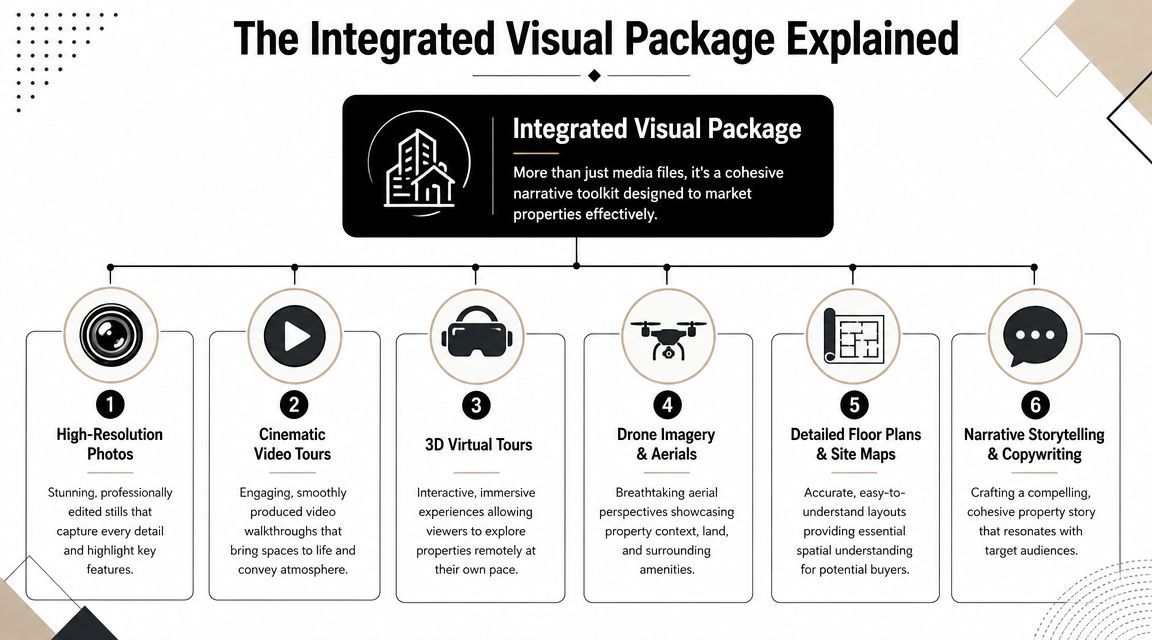
The Integrated Visual Package Explained
An integrated package should feel less like a media dump and more like an editorial system. Each asset has a job. Some images establish the whole. Others isolate craftsmanship. Video ties the sequence together and makes the viewer feel how the project unfolds.
What belongs in the package
A strong package usually combines several layers of coverage:
- Architectural hero stills that define the exterior, primary public spaces, and signature moments of the project.
- Vignette images that isolate joinery, finishes, furnishings, lighting, and transitions between materials.
- Cinematic walkthrough footage that shows circulation, sightlines, and atmosphere.
- Aerial views that establish context, access, land use, and adjacency.
- Support assets such as floor plans, site maps, or copy that help non-design audiences read the project quickly.
The difference between standard listing media and architectural coverage is intent. Listing media often answers, “What's here?” High-end visual coverage answers, “Why was it designed this way, and why should the viewer care?”
How the pieces work together
Think of it as the difference between a spec sheet and a magazine feature. One is transactional. The other builds desire, confidence, and memory.
A practical package often works like this:
| Asset type | Primary purpose | Best use cases |
|---|---|---|
| Stills | Precision and control | Website galleries, print, award entries, press kits |
| Video | Flow and emotion | Presentations, landing pages, social campaigns |
| Drone | Site context and scale | Developer decks, leasing, mixed-use overviews |
| Plans and maps | Spatial clarity | Investor materials, tenant packets, remote review |
To see that concept in motion, this kind of walkthrough shows how a property can be paced visually for audience attention:
What clients should ask for
Not every project needs every format at the same depth. What matters is alignment with use.
Practical rule: Ask what the assets need to do after delivery. Portfolio use, leasing, editorial outreach, investor communication, and social distribution all require different framing choices and different edits.
If the answer is “everything,” then the package should be designed from the start to generate both horizontal and vertical material, wide establishing views and tight details, plus video sequences that can be edited long and short without losing coherence.
Strategic Benefits for Marketing and Brand Building
The strongest argument for combined photo and video services isn't that they look better. It's that they keep producing value after the initial campaign ends.
For an architect, developer, or interior design firm, a shoot shouldn't serve only the opening announcement. It should create a reusable content library that supports new business. A completed project can become a homepage feature, a case study, a speaking engagement backdrop, a social campaign, a proposal visual, and a submission package for awards or press outreach.
Why video changes the response curve
Video does something stills can't. It handles time. It lets you guide attention. You decide when a viewer sees the approach, the threshold, the reveal, and the finish detail.
That control matters because motion often increases engagement at the top of the funnel. In real estate marketing, only 10% of agents use video, yet listings with video receive 403% more inquiries than listings without it, according to Matterport's real estate marketing statistics. For architects and developers, the takeaway isn't limited to residential listings. Audiences respond when space is presented immersively.
One shoot, many deliverables
Return on investment stems from asset versatility. A thoughtful production day can yield:
- Portfolio material for your website and capability deck
- Short-form edits for LinkedIn, Instagram, or presentations
- Sales support visuals for leasing agents and development teams
- Press-ready stills for editors who need clean, controlled imagery
- Recruiting content that shows the quality of your built work and workplace culture
That's why many clients start thinking less in terms of “booking photography” and more in terms of building a usable content archive. The conversation shifts from cost to lifespan.
A useful way to frame that investment is through the broader business case around professional visuals, which is explored in this look at the ROI of professional photography.
Brand equity matters more than one listing cycle
Developers and design firms often underestimate how much visual consistency influences future client acquisition. Prospective clients compare firms long before they call. They read the quality of your work partly through the quality of your presentation.
A polished, integrated body of visuals signals that the firm is disciplined, design-literate, and serious about execution. Low-effort media sends the opposite message, even when the project itself is strong.
Good visual strategy doesn't just market the property. It markets the people responsible for it.
That's the larger opportunity in real estate photography videography for commercial and design clients. You're not just trying to move one asset. You're creating proof of taste, competence, and process.
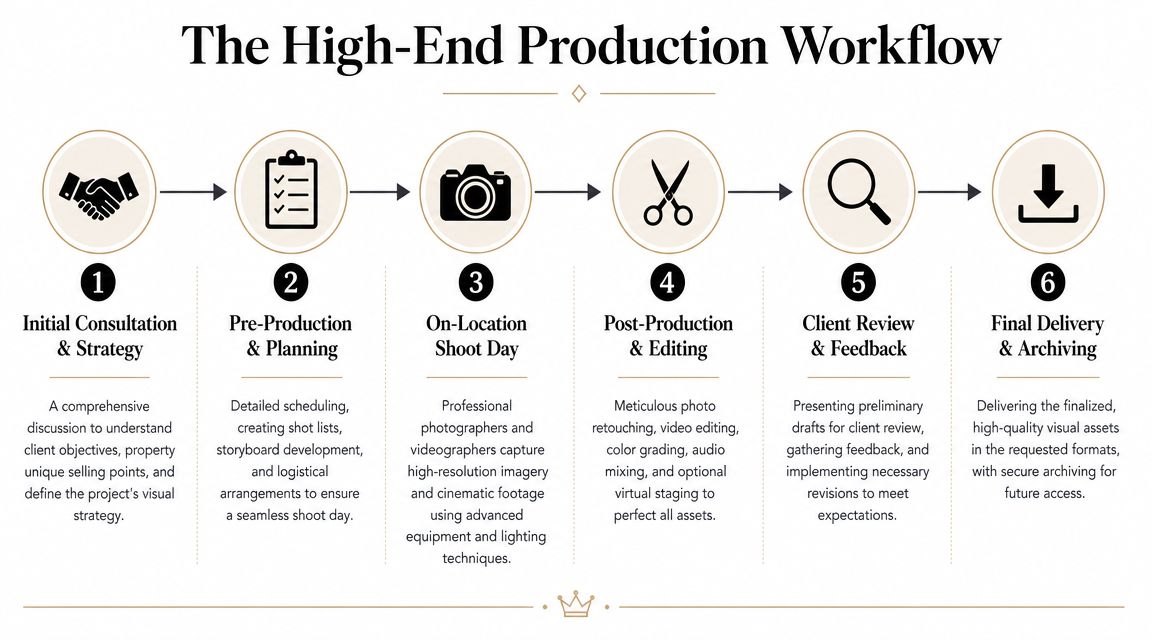
The High-End Production Workflow
The finished images may look effortless, but the process shouldn't be casual. High-end work depends on planning decisions made well before the camera comes out. The better the pre-production, the more deliberate the result.
Pre-production sets the value
Most problems on shoot day are planning problems. If the team hasn't agreed on the audience, deliverables, and usage, the coverage becomes reactive.
A strong pre-production phase usually includes:
Goal definition
Decide whether the priority is leasing, portfolio development, editorial outreach, investor communication, or a mix.Shot planning
Identify hero spaces, key design moments, exterior angles, and any must-have details such as signage, amenities, branded interiors, or site features.Schedule control
Match the order of shooting to the light. Exterior work, lobby coverage, and interiors with strong daylight exposure rarely perform best on the same timeline unless planned carefully.
Production requires discipline on site
On-site work is where visual strategy meets reality. Tenants may still be moving in. Landscaping may be unfinished in one corner. Glare may appear where everyone thought it wouldn't. A clean workflow makes those issues manageable.
The core production tasks often include:
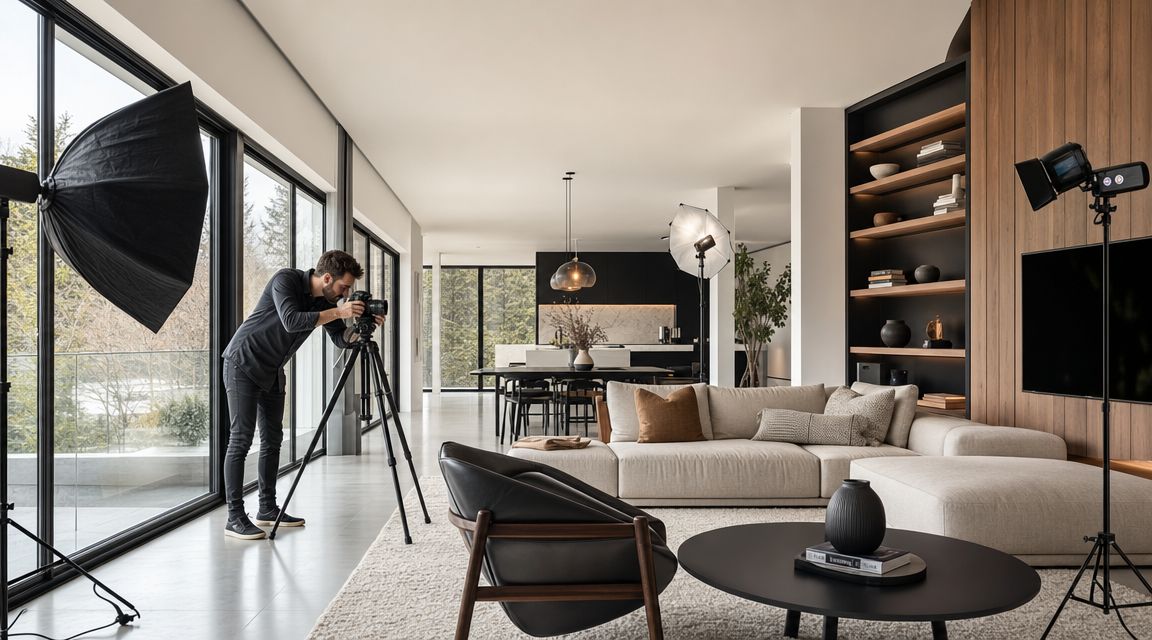
- Lighting decisions that preserve realism while controlling contrast
- Styling adjustments to remove distractions and improve balance
- Drone coordination when context and site planning matter
- Motion planning so walkthroughs feel stable and intentional rather than rushed
A shoot day runs smoothly when everyone knows what the final assets need to say.
Post-production is where cohesion happens
Raw files rarely tell the full story. Post is where stills and motion start speaking the same visual language.
For still photography, that means perspective correction, exposure balancing, color refinement, retouching, and consistency across the set. For video, it means editing structure, pacing, color grade, music selection when appropriate, and cleaning transitions so the viewer moves naturally through the project.
A client review stage is also part of professional practice. Not because the first pass should be rough, but because stakeholders often catch factual details tied to operations, branding, or project phasing that need adjustment before final release.
When this workflow is respected, the finished package feels unified. It doesn't look like separate pieces captured by different priorities. It reads as one point of view.
Setting Technical and Creative Standards
A discerning client can usually tell within seconds whether the coverage was made by someone who understands buildings or someone who only knows how to expose a room. The difference is partly technical and partly editorial.
The technical baseline for video
For professional real estate videography, one common benchmark is 4K capture at 60 fps, a shutter speed around 1/120, and a bitrate of 100 Mbps or higher, which helps preserve fine architectural detail and smooth motion, according to Imagtor's guide to real estate videography settings.
Those specs matter because architecture punishes weak capture. Fine textures, repeating lines, shadows across walls, and gentle camera movement all reveal compression problems fast. If the bitrate is too low or motion isn't handled well, surfaces smear and edges break apart.
The still photography standard
On the still side, the expectations are different. A proper architectural set needs straight verticals, careful lens selection, balanced mixed lighting, and enough control to render surfaces accurately without flattening the space.
That often means using tools and methods associated more with editorial and commercial work than quick-turn listing coverage:
- Tilt-shift lenses when perspective control needs to happen optically
- Solid tripod work for precision composition and exposure consistency
- Supplemental lighting when ambient light produces muddy color or blocked shadows
- Measured retouching that cleans distractions without making the space look synthetic
Light is usually the deciding factor. Available light can be beautiful, but only when it supports the architecture. When it doesn't, the photographer has to shape the scene deliberately, making thoughtful planning around choosing the best light for a site shoot central, not optional.
When to break the rules
The old rule set for property imagery is familiar. Shoot wide. Keep the camera level. Show the whole room. Those are good defaults, not absolute laws.
For many projects, the strongest frame isn't the widest one. A tighter composition may explain material quality better. A vertical frame may work better for mobile-first distribution. A feature-focused shot may sell the identity of a boutique hotel or branded office interior more effectively than another corner-wide view.
One of the more useful gaps in current education is exactly this question: when should a photographer stop obeying the baseline formula and start framing for story, platform, or conversion? That decision separates competent coverage from memorable coverage.
The best composition isn't always the most comprehensive one. It's the one that communicates the point of the space fastest and most clearly.
That's especially true in real estate photography videography used across multiple channels. MLS-style coverage and brand storytelling don't always need the same frame.
Pricing Models and Preparing Your Property
A developer approves a shoot to document a flagship project, then asks for a price on "photos and video" as if those are fixed products. They are not. Cost follows scope, usage, access, and the amount of control the project needs on site and in post.
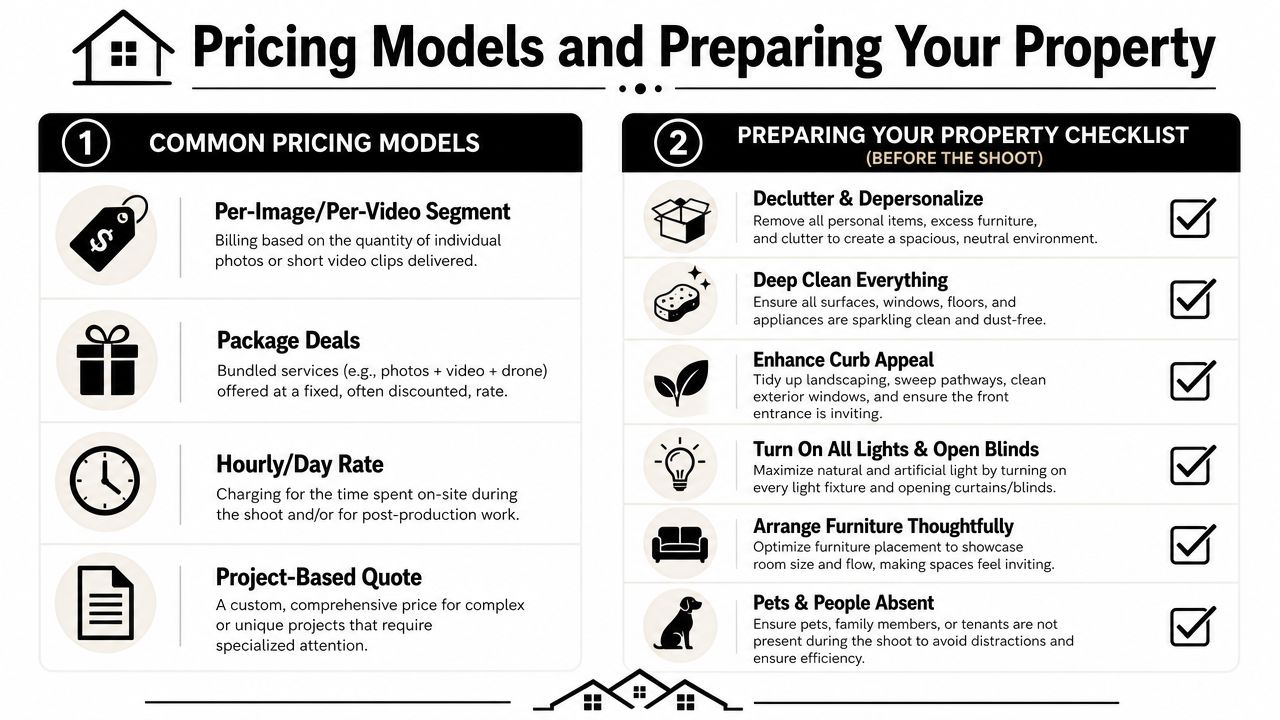
For architects, developers, and design firms, the better opening conversation is about purpose. Are the assets meant for a leasing launch, a practice portfolio, investor presentations, press outreach, an awards submission, or all of the above? A shoot built for one brochure and a shoot built to supply a year's worth of brand content should not be priced the same way.
Common pricing structures
Commercial and architectural assignments usually fit into a few workable models:
| Model | Best fit | Watch for |
|---|---|---|
| Per-image or per-segment | Tight deliverable lists | Scope creep once stakeholders ask for alternates, details, or extra edits |
| Package pricing | Defined photo and video bundles | Whether deliverables, edit length, and usage are spelled out clearly |
| Day rate | Large sites or projects with shifting priorities | How editing, assistants, styling, and travel are billed |
| Project quote | Multi-day productions with several decision-makers | Licensing, revision rounds, weather holds, and rescheduling terms |
Licensing deserves careful review. Architectural and commercial imagery often keeps working long after the first release. The same commission may feed a website, a sales deck, PR outreach, signage, social campaigns, and future case studies. If those uses matter, they should be addressed before the shoot, not negotiated after the files are delivered.
In practice, the cheapest proposal often becomes the most expensive one if it leaves out usage, retouching depth, or edit revisions.
Site preparation affects the result more than extra gear
A polished production starts before the crew arrives. Time spent clearing a lobby, replacing failed lamps, or removing temporary labels protects the schedule and improves the final edit more than adding another light or another camera body.
Use this checklist before the shoot:
- Declutter with intent so reception desks, counters, conference tables, and amenity spaces read clearly in stills and motion.
- Finish visible maintenance such as dead bulbs, paint touch-ups, crooked signage, loose cables, and fingerprint-heavy glass.
- Prepare exterior sightlines by sweeping entries, moving bins, trimming distractions, and controlling parked vehicles where possible.
- Coordinate building access so tenants, staff, cleaners, and contractors are not interrupting key setups.
- Choose a styling direction early because restrained, hospitality-driven, active, and editorial styling each send a different message about the project.
For a more detailed planning reference, use this guide on how to prepare a site for a photoshoot.
Preparation matters even more on integrated assignments because video notices what still photography can sometimes avoid. A loose power cord might be cloned out of one frame. It becomes a recurring problem in a moving shot. The same goes for flickering fixtures, inconsistent monitor brightness, elevator activity, and reflections that shift as the camera moves through space.
Details carry brand value. If a millwork edge is unfinished, the metal trim is smeared, or wayfinding still has temporary tape marks, those flaws pull attention away from the design and toward the oversight. For firms using these assets to win future commissions, that is not a small issue. It changes how carefully the project itself feels considered.
Examples from Commercial and Design Projects
A commercial developer marketing a new office building and an architecture firm documenting a completed residence may both hire photo and video coverage, but they aren't buying the same thing.
The office project needs to attract tenant interest and support brokers. The visual strategy usually starts with aerial coverage to establish site position, access, and surrounding amenities. From there, the focus shifts to arrival sequence, lobby volume, shared spaces, and flexible office interiors. Video is especially useful here because it can connect the street, entrance, circulation core, and amenity areas in one controlled sequence that a leasing team can use in presentations.
The architecture firm has a different goal. It needs authorship and design clarity. Wide exterior frames matter, but so do controlled interior compositions, twilight hero shots, and detail images that reveal custom elements the firm wants associated with its brand. In that context, motion works best when it feels restrained and observational. A slow walkthrough, carefully paced, can support an awards submission or a portfolio feature without turning the house into a generic real estate reel.
Two different goals, two different edits
The difference usually shows up in the final edit choices:
Commercial leasing package
Cleaner pacing, stronger context shots, emphasis on accessibility, amenities, and tenant-facing features.Design portfolio package
More attention to materials, detail, framing discipline, and the internal logic of the architecture.
The camera should follow the business objective. If the objective changes, the shot list should change with it.
This is the primary advantage of integrated real estate photography videography for discerning clients. You don't end up with generic media that almost fits several purposes. You get a visual system designed specifically for the actual job the assets need to do.
If you need architectural stills, cinematic property video, or a coordinated visual package for a commercial, design, or development project, Jimmy Clemmons Photographer provides Atlanta-based production for built environments, brand storytelling, and polished marketing assets suited to how the work will be used.