
A lot of people arrive at the same moment of confusion. They've paid for a commercial shoot, the files have been delivered, the campaign is moving, and then someone on the team asks, “We own these now, right?”
That question matters more than most clients realize. It affects where the images can run, how long they can stay in circulation, whether a designer can hand them to an ad agency, and whether a property developer can reuse them next year for a new leasing push. If you're licensing a photo for commercial use, the useful conversation isn't about vague ownership. It's about permission, scope, and risk.
In practice, strong licensing work protects both sides. The photographer knows exactly what's being granted. The client knows exactly what they've paid for. And if the image shows an interior, a branded environment, or anything that may trigger third-party rights, the license has to do more than sound professional. It has to hold up when the image gets used.
Understanding What Commercial Use Really Means
The most common misunderstanding in commercial photography is simple. A client pays for the shoot and assumes that payment includes unlimited rights forever.
It usually doesn't.
Commercial photo licensing is built on copyright, and in most major markets copyright attaches automatically when the photo is created. Because of that, paying for the shoot does not by itself transfer the right to use the image however the client wants. The photographer grants a license that defines the scope of use, which is the structure behind modern commercial photography markets globally, as outlined in VSCO's photo licensing guide.

Service fee versus license fee
A commercial assignment usually has two business components.
- Service fee covers the photographer's time, creative direction, production, lighting, assistants, retouching, and delivery.
- License fee covers permission to use the finished images in defined ways.
That distinction is where many disputes start. A client may be completely current on invoices and still not have the rights they assume they purchased. A photographer may deliver polished files and still retain broad control over future use.
A real estate analogy helps. Hiring the photographer is like hiring the architect. Licensing is the lease that tells you how you can occupy the finished space.
Practical rule: If the contract doesn't say the client can use the images for a specific commercial purpose, don't assume that right exists.
What counts as commercial use
Commercial use means the image is helping sell, promote, market, brand, or support a business activity. That can include a company website, social ads, printed collateral, signage, pitch decks, email campaigns, hospitality brochures, paid media, and outdoor advertising.
For architecture and interiors clients, this often gets blurry because one image may serve several functions at once. A firm might want the same photo on its website, in an award submission, in a developer presentation, and in a paid campaign. Those are not all the same use case, and they shouldn't be treated as if they are. If you work in built-environment imagery, a detailed primer on architectural image rights and licensing helps frame those distinctions clearly.
The Four Pillars of a Commercial Photo License
When I review a license, I want four points nailed down before anyone starts talking about price. If those points stay fuzzy, the agreement stays risky.
Industry guidance for commercial licensing uses a practical method. Define the exact asset set, then lock down license type, usage channels, geography, and term before pricing. Leaving any of those out creates ambiguity, which often turns into unintended reuse or fee disputes later, as explained in Casey Templeton's licensing guidance.
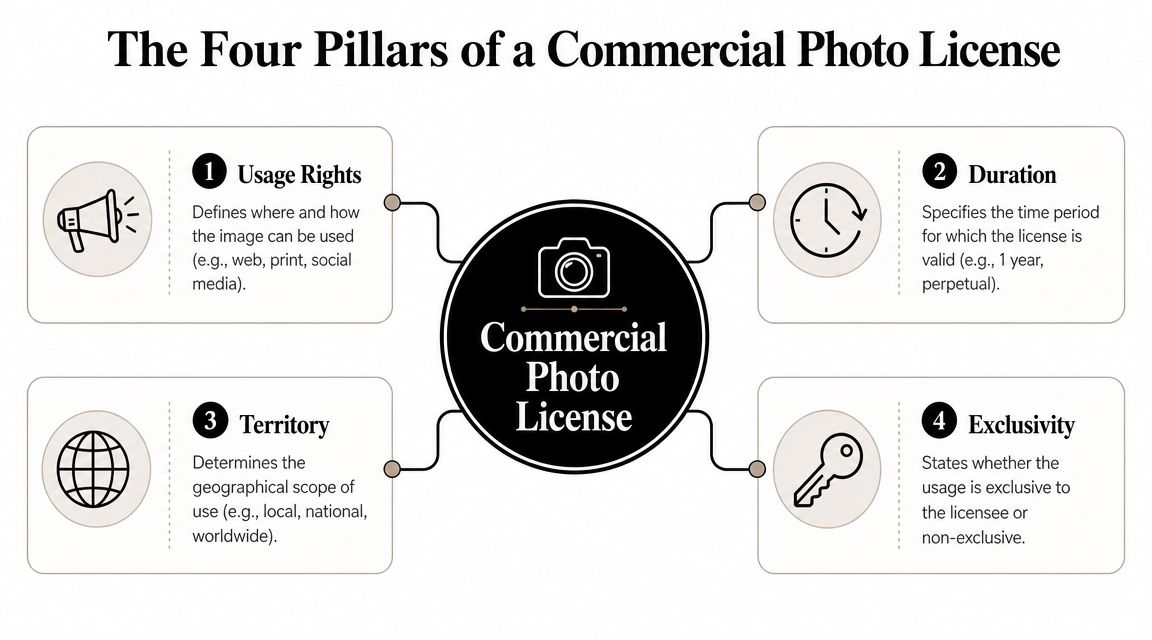
Usage rights
Start with the exact channels. Not “marketing use.” That's too broad to be useful.
A precise license spells out where the image may appear. For example:
| Use case | Clear wording |
|---|---|
| Company website | Homepage, project pages, and blog |
| Social media | Organic social posts on brand-owned channels |
| Brochures, lookbooks, sell sheets | |
| Advertising | Paid social, display ads, print ads, OOH |
| Brand newsletters and campaign email |
An architectural photograph of a hotel lobby has very different value if it appears only in a firm's portfolio than if it becomes the hero image in a paid hospitality campaign. Same file. Different commercial exposure.
Duration
Time changes value. A short campaign window is not the same as open-ended reuse.
Some clients only need a license tied to a launch, leasing cycle, or seasonal push. Others want a longer runway because the image supports the brand over time. The mistake is treating all future use as inevitable. It isn't. A smart license matches the image's shelf life.
If the client isn't sure, I usually recommend choosing a term that encompasses the immediate business plan and includes a path to renew later. That keeps the initial agreement efficient without giving away rights the client may never need.
The cleanest licensing conversations happen when the client describes the campaign calendar first, not the budget first.
Territory
Geography matters even when the image is digital.
A regional architecture firm promoting a project in Atlanta doesn't need the same rights as a hospitality group rolling out assets across multiple markets. Territory should answer where the license applies. Local, national, international, or worldwide. For digital use, that may require careful drafting because web exposure can travel far beyond the intended market.
A narrower territory can keep the license aligned with actual business use. A broader territory can save renegotiation later, but only if the client expects to use it.
Exclusivity
Exclusivity is where many people either overspend or underprotect themselves.
If a client needs to ensure the photographer won't license the same image to another party, especially a competitor, exclusivity has value. But not every project needs it. An editorial-style image of a skyline may work fine on a non-exclusive basis. A signature interior image created for a brand campaign is a different story.
Here's the practical test:
- Choose non-exclusive when broad uniqueness isn't central to the business use.
- Choose exclusive when competitive separation matters.
- Define limits carefully if exclusivity applies only to a specific industry, market, or period.
The strongest licenses don't use legal theater. They use plain, specific language that matches how the image will be used.
Clearing Essential Legal and Property Rights
A commercial photo license solves one problem. It gives permission to use the photograph itself.
It does not automatically clear everything visible inside that photograph.
That distinction matters a great deal in architecture, interiors, hospitality, retail, and branded spaces. A photo may include artwork, custom furniture, visible logos, packaging, signage, or people who are recognizable. In those cases, the image can carry a stack of separate rights issues beyond the photographer's copyright. That's why Serge's explanation of licensing and underlying rights is so useful. It notes that a photo license grants rights in the photograph, but not automatically in separately protected works depicted within it.
The release stack in real projects
Take a clean interior photograph of a luxury residential lobby. The photographer owns the photo. But the scene may also include:
- A painting or mural that may be separately protected
- Designer furniture that may raise copyright or design-rights questions in some contexts
- Visible brand marks on appliances, fixtures, or products
- A recognizable person in the frame
- Private property access that may require location permission
That's the release stack. One image. Several possible permissions.
For clients, the mistake is assuming the photographer's invoice clears the whole chain. It doesn't. For photographers, the mistake is staying silent when the scene obviously includes third-party material that could matter commercially.
When to ask for more than a license
You don't need to panic every time a chair or logo appears in frame. You do need a review process.
Use this decision screen before broad commercial use:
- Is anyone recognizable? If yes, confirm whether a model release is needed for the intended use.
- Was the image shot on private property? If yes, check location and property permissions.
- Does the scene include artwork or other clearly authored elements? If yes, assess whether separate permission is needed.
- Are trademarks prominent? If yes, review whether the commercial context suggests endorsement or affiliation.
- Will the image run in advertising rather than editorial-style context? If yes, clearance standards should be stricter.
A clean rights workflow starts before the shutter clicks. It's much harder to solve clearance issues after the image is already central to a campaign.
Architecture and interiors need extra diligence
Architectural photography differs from many simpler commercial assignments. In a portrait against a plain background, the rights questions are often straightforward. In a layered interior, nearly everything in frame may have been selected, designed, or owned by someone else.
That doesn't mean the image can't be licensed. It means the parties should treat licensing and clearance as related but separate tasks. The photographer grants the image rights. The client, producer, agency, or legal team may still need to clear what appears inside the image before major commercial rollout.
A good rule for developers, designers, and hospitality groups is to review hero images the same way they review ad copy. If the image will do serious commercial work, it deserves a rights check, not just an aesthetic check.
How to Price and Negotiate Photo Licensing
Licensing isn't priced by guesswork. It's priced by business value.
That's the correct model, and it's the only one that stays logical when the same image might appear in a local website update or a broad advertising campaign. Usage changes value. Reach changes value. Time changes value. A cost-plus mindset misses that completely because the photographer's effort to make the image may be identical in both cases.
Here's a visual summary of the factors that usually shape the conversation.
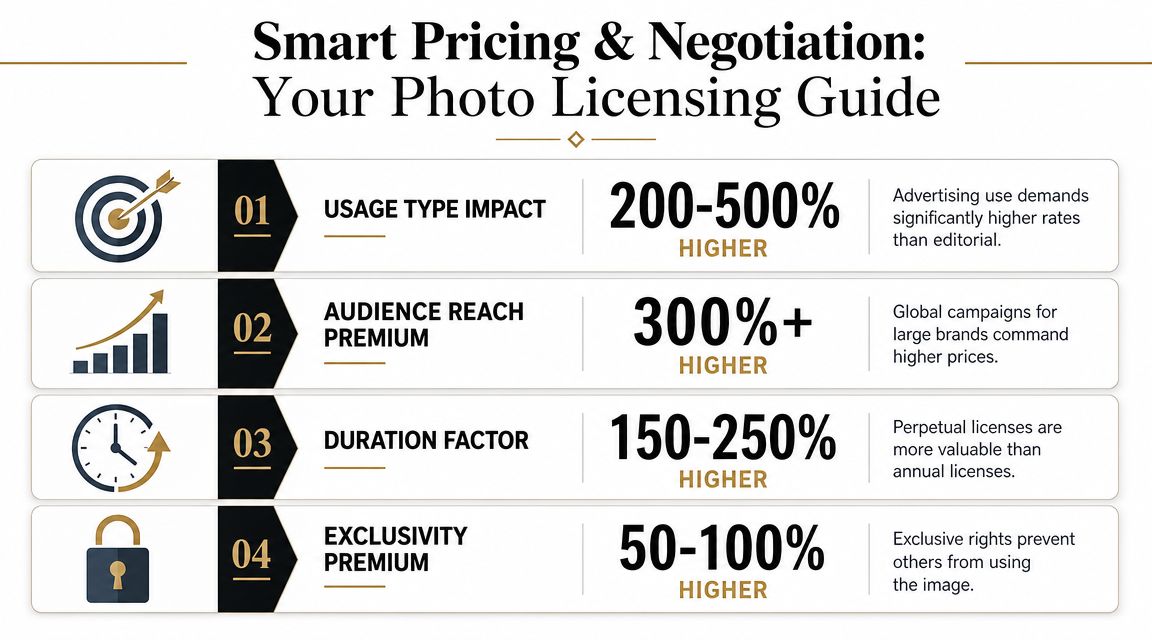
A widely used benchmark in commercial licensing has long been the Getty rights-managed calculator. Industry educators cited by The Image Crafters' usage fee resource note that small brands may pay about 5% to 7% of a Getty-style recommendation, while larger brands may pay roughly 10% to 25% depending on scale and usage. The same guidance emphasizes that pricing is tied to measurable factors like audience reach, media placement, and time period.
Why value-based pricing works
A local digital ad and an international print campaign don't create the same commercial value for the client. That's why licensing fees for limited digital or editorial use often sit in the lower range, while broader advertising rights can move into much higher territory, as reflected in Whiskfully So's commercial licensing guide.
That doesn't mean every client should buy the biggest package. Quite the opposite. Strong negotiation usually comes from narrowing the license until it fits the actual use.
For photographers, that means pricing the rights requested.
For clients, that means not asking for perpetual worldwide exclusivity out of habit.
A negotiation format that usually works
Tiered options tend to produce better conversations than one all-or-nothing number. A simple structure might look like this:
- Base license for web and organic social use
- Expanded license adding print and email
- Campaign license adding paid media, broader geography, or longer term
That approach gives the client room to choose without forcing the photographer to collapse the value of every possible use into one flat fee.
A practical reference point can help if you need context on how commercial photography fees are commonly structured. Jimmy Clemmons Photographer's pricing page is one example of how service and usage considerations can be separated or combined depending on assignment scope.
Here's a useful video overview before you start comparing estimates:
Scripts that keep the conversation productive
For photographers:
“I can price this accurately once we confirm where the images will appear, how long you need them, and whether the use is exclusive.”
For clients:
“We only need these selects for our website, organic social, and one printed capabilities piece. We don't need paid media or perpetual use right now.”
Those two positions usually lead to a fairer result than vague language like “full rights” or “all usage.” Those phrases sound decisive, but they often create confusion or unnecessary cost.
What doesn't work
A few habits derail licensing discussions fast:
- Bundling every possible use into one undefined fee creates confusion later.
- Asking for unlimited rights by default often inflates the quote without improving the campaign.
- Ignoring the actual asset set leads teams to pay for images they won't use.
- Leaving renewals unspoken turns future reuse into a dispute instead of a routine extension.
Good licensing negotiations are specific, calm, and documented. The best ones feel less like haggling and more like accurate scoping.
Building a Bulletproof Licensing Agreement
A strong licensing agreement doesn't need to sound dramatic. It needs to be clear.
Most problems in commercial photo licensing come from ambiguity, not from lack of effort. Someone says “digital use,” but means paid social and website headers. Someone says “exclusive,” but only intends that within one industry. Someone says “one year,” but forgets to define when that year begins. The contract should remove those gaps before anyone relies on the images in public.
The clauses that matter most
A workable agreement should identify the parties, the images being licensed, the rights being granted, the limits on use, the time period, and the fee.
A simple structure looks like this:
| Clause | What it needs to do |
|---|---|
| Parties | Identify licensor and licensee clearly |
| Asset description | Specify the exact image set or selects |
| Grant of rights | State the permitted uses |
| Restrictions | State what the client may not do |
| Term and territory | Define when and where use is allowed |
| Exclusivity | Confirm exclusive or non-exclusive status |
| Fee and payment | Tie rights to payment terms |
| Credits or attribution | Include only if relevant |
| Release responsibilities | Clarify who secures third-party permissions |
Sample language in plain English
You don't need dense legal phrasing to make a contract functional. You need precise phrasing.
Try language in this style:
Grant of rights
The photographer grants the client a non-exclusive license to use the selected images for the client's website, organic social media, email marketing, and printed collateral.Term
The license begins on first public use and continues for one year.Territory
Use is limited to the United States.Restrictions
The client may not sublicense, resell, or transfer the images to third parties without written permission.Exclusivity
If exclusivity applies, define the boundary. Industry, geography, and duration all matter.
That's the point. The agreement should answer operational questions before they become legal questions.
Restrictions are not hostility
Clients sometimes read restrictions as mistrust. They're not. They're workflow tools.
If an agency, developer, architect, or PR partner will need access, say so. If retouching is allowed but compositing is not, say so. If the brand may crop for layout but not alter the work in a way that changes the design intent, say so.
One of the most common breakdowns happens when a client assumes its outside vendors can reuse the files freely. A license can permit that, but only if the agreement says it does.
Add language for approvals and expectations
This is the part many teams skip. They define the rights, but not the practical standards around use.
Consider adding short clauses covering:
- File delivery with formats and resolution
- Approval chain for final selects
- Retouching boundaries so no one over-edits finished work
- Portfolio use if the photographer wants to display the work
- Credit requirements when relevant
Managing expectations early reduces friction later, especially when several stakeholders are involved. A helpful companion read is managing client visual expectations, because many licensing disputes begin as expectation disputes.
The best contract language sounds almost boring. That's a good sign. It means the terms are understandable enough to follow in real life.
Keep ambiguity out of the timeline
Dates deserve extra care. A term should state when it starts. On shoot date, on delivery date, or on first use. Those are not the same thing.
Renewal language also matters. If the client may want to extend, build in a simple renewal path rather than forcing a rushed renegotiation later. When both sides know how extensions work, the relationship stays professional even if the campaign expands.
A bulletproof agreement does one thing very well. It makes the intended use of the image hard to misunderstand.
Final Checklist and Future-Proofing Your License
Before anyone signs, pause and test the agreement against actual use. Not the ideal use. The actual one.
Licensing a photo for commercial use goes more smoothly when both sides run a short pre-flight review. That review should confirm the image set, permitted channels, term, territory, exclusivity status, payment terms, and any release obligations tied to what appears in frame.
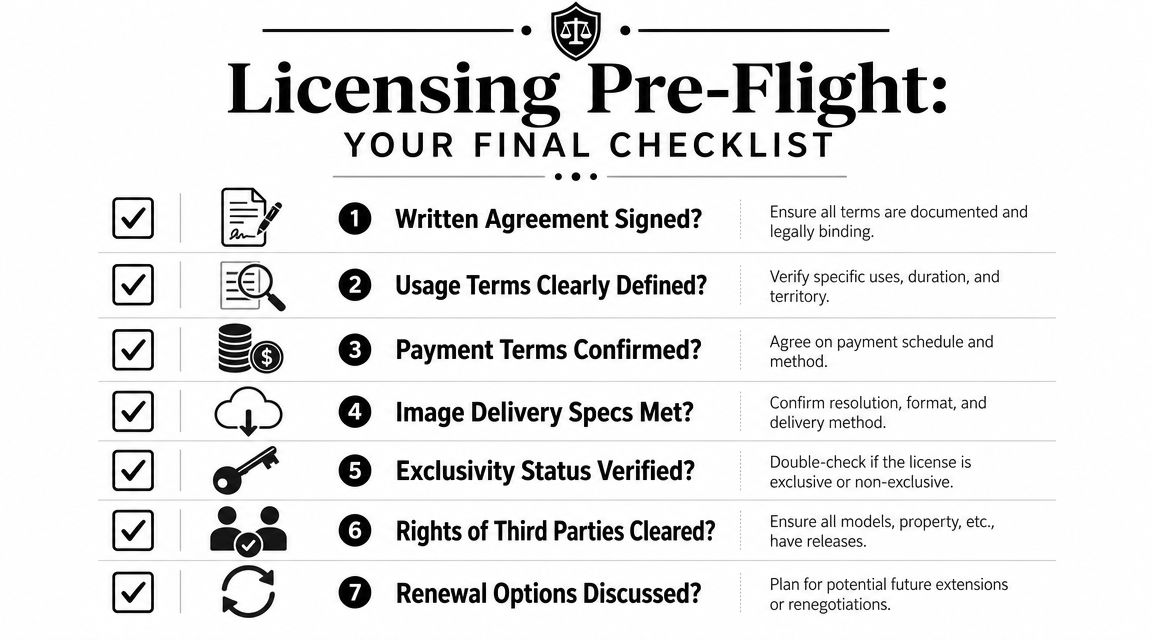
A practical sign-off checklist
- Written agreement signed before delivery or launch
- Exact image set identified so no one assumes the whole shoot is included
- Usage channels named clearly instead of using broad catchalls
- Term start date confirmed so the clock is not ambiguous
- Territory defined for both print and digital use
- Third-party rights reviewed for people, property, artwork, and marks
- Renewal path discussed in case the campaign outlives the initial term
Add AI language now, not later
A modern license should also answer a question that older forms often ignore. Can the image be used for AI training, scraping, model-building, or dataset ingestion?
That issue isn't theoretical anymore. In a 2024 WIPO survey, 83% of IP professionals said AI had increased the number of licensing questions they handle, and 70% said clients now ask specifically whether content can be used to train AI systems, as cited in Lindsay Kaye's discussion of commercial photography licensing and AI terms.
If the agreement is silent, both sides may assume something different.
A short clause can solve that. It can either prohibit machine-learning use outright or permit it under defined conditions. What matters is that the parties decide intentionally. For photographers, this protects a valuable emerging right. For clients, it prevents accidental overreach by internal teams, vendors, or platforms.
The strongest license now does two jobs at once. It handles today's campaign and closes tomorrow's loopholes.
If you need help structuring image usage for architecture, interiors, brand campaigns, or commercial property marketing, Jimmy Clemmons Photographer works with clients on both the visual side of the assignment and the practical licensing details that keep those images usable after delivery.