

You've likely been here before. The project is finished, the interiors are clean, the light is finally right, and you need photography that reflects the quality of the work. Then the quote arrives, and it doesn't read like a simple service menu. There's a creative fee, maybe post-production, maybe licensing, maybe travel, maybe a line for production support.
That's usually the moment when clients start looking for a simple answer to “price list photographer.” They want one neat number. In practice, high-end architectural and brand photography rarely works that way, because the value isn't tied only to time with a camera. It's tied to planning, execution, editing, and the ways the images will be used after delivery.
A strong photography quote should feel less like a mystery and more like a blueprint. If you understand what each part pays for, it becomes much easier to budget well, compare proposals fairly, and decide what level of production fits your goals. That's also why the business case matters. If you want a broader view of how commissioned imagery performs after the shoot, this look at the ROI of professional photography is a useful companion.
Why Photography Pricing Is More Than Just a Number
A developer finishes a property renovation and needs images for leasing materials, investor decks, press outreach, and the website. An architect wants portfolio work that can stand beside years of carefully built projects. A brand team needs a library of images that must look polished across web, print, and campaign use. All three are hiring a photographer, but they're not buying the same thing.
That's why a price list photographer format can look confusing at first glance. One project may need only efficient coverage and a modest delivery set. Another may require pre-production calls, a detailed shot plan, lighting control, permit coordination, retouching, and licensing structured for broad commercial use.
A low quote can be expensive if it leaves out the work needed to make the images usable.
The fee reflects decisions long before the shutter fires. For architectural work, those decisions often include scheduling around sun position, styling a space so it reads well in frame, balancing interior and exterior exposure, and protecting vertical lines so the building feels true to the design. For commercial brand work, the process may also involve coordinating talent, products, messaging, and layout needs.
Clients usually don't regret paying for clarity. They regret hiring from a vague estimate that turns into add-ons, rushed coverage, or images that don't support the intended use.
What you're actually investing in
A well-built quote usually captures three layers of value:
- Craft: The photographer's ability to compose, light, and solve visual problems on location.
- Process: The planning, scheduling, file handling, editing, and delivery that make the shoot run cleanly.
- Asset value: The long-term usefulness of the images across marketing, editorial, sales, and portfolio needs.
That's why pricing varies so much. You're not only paying for photographs. You're paying for the quality of the visual asset and the reliability of the process that produces it.
Understanding the Three Core Pricing Models
If you've ever commissioned custom furniture, the pricing logic will feel familiar. You can pay for each finished piece, pay for the craftsperson's time, or pay for the whole project as a defined scope. Photography works much the same way.
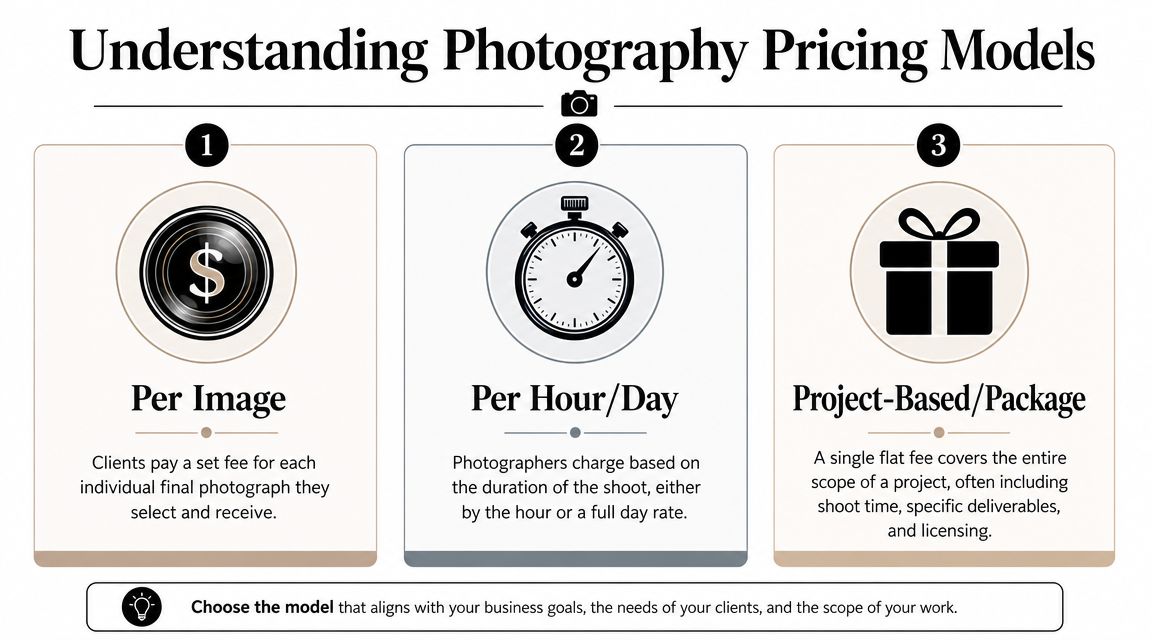
Published U.S. benchmarks show how varied these structures can be. Professional hourly rates are commonly listed at $100 to $300 per hour, with top-tier photographers at $200 to $500+ per hour and $400 to $1,000+ per image. The same market guide notes overall photographer pricing can run from $25 to $500 per hour, with day rates of $300 to $3,000, while product photography may be $35 to $170 per image and website photography $35 to $150 per image according to Studio Pod's photography industry statistics.
Per image
This model charges for each final selected photograph. It works well when the deliverable is tightly defined and the client knows exactly how many finished images they need.
For some product work, straightforward e-commerce, or a tightly controlled small assignment, per-image pricing can be efficient. It keeps the estimate easy to read and gives the client direct control over quantity.
The downside is that it can create the wrong incentive on more nuanced shoots. Architectural work often requires experimentation, waiting for the right light, and creating alternate compositions. When every frame is treated as a separate purchase, clients sometimes under-order, and the final library ends up too thin for the actual marketing need.
Per hour or day
This model charges for shoot time, often labeled as a creative fee or day rate. It's common when the schedule is the clearest unit of scope.
For portrait sessions, event coverage, or a defined on-site production window, it's a practical structure. If you're comparing simpler service categories, this overview of professional portrait photography cost shows how time-based pricing can make sense in a narrower assignment.
For architecture and brand work, time-based pricing is useful when production complexity matters more than image count. A half-day on site with difficult lighting, access constraints, and styling needs may involve more expertise than a longer but simpler assignment.
Project-based pricing
This is often the cleanest option for commercial clients. One flat project fee covers the agreed scope, usually including production planning, shoot time, a delivery range, and defined licensing.
Practical rule: If your team needs predictable budgeting and clear deliverables, project-based pricing usually creates the fewest surprises.
The weakness is that it only works if the scope is written carefully. If the shot list expands, if the usage changes, or if extra locations get added, the project fee has to be revised. Otherwise the quote stops reflecting the actual work.
Deconstructing the Creative Fee and Day Rate
A creative fee isn't a charge for “showing up with a camera.” It's the price of the photographer's judgment, preparation, and execution across the entire assignment.
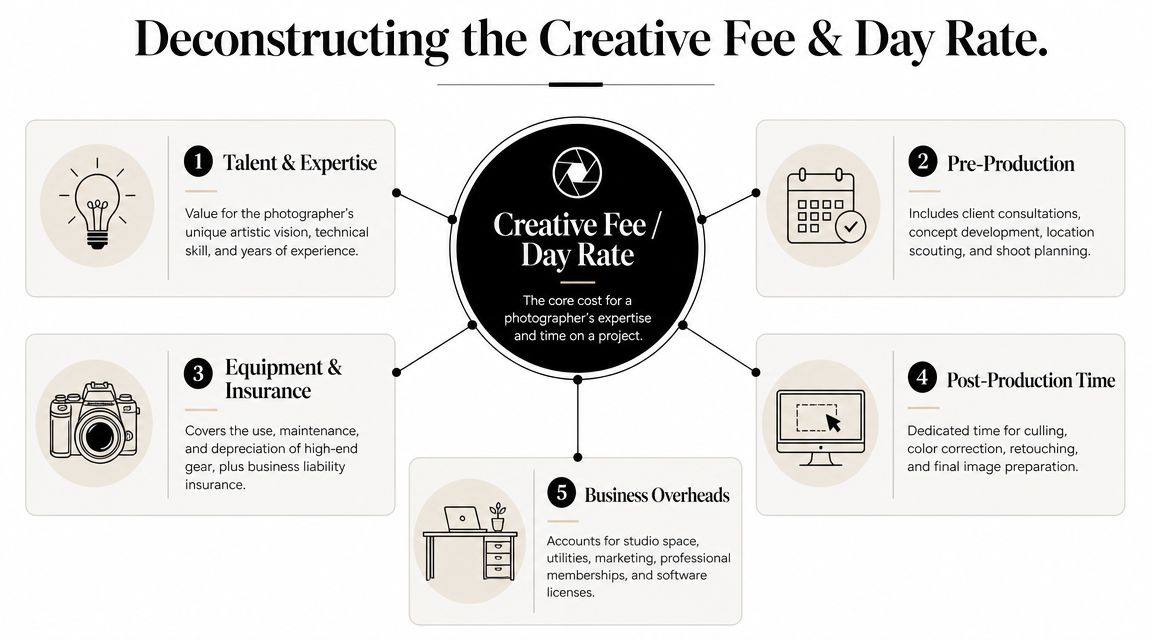
The most defensible way to build that fee is from Cost of Doing Business, not from whatever a competitor posted online. That includes equipment depreciation, software, studio overhead, insurance, marketing, travel, and living expenses. Market guidance also places commercial photography at $250 to $500 per hour, $1,200 to $2,000 for a half-day, and $2,500 to $4,000 for a full day, while real estate packages often run about $150 to $500 depending on deliverables, as outlined in Picdrop's photography pricing guide for professionals.
What the day rate is really buying
A serious architectural shoot starts well before call time. Someone has to review the brief, study the site, talk through priorities, assess the sun path, think about occupancy, and determine whether the space needs supplemental lighting or additional production support.
That work often includes:
- Pre-production planning: Calls, emails, scheduling, and refining the shot list.
- Location problem-solving: Deciding how to handle window light, mixed color temperatures, weather, or access restrictions.
- Visual direction: Determining what the images need to communicate about design intent, scale, materials, and use.
- Execution on site: Composing, lighting, managing reflections, and adapting as conditions change.
- Post-production oversight: Selecting frames and preparing files that are polished and consistent.
A quote that compresses all of that into “shooting time” usually hides more than it explains.
Why experienced photographers rarely discount this line
The creative fee is where skill lives. A veteran photographer works faster because they've already solved many of the problems that slow an inexperienced crew. They know when a room needs lights, when it needs less styling, when to wait ten minutes for better light, and when to move on.
Good production feels calm. That calm comes from preparation, not luck.
This is also where overhead matters. High-end cameras, tilt-shift lenses, backup bodies, calibrated monitors, liability coverage, storage, and editing software aren't abstract business costs. They are part of what makes the work consistent and dependable.
What it doesn't always include
A day rate may cover the photographer's time and core creative process, but it often does not include every project expense. Assistants, stylists, rentals, scouting beyond a standard level, travel, permits, and heavy retouching may appear as separate lines. That separation isn't padding. It's often the cleanest way to keep the proposal accurate.
Understanding Photography Licensing and Usage Fees
Licensing is where many commercial quotes start to look unfamiliar. Clients often assume that paying for the shoot means owning the images outright. In most commercial photography, that's not how it works.
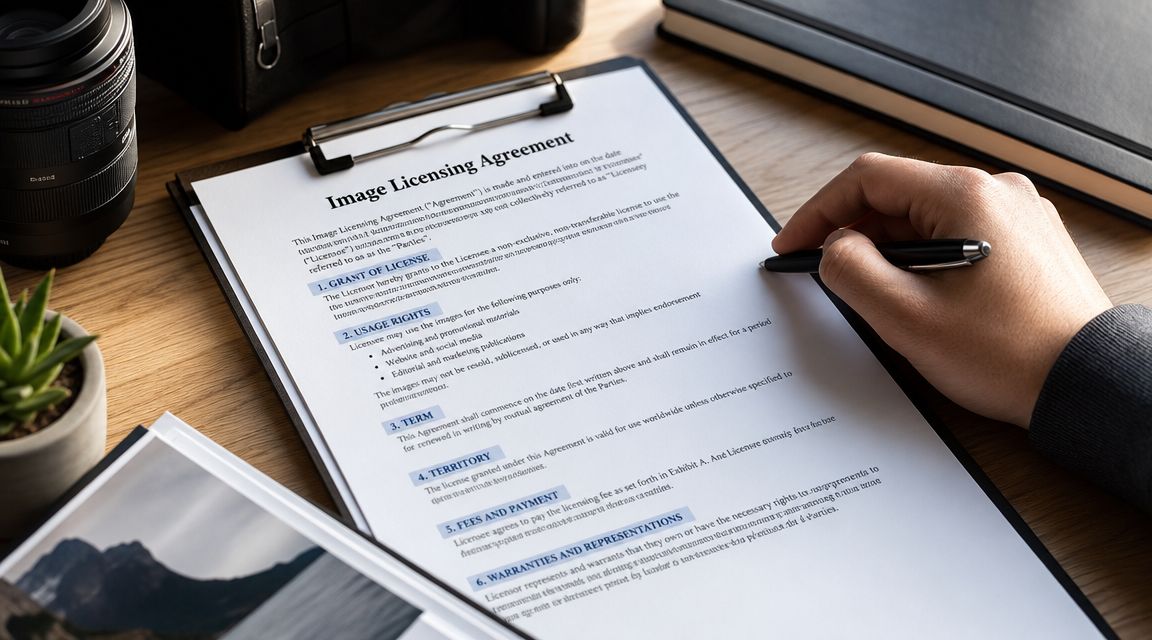
A better analogy is leasing a car for specific roads. You're not buying the manufacturer. You're securing the right to drive the vehicle under agreed terms. Photography licensing works the same way. The client receives permission to use the images in defined ways, for a defined period, in defined places.
Commercial benchmarks show why this matters. Day rates can range from roughly $800 to $5,000, with licensing fees adding $250 to $10,000 depending on usage scope, according to VSCO's photography pricing guide. If your work involves buildings, interiors, campaigns, or branded spaces, this explainer on architectural image rights and licensing helps clarify the practical side.
The key licensing terms clients should watch
When you read a quote, look for these terms:
- Duration means how long you can use the image. A short-term campaign and an ongoing evergreen website use aren't the same.
- Territory defines where the image appears. Local, regional, national, and international use can carry different value.
- Media channels refers to where the image runs, such as web, print, paid advertising, social, editorial submission, or internal collateral.
- Exclusivity determines whether the photographer can license similar imagery elsewhere, or whether your use is reserved.
A photograph used in a firm's internal newsletter carries a different business value than the same image used across digital ads, brochures, trade press, and out-of-home media.
Why licensing is separate from capture
Separating licensing from the creative fee protects both sides. The photographer gets paid in proportion to the image's commercial value. The client pays for the rights they need, rather than overbuying by default.
That distinction matters most in brand and campaign work. If a hotel image is used once on a project page, the value is one thing. If that same frame becomes the hero image in a broad paid campaign, the value changes.
The more the image does for the business, the more carefully its rights should be priced.
Here's a short visual explanation that helps many teams grasp the concept before a proposal review:
What a good license line should say
A usable quote doesn't bury licensing in vague language. It should tell you, in plain terms, what's included. For example, a clear line might specify marketing use by the commissioning firm, for agreed channels, in a named territory, for a set duration. If the project may later expand into advertising, publication, or partner use, that should be flagged early so the license can be structured correctly.
This is one place where generic consumer-style pricing pages often fail commercial clients. They show a session fee, but not what the buyer may legally do with the images afterward.
How to Read a Professional Photography Quote
The fastest way to compare quotes is to stop looking at the total first. Read the line items. A lower number can mean a thinner scope, weaker usage rights, fewer retouched images, or unlisted production costs that show up later.
A clean quote usually separates the work into distinct buckets. That's a good sign, not a red flag. Recent business analysis notes that photographers may carry $100 to $200 per month in software and subscription overhead, with additional hidden costs such as second shooters at $200 to $500 per day and venue or permit fees from $25 to $500. That's why nuanced estimates often separate creative fee, production expenses, travel, licensing, and post-production, as discussed in Fstoppers' breakdown of hidden professional photography costs.
A sample quote structure
Here's a simple template for the way an architectural photography proposal is often organized.
| Line Item | Description | Example Cost |
|---|---|---|
| Creative Fee | Photographer's time, planning, and on-site execution | Custom quote |
| Post-Production and Retouching | File culling, color correction, perspective control, retouching, export | Custom quote |
| Production Expenses | Assistants, stylists, rentals, permits, parking, location costs | Custom quote |
| Travel | Mileage, transit time, lodging if needed | Custom quote |
| Licensing Fee | Agreed image usage by channel, territory, and duration | Custom quote |
What each line is telling you
Creative Fee
This line covers the photographer's expertise and production time. It usually includes planning and the shoot itself. If this line is very low, ask what level of preparation and on-site problem-solving is included.
Post-Production and Retouching
Architectural images almost always need careful finishing. That may include color balancing mixed light sources, cleaning up distractions, correcting perspective, and making the final set feel cohesive. If retouching isn't called out, ask whether the quote includes only basic global edits or more detailed finishing.
Production Expenses
This category catches what many clients forget to budget. Assistants help move gear, manage lights, and keep the day efficient. Stylists can make a room photograph better without changing its design intent. Permits, access fees, and parking can also belong here.
If one quote bundles everything and another itemizes production, compare scope before comparing price.
Questions worth asking before you approve
A good client doesn't need to know every technical detail, but these questions will sharpen any proposal:
- What deliverables are included: How many final images, what resolution, and what level of finishing?
- What usage is covered: Internal use, website, social, paid media, editorial submission, or something broader?
- What triggers additional fees: Extra locations, extended shoot time, rushed delivery, weather delays, or expanded licensing?
- Who handles production: Does the photographer bring assistants or stylists, or is the client expected to coordinate that?
What works and what doesn't
What works is a quote that gives both sides room for accuracy. It names the scope, defines the output, and leaves little ambiguity about rights.
What doesn't work is a flat number with no detail. That kind of estimate is hard to compare, easy to misunderstand, and often unfair to either the client or the photographer once the job begins.
Smart Budgeting for Your Next Photography Project
A common budgeting mistake happens before the camera comes out. A team approves a shoot for a new property, hotel, or office, but no one has settled the brief. Then the project grows midstream. Marketing wants campaign assets, the design team wants detail studies, leadership wants portraits, and the original estimate no longer matches the assignment.
Good budgeting starts with decisions, not numbers.
Set the business use first. Industry pricing guidance often ties fees to how broadly the images will be used, so a gallery for your website is priced differently than a regional ad campaign or a national brand rollout. That decision affects the creative approach, the production support, and the license. If usage stays vague, the quote either comes in too low and needs revision later, or too high because the photographer has to protect against unknowns.
A few choices usually keep a project efficient without stripping out the quality that makes the images valuable:
- Approve the brief before production: Get marketing, leadership, design, and operations aligned on what the images need to do.
- Prioritize the shot list: Separate required images from nice-to-have requests. That protects time on set.
- Consolidate deliverables where it makes sense: If interiors, exteriors, detail shots, and a few environmental portraits can be produced in one schedule, you avoid repeated setup and travel costs.
- Share the budget early: An experienced photographer can tell you what fits, what should be phased, and where cutting too far will show in the final work.
One practical option for Atlanta-area commercial, portrait, and architectural assignments is Jimmy Clemmons Photographer, which offers location scouting, lighting design, on-set direction, and professional editing as part of its service mix.
Where clients usually overspend is on change, not on planning. Added locations, extra rooms, weather holds, twilight coverage, rush retouching, and expanded licensing all cost money because they add time, labor, or rights. None of that is unreasonable. It just needs to be anticipated.
The strongest budgets leave room for craftsmanship. In architectural and brand photography, the investment is not only the shoot day. It is the preparation that keeps the day efficient, the production decisions that shape the images, and the licensing structure that matches how the work will create value after delivery.
Common Questions About Photography Pricing
Do we own the photos after delivery
Usually, you own the delivered files as assets for the uses defined in the agreement, but you don't automatically receive full copyright. Commercial photography is commonly licensed rather than sold outright.
Why is travel sometimes billed separately
Travel affects time, scheduling, mileage, parking, lodging, and production logistics. On local assignments it may be minor. On more involved projects, separating it keeps the quote transparent.
Why isn't editing just included
Sometimes basic editing is included. Detailed retouching often isn't, because different projects require different finishing standards. A hospitality interior, a corporate portrait, and a construction progress image usually need different levels of post-production.
What happens if the scope changes during the project
A professional quote should allow for revisions or change orders. If the client adds locations, requests more final images, extends the schedule, or expands image usage, the estimate should be updated so both sides stay aligned.
Is the cheapest quote ever the best value
Sometimes a modest quote is perfectly appropriate for a modest need. But if the assignment involves architecture, brand standards, publication goals, or campaign usage, the cheapest number often leaves out planning, finishing, or rights that matter later.
The right quote is the one that matches the real job, not the one that looks simplest at first glance.
If you're planning architectural imagery, commercial brand photography, or professional portraits and want a quote that clearly separates creative fees, production costs, and usage, Jimmy Clemmons Photographer is available for consultations and project discussions.