
Your project is finished. The punch list is closed, the furniture is in place, the lighting finally does what the drawings promised, and everyone involved wants the same thing. Images that show what was achieved.
That’s the point where many teams discover the gap between having photos and having photographs that carry the weight of the work. A few quick frames can record a building’s existence. They rarely communicate proportion, sequence, material, restraint, or the way natural light moves through a space at the right hour. For architects, developers, designers, and contractors, that difference matters because the photographs often outlive the project itself. They become the portfolio, the press kit, the award submission, the leasing package, and the first impression for the next client.
Architecture photography services sit right at that intersection of craft and business value. The job isn’t to make a building look flashy. The job is to make the design legible, persuasive, and memorable.
Beyond the Snapshot Why Professional Architectural Imagery Matters
A completed project deserves more than proof that it exists. It needs a visual record that explains why the project matters, how it feels to occupy, and what decisions shaped it.
Documentation records facts
A phone photo can show a façade, a lobby, or a conference room. That’s useful for reference.
It usually fails at the harder parts. Vertical lines distort. Windows blow out. Interior finishes flatten. Scale gets muddy. Spaces that feel calm in person can look cramped or careless in a rushed image.
Editorial photography communicates intent
A professional architectural photograph does more than describe square footage. It organizes information.
The frame tells the viewer where to look first, how the eye should move, and which relationships matter most. That might be the alignment between structure and glazing, the tension between concrete and wood, or the way a stair anchors circulation through a lobby.
Practical rule: If a photograph could apply to almost any building, it isn’t doing enough for your brand.
The market for this work isn’t shrinking into irrelevance. The American Institute of Architects projects an 8.5% increase in architectural projects for 2025, with residential building projected to grow by 12% and senior living facilities by 37%, which signals expanding demand for photography that documents new work with precision and intent (AIA projections referenced here).
What clients are really buying
When clients hire architecture photography services, they’re usually buying several things at once:
- Portfolio credibility for future pursuits
- Publication-ready visuals for editors and marketing teams
- Consistency across project pages, proposals, and presentations
- A lasting archive of built work before the site changes
A generic snapshot treats every project the same way. Strong architectural imagery doesn’t.
It recognizes that a school, a hotel, a workplace, and a residence each ask for different visual language. Some projects need restraint. Some need atmosphere. Some need a clear narrative from site approach to key interior moments.
That’s why professional imagery should be considered part of the project’s communication strategy, not an afterthought at the end of construction.
The Anatomy of a Professional Architectural Photograph
Clients often ask what architecture photography services include. The short answer is that the camera is only one part of the job.
The larger job is decision-making. What gets emphasized, what gets minimized, when to shoot, where to stand, how to control perspective, and how far to refine an image without making it feel artificial.
Exterior work starts before the first frame
Exteriors are about timing as much as technique. A building can read one way at noon and another way near dusk.
Cloud cover can help a façade feel even and graphic. It can also flatten depth. Direct sun can reveal form beautifully, then ruin a glazing-heavy elevation if reflections take over.
A typical exterior plan accounts for:
- Orientation of the building so sunlight supports the architecture instead of fighting it
- Approach sequences because the first public view often matters more than the most obvious one
- Foreground control including parked cars, signage, and exterior elements maintenance
- Hero angles that establish the project without exaggerating it
A useful comparison is this. Scouting for architecture photography works like location blocking in film. You don’t just find a place to put the camera. You decide where the scene makes sense.
Interiors require balance, not tricks
Interior photography gets difficult fast because spaces usually contain mixed light. Window daylight, overhead fixtures, decorative lamps, and reflected surfaces rarely cooperate on their own.
The goal isn’t to blast the room with light until every corner is bright. That often kills mood and makes materials look synthetic. Good interior work balances exposure so the room still feels like itself.
What that usually involves
- Composition choices that clarify circulation and hierarchy
- Supplemental lighting when needed to support the architect’s intended atmosphere
- Styling adjustments to simplify distractions without redesigning the room
- Exposure blending and retouching that preserve realism
Straight verticals aren’t a technical fetish. They’re part of making architecture feel stable, believable, and properly proportioned.
Specialized gear matters here. Professional shoots often rely on tilt-shift lenses, which can shift up to 12mm to correct perspective distortion optically. Paired with high-dynamic-range cameras and geared tripod heads, that setup can reduce post-production correction time by as much as 70% (technical details from Imagen).
Retouching should finish the image, not rescue it
There’s a common misconception that everything can be fixed later. That usually produces weaker photographs and longer timelines.
If perspective is sloppy on site, correcting it aggressively in post can cost sharpness and natural proportions. If reflections aren’t managed during capture, retouching becomes expensive and less convincing.
A clean workflow looks more like this:
| Stage | What happens | Why it matters |
|---|---|---|
| Pre-shoot | Scout, schedule, align priorities | Prevents avoidable problems |
| Capture | Control perspective, exposure, framing | Builds a strong negative to work from |
| Edit | Refine color, contrast, distractions | Polishes without overprocessing |
| Delivery | Organize by usage and sequence | Makes images usable immediately |
The strongest architectural photographs feel effortless. They never are.
They come from careful choices about optics, height, timing, and restraint. That’s what separates a polished image from a wide shot of a room.
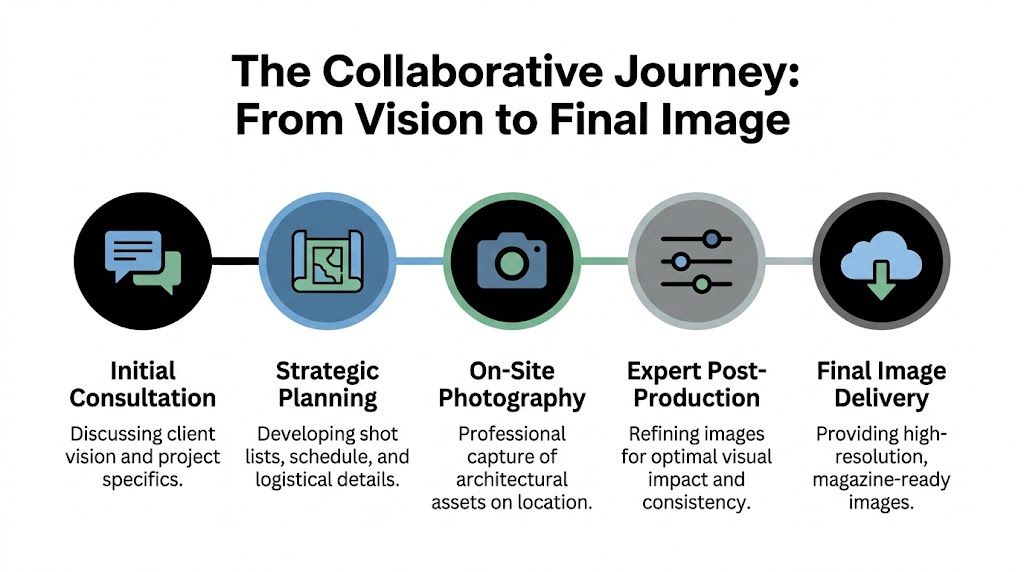
A Collaborative Process from Vision to Final Image
The best results usually come from a clear process, not improvisation. Architecture photography services work best when the photographer and client are solving the same problem from the start.
The first conversation shapes the shoot
A serious project usually starts with a discussion that has nothing to do with camera settings. The useful questions are broader.
What is this project meant to do for the client now? Is the priority awards, press, leasing, fundraising, recruitment, or a portfolio update? Which spaces matter most to the architect, and which matter most to the owner or marketing team?
Those answers affect everything that follows. A hospitality shoot may need atmosphere and guest experience. A contractor may need proof of workmanship. An architecture firm may need a clean visual argument about form, light, and sequence.
Planning removes avoidable friction
Once priorities are clear, the practical work begins. The practical work involves sorting out shot lists, access times, occupancy issues, staging needs, and weather windows.
For clients who want a cleaner shoot day, it helps to review a site prep guide in advance. This practical resource on how to prepare your project site for a professional photoshoot covers the kinds of details that save time on location.
A strong plan usually accounts for:
- Who approves images so feedback doesn’t bottleneck delivery
- Which spaces must be camera-ready before call time
- What can be moved and what must remain untouched
- When the building is least disruptive to photograph
The smoothest shoot isn’t the one with no surprises. It’s the one where everyone already knows how decisions will be made.
Shoot day stays structured but flexible
On site, the process becomes more observational. Sometimes the planned hero shot is correct. Sometimes the better image reveals itself after seeing how light lands in the room or how circulation feels in person.
That flexibility matters. Architecture doesn’t always disclose itself in the same order it appears on a plan set.
A shoot day often moves through a rhythm like this:
- Walk the space again to confirm conditions and adjust priorities.
- Build the major frames first while the light window is right.
- Refine details and secondary views once the anchor images are secured.
- Check continuity so the final set feels cohesive, not random.
Post-production is where coherence takes shape
Editing isn’t a separate creative act from the shoot. It’s the completion of it.
Color is normalized across rooms, small distractions disappear, and the final image set starts to feel intentional as a group. The point isn’t to over-polish. It’s to give the project a consistent visual language.
Clients notice that coherence right away. The delivered set feels considered, publication-ready, and easier to deploy across proposals, websites, press submissions, and social channels.
The Editorial Eye Jimmy Clemmons’ Design-Forward Approach
Not all architecture photography services aim for the same result. Some are built around straightforward documentation. Others are built around interpretation, sequencing, and visual authorship.
The editorial approach is more demanding, but it produces photographs with longer life and broader use.
What an editorial eye changes
Editorial training teaches a photographer to ask different questions. Not just, “What does the building look like?” but, “What is the story here, and how should it unfold?”
That discipline matters in architecture. A project isn’t experienced as one single hero shot. It’s encountered in pieces. Arrival. Threshold. Compression. Release. Detail. Material. Light.
A design-forward photographer builds a set that mirrors that experience.
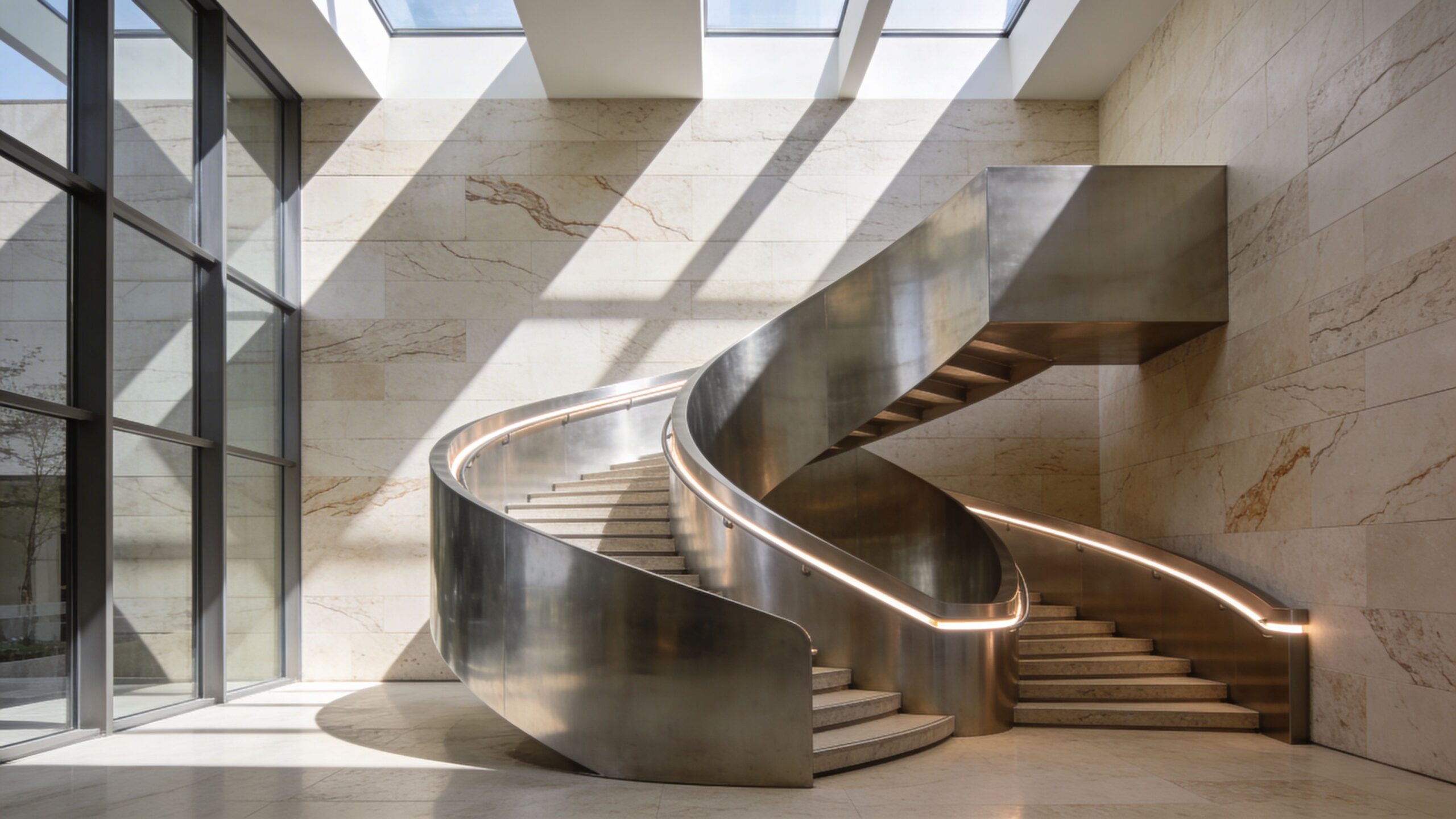
A generic documentary image might show a lobby from the widest possible corner. It proves the space exists. An editorial image might use the stair, the window rhythm, and a patch of directional light to explain the architect’s compositional logic. Same project. Different value.
Magazine discipline creates stronger architecture images
A background shaped by editorial assignments changes how a photographer sees. Publications such as Condé Nast and Atlanta magazine don’t reward visual clutter or lazy framing. They demand clarity and selection.
That carries over directly into architectural work:
- Frames are edited harder so every line earns its place
- Details matter more because they support the larger narrative
- Sets are sequenced intentionally instead of delivered as disconnected pretty shots
- Atmosphere is preserved rather than flattened for convenience
This is also where Jimmy Clemmons Photographer fits naturally in the market. The studio’s service mix includes location scouting, lighting design, on-set direction, and editing, with architectural photography as a primary focus. In practice, that means the work can be planned and produced with the needs of architects, developers, and editorial users in mind.
The difference between coverage and storytelling
Clients often need both breadth and depth, but not in equal measure. A useful image set usually includes a few categories working together:
| Image type | What it does |
|---|---|
| Establishing view | Places the project in context |
| Signature composition | Gives the project a memorable visual identity |
| Spatial interior | Explains use and circulation |
| Detail frame | Shows material intelligence and craft |
When these categories are handled with editorial discipline, the full set reads like a feature, not a contact sheet.
That matters for modern design narratives too. One of the most overlooked opportunities in architecture imagery is how sustainable features are photographed. A 2025 Architectural Record survey found that 68% of firms lacked sufficient imagery for their green project pitches, which points to a real storytelling gap for projects with sustainable design elements (survey reference).
A solar screen, a green roof, passive shading, reclaimed materials, or a daylighting strategy won’t communicate much if they’re treated as technical checkboxes. They need framing and context. They need to be integrated into the broader story of the project.
Here’s a short visual example of how an editorial sensibility carries into built environment work:
What doesn’t work
Some common habits weaken architectural imagery fast:
- Over-reliance on ultra-wide views that exaggerate scale and distort experience
- Heavy HDR treatment that makes materials look plastic
- Too many angles of the same space with no clear visual hierarchy
- Busy styling that competes with architecture instead of supporting it
Good editorial architecture photography doesn’t shout. It edits.
That’s the central difference. A design-forward approach isn’t about adding drama for its own sake. It’s about choosing what deserves emphasis, then photographing it with enough discipline that the image can hold attention on a website, in a magazine spread, or across a presentation deck months later.
Use Cases and Measuring the Return on Your Investment
The value of architecture photography services becomes easier to understand when you look at where the images get used. A strong image set isn’t a decorative extra. It supports business development, brand positioning, and project communication across several audiences.
For architects and designers
Architecture firms need photographs that can do multiple jobs without feeling generic. The same project may need to live on a website, in an award entry, in a proposal deck, and in a press package.
That means the images have to hold up under scrutiny. They need enough rigor for design peers and enough clarity for clients who don’t speak in plans and sections.
A practical way to think about it is this:
- Portfolio use calls for a concise, high-standard edit
- Awards and editorial submissions need narrative coherence
- Proposal use rewards images that explain problem-solving, not just beauty
For developers and property teams
Developers and commercial property managers often need images that support leasing, investor communication, and public-facing marketing. In those cases, the photographs have to sell more than finishes.
They need to show access, atmosphere, tenant appeal, and the way the project fits into a broader brand story. If the imagery is weak, the building may still be strong, but the marketing language gets harder to believe.
The available data on return is unusually direct here. A 2025 Dodge Data report covering 500 U.S. architecture firms found that projects marketed with high-end visuals correlated with a 25% higher win rate on competitive bids, effectively boosting project acquisition by 12-18% (report reference here).
That doesn’t mean every photograph creates the same result. It means image quality is tied to how persuasively a project enters the market.
For a broader discussion of how visuals function as a business asset, this piece on the ROI of professional photography is a useful reference point.
For contractors and builders
Contractors often get underserved by generic final photography. Their work shows up in the finished building, but not always in a way that demonstrates sequencing, execution, and craft.
The right photographs can highlight:
- Envelope quality and alignment
- Interior finish execution
- Complex assemblies that required precision
- Completed work that supports future bids
A simple way to evaluate return
You don’t need a complicated model to evaluate image value. Start with where the photographs will appear and who needs to trust them.
| Client type | Primary use | What the images need to prove |
|---|---|---|
| Architect | Portfolio, awards, press | Design intelligence |
| Developer | Leasing, marketing, investors | Market appeal and brand value |
| Contractor | Qualifications, proposals | Build quality and capability |
| Interior designer | Portfolio, editorial, client presentations | Material curation and atmosphere |
If the imagery helps your team win better work, present work with more authority, or get stronger editorial attention, the return isn’t abstract. It’s operational.
Understanding Pricing and Packaging for Your Project
Pricing in architecture photography services can feel opaque when proposals only show a total. It becomes easier to evaluate once you know what drives scope.
What shapes the quote
The biggest pricing factors usually have less to do with pressing the shutter and more to do with production demands.
Common variables include:
- Project scale such as a single interior, a full campus, or a mixed-use development
- Access complexity including occupied spaces, security rules, or limited shoot windows
- Image count and variation from a tight edit to a broader marketing library
- Post-production demands when reflections, composites, or cleanup become extensive
A small but carefully art-directed shoot may require more effort than a larger but simpler one. That’s why square footage alone rarely tells the full story.
Licensing is part of the value
One of the most misunderstood parts of commercial photography is licensing. Clients sometimes assume they’re only paying for the day of shooting.
They’re also paying for permission to use the resulting images in specific ways. That matters because photographs are reusable business assets.
A verified example from the field makes the point clearly. One top architectural photographer earned $235,500 in 2023, with 16% of that income coming from third-party licensing (income breakdown reference). That doesn’t suggest every project needs a complex licensing structure. It shows that the images carry ongoing value beyond the initial assignment.
If a photograph will help market the project long after shoot day, licensing isn’t a technicality. It’s part of the asset value.
How to compare proposals intelligently
If you’re reviewing multiple bids, compare them on scope before comparing totals.
Ask questions like these:
- What deliverables are included and at what level of finish?
- What usage rights are covered for web, print, editorial, or third-party partners?
- How much planning is included before the shoot?
- What kind of retouching is standard and what counts as additional work?
Clients looking for a service overview can review commercial architectural photographer to see how a studio may frame scope around commercial use cases.
The right package isn’t always the biggest one. It’s the one that matches the project’s communication goals, usage needs, and timeline without forcing you to repurchase the same value later in a different form.
Your Questions Answered
Most clients reach the same set of practical questions right before booking. The answers shape the schedule as much as the photographs.
How far in advance should we book
Earlier is better, especially if your project depends on weather, seasonal landscaping, occupant access, or a narrow marketing deadline.
Architecture photography is timing-sensitive. Good light, site readiness, and stakeholder availability need to align. If the project has a hard launch date, don’t wait until the building is technically complete to start the conversation.
How should we prepare the space
Cleanliness helps, but preparation is really about visual control.
That usually means removing temporary signage, cords, bins, paper notices, and anything that reads as accidental rather than designed. It also means confirming that landscaping, furniture placement, and lighting are ready before the crew arrives.
A useful prep checklist often includes:
- Confirm all fixtures are working
- Remove temporary construction remnants
- Decide what stays in frame
- Assign one point person on site
Who owns the copyright, and what does licensing mean
In commercial architectural work, the photographer typically retains copyright and grants the client a license for agreed uses. That license defines how the images can be used and by whom.
This isn’t unusual. It’s the standard mechanism that lets images function as professional assets while giving clients the rights they need for marketing, editorial outreach, and internal use.
What is turnaround like
Turnaround depends on project scope, the level of retouching, and how many stakeholders need to review the work.
The more important question is whether the delivery schedule fits the project’s actual use. If you need images for a press release, proposal, or launch campaign, mention that early. A good production process can prioritize accordingly, but only if those needs are known from the start.
The best time to solve schedule problems is before the shoot is scheduled, not after the building is photographed.
If you’re evaluating architecture photography services for a finished project, a new development, or a portfolio refresh, start with the intended use of the images. That single decision usually clarifies everything else, from timing and scope to shot selection and licensing.
If you need architecture photography services that approach a project with editorial discipline, design literacy, and a clear production process, contact Jimmy Clemmons Photographer to discuss your project, intended usage, and schedule.