
A buyer is on the couch with a phone in one hand and a listing tab in the other, trying to decide whether a Saturday drive is worth it. The photos look good, but they don't answer the question, how does the place feel to move through? That's where 360 real estate photography earns attention, because it lets people evaluate layout, flow, and spatial logic before they ever book a showing.
What 360 Real Estate Photography Actually Is
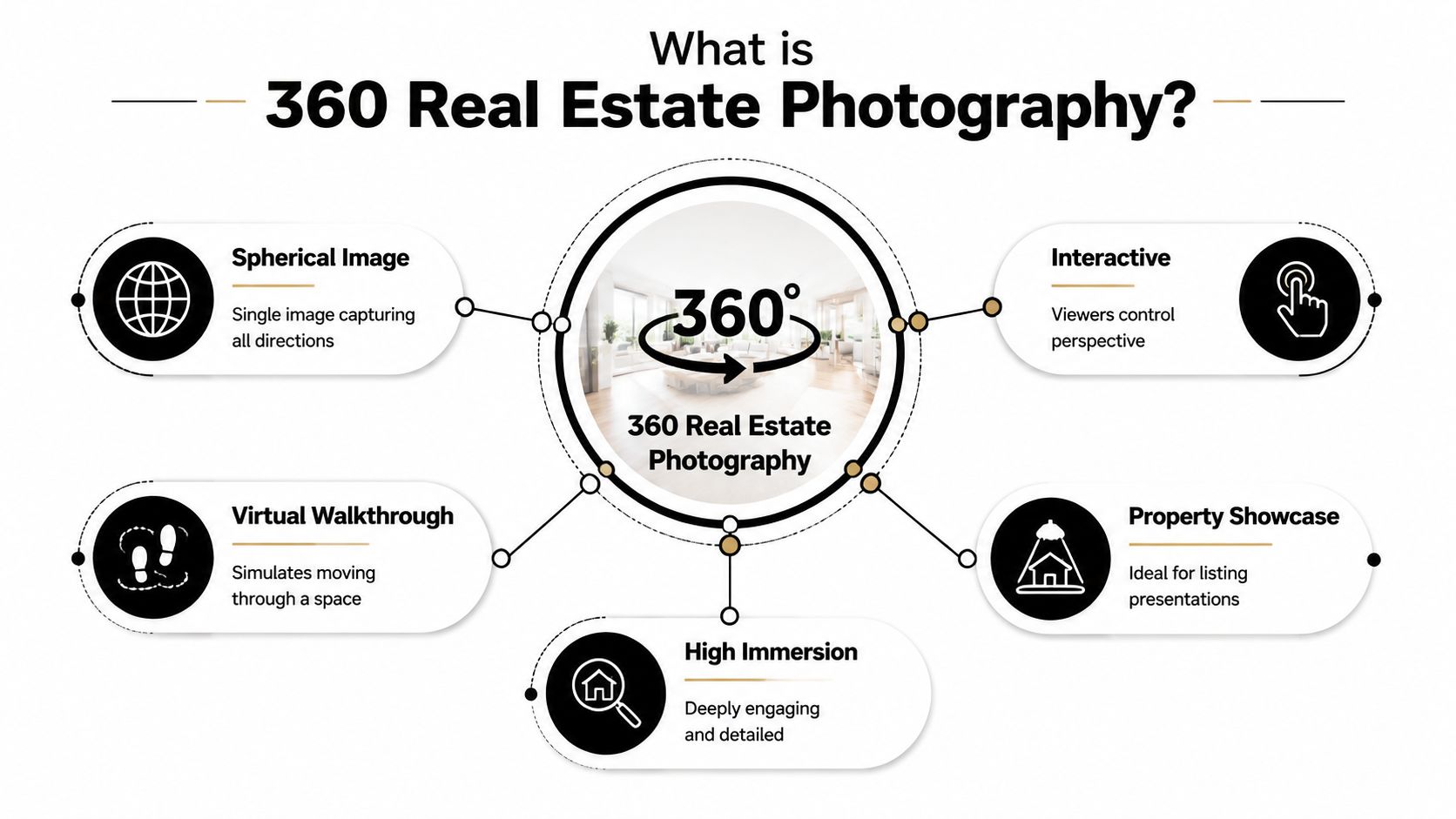
A 360 real estate photograph is a spherical image that lets the viewer look in every direction from a single camera position. In practice, it's usually delivered inside an interactive platform, so the viewer can pan, zoom, and jump to the next room instead of staring at one fixed frame. That makes it different from a normal listing photo, which only shows one carefully chosen angle.
Single panorama versus multi-node tour
A single panorama is one viewpoint. A multi-node virtual tour strings several panoramas together so the viewer can move from room to room and understand the property as a sequence, not a set of isolated scenes. That difference matters, because a lone sphere can show a space, but it doesn't yet guide someone through it.
Practical rule: if the layout is part of the sale, a connected tour usually does more work than a standalone panorama.
This format sits between other common deliverables. A drone 360 is about exterior context and site scale. Video walkthroughs add motion and pacing, but the viewer can't control the viewpoint the way they can in a 360 tour. 3D scanned dollhouse views go further into measured spatial reconstruction, which can be useful, but they're not the same thing as a photographic tour built from real camera captures.
Where each format fits
Use 360 when the property's value is tied to circulation, room-to-room continuity, or the ability to inspect a space remotely. Use video when the emotional pitch matters more than navigation. Use editorial stills when the job is to make architecture, materials, and composition feel carefully curated.
A good 360 tour shouldn't replace every other asset. It should answer the questions still photos can't answer fast enough.
In other words, 360 real estate photography is not just “wide photos.” It's a navigable experience, built to let buyers self-select with more confidence. That's why it shows up most often in listings where distance, complexity, or premium expectations raise the cost of a bad showing.
Why 360 Photography Changes Listing Performance
A strong 360 tour changes the first few minutes of buyer behavior. Instead of skimming a gallery and guessing at scale, people can test whether a home, unit, office, or suite fits what they need. That is a practical shift, not just a visual one, because it changes who keeps exploring and who drops out early.
Independent roundups of industry research report that more than half of U.S. adults who use the internet have taken a virtual tour, 54% of buyers will not look at a property unless it has virtual images, and that virtual tours can keep visitors on a website 5 to 10 times longer than standard browsing (industry roundup). Another industry summary reports that 360-degree photography increases listing views by 25% (industry summary).
What those numbers mean on a listing
Those figures point to a simple pattern. Buyers who are casually browsing tend to leave faster. Buyers who are serious enough to engage with a tour stay longer, inspect more carefully, and arrive at a showing with fewer surprises. That usually means fewer wasted appointments and better-qualified conversations.
For brokers and developers, the value is not “more clicks” in the abstract. It is that immersive content supports remote evaluation, which matters when a buyer is comparing several properties at once. It also helps a listing explain itself before an agent has to do it one call at a time.
Where the ROI logic gets practical
The performance case gets stronger when the property is hard to visit, expensive to staff, or visually similar to competing inventory. In those situations, 360 works as an attention filter. It lets the right people move forward sooner and makes the wrong people self-eliminate before they consume sales time.
For a closer look at the business case, see the ROI of professional photography. The same logic applies here, except 360 adds spatial proof to the usual still-image story.
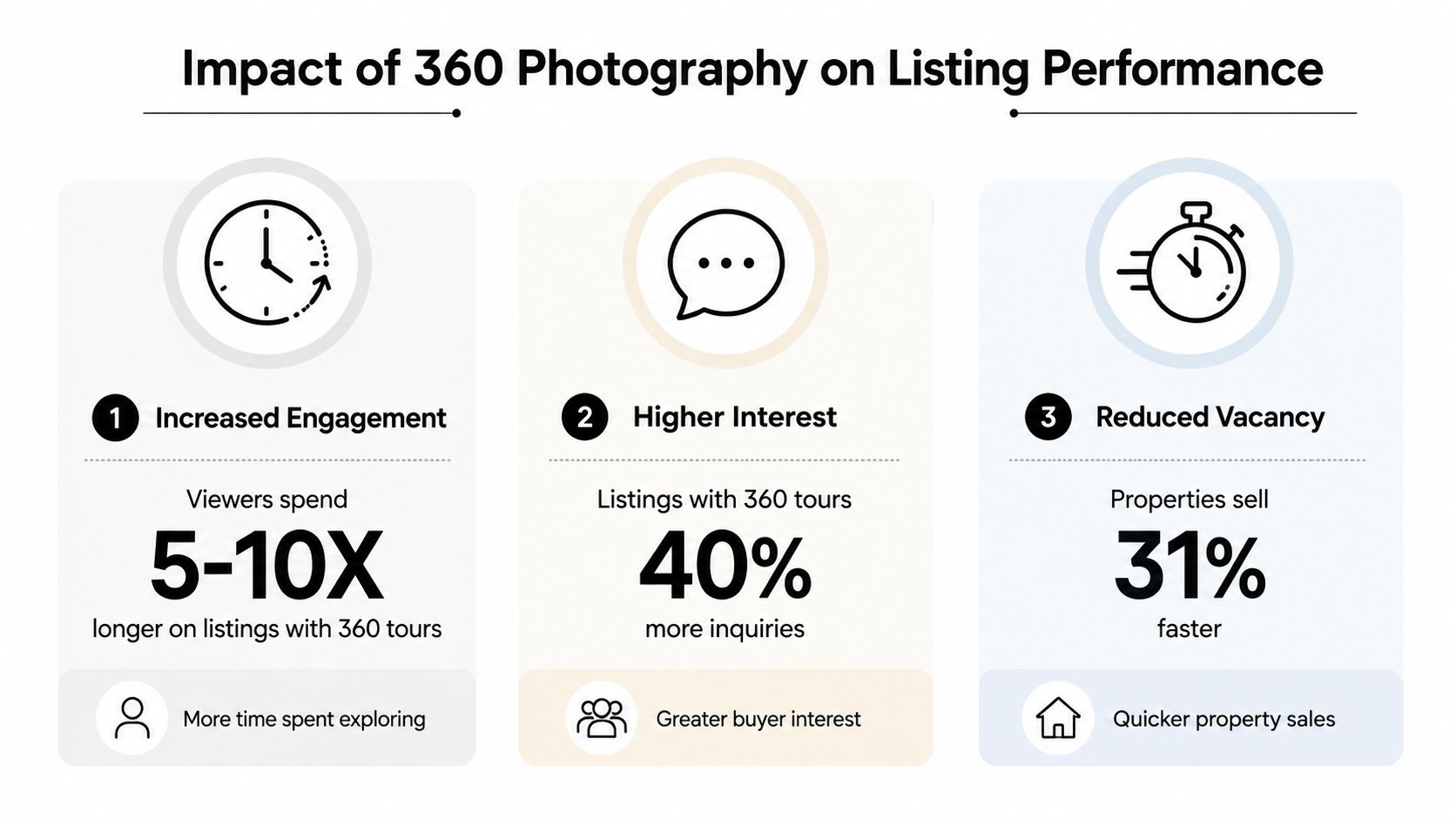
The point is straightforward. 360 real estate photography is useful because it changes behavior earlier in the funnel. It gives buyers more confidence, gives sellers better visibility into serious interest, and gives marketing teams a way to justify content that does more than decorate a listing.
How a 360 Shoot Is Produced
A professional 360 shoot starts before the camera comes out. The room has to be cleaned for a spherical view, which means clutter, cords, mirrors, and reflective distractions matter more than they do in a tightly framed still image. The camera sees almost everything, so the setup has to be cleaner than most clients expect.
Professional 360 real estate photography benefits materially from a camera with at least a 1-inch sensor and HDR-capable capture, because interiors usually combine bright windows with deep shadow areas (shooting guide). That combination is exactly where blown highlights and crushed shadows show up if the capture isn't handled carefully.
Capture choices that protect the tour
The camera is typically placed about 5 feet, or 1.5 m, high in the room center, then triggered remotely so the photographer stays out of frame and the stitching area stays clean. That height usually lands close to normal eye level, which makes the room feel believable rather than oddly low or high. It also helps keep doorways, countertops, and ceiling lines more stable through the stitch.
A clean workflow usually looks like this:
- Prep the room first. Open blinds, light the space evenly, and remove anything the camera would catch from every direction.
- Keep the camera centered. Off-center placement makes movement feel awkward once the viewer starts panning.
- Trigger from outside the frame. Remote capture prevents the photographer from appearing in the sphere.
- Check stitching before leaving. Straight lines, especially cabinets and frames, reveal problems fast.
Post-production is not an afterthought
Once the images are captured, stitching software merges the frames, then the file is cleaned for color, exposure, and visible artifacts. Nadir patching matters here, because the bottom of the sphere often reveals the tripod or support point. That patch is one of the easiest signs of whether the tour was built carefully or rushed.
Premium tours increasingly include floor-plan overlays, room labels, hotspots, and platform-specific delivery. That moves the deliverable from raw panorama toward guided narrative, which helps a buyer understand what they're clicking into rather than forcing them to guess.
A sloppy tour usually looks fine at thumbnail size and falls apart the moment someone zooms in.
For a working checklist that mirrors a real production day, use this photo shoot checklist. It is the difference between a camera being pointed at a room and a tour being built for a buyer.
Quality Markers That Separate a Premium Tour From an Average One
Resolution is the first thing people talk about, and it's not the only thing that matters. For premium virtual tours, current market benchmarks put the practical floor at 5.7K to 8K capture, while some modern systems deliver 72MP stills or even 120MP panoramic photos (market benchmarks). At that level, viewers can pan and zoom without obvious pixelation, which matters on larger screens, in VR headsets, and in commercial presentations where detail carries trust.
What to inspect in a sample tour
A buyer can spot quality problems without being technical. Look for clean stitching, balanced exposure, and consistent color from node to node. If one room feels warm and the next feels cold, the tour will feel improvised even if the resolution is high.
The most obvious failure points are easy to spot once you know where to look:
- Visible tripod or shadow artifacts. A clean nadir patch should hide the support area.
- Parallax seams. Door frames, railings, and counters reveal stitching mistakes fast.
- Blown windows. HDR handling should protect view detail when a room has strong exterior light.
- Ghosting on reflective surfaces. Mirrors and glass can show duplicated edges if capture or stitching is weak.
- Distorted furniture near the base. Objects too close to the lens can warp badly if the camera is placed carelessly.
Mobile performance still matters
A tour can look impressive on a desktop and still feel clumsy on a phone. That's a real problem because many buyers first encounter listings on mobile. Hotspots should load quickly, navigation should be obvious, and the tour shouldn't force people to hunt for the next room.
Consistent white balance is another quiet marker of competence. If the photographer corrected each node differently, the property feels less cohesive. Premium work looks intentional across the whole sequence, not just in one hero room.
The simplest test is this. If a viewer can pan, zoom, and move through the property without noticing the mechanics, the tour is doing its job. If they notice seams, color jumps, or awkward object distortion, the production quality is too low for premium marketing.
Typical Deliverables and Pricing You Should Expect
A serious 360 quote should tell you exactly what the buyer is getting. If it only mentions “virtual tour,” the scope is probably too vague to compare against other proposals. Ask for the number of panoramas, hosting terms, branding, and any extras that are being layered in.
What a standard package usually includes
A basic deliverable set often covers the hosted tour link, a branded intro screen, room-to-room navigation, and a handful of supporting stills. More complete packages add floor-plan overlays, room labels, hotspots, and MLS-compatible stills for the listing feed. Hosting duration also matters, because a tour that disappears after a short period creates a hidden cost later.
What pushes cost higher
A quote rises when the property is harder to shoot or the final product needs more polish. Square footage, remote locations, twilight capture, HDR-heavy interiors, drone 360, custom hotspot design, and fast turnaround all add labor. Luxury residential, commercial, and hospitality work usually demands more attention because the viewer expectation is higher and the architecture is often more complex.
| Tier | Property Type | Typical Deliverables | Best For |
|---|---|---|---|
| Entry-level tour | Smaller residential listings | A few linked panoramas, basic hosting, simple navigation | Listings that need layout clarity without a large production scope |
| Mid-tier marketing package | Standard residential and multifamily | More nodes, branded tour, floor-plan overlay, room labels, supporting stills | Agents and property managers who want a stronger listing presentation |
| Premium residential | Luxury homes and design-forward properties | Higher-resolution capture, custom hotspots, refined styling, polished hosting | Listings where presentation quality needs to match price point |
| Commercial or hospitality | Offices, retail, hotels, amenity spaces | Guided tour flow, annotated spaces, platform-specific delivery, tailored branding | Remote buyers, tenant marketing, and pre-visit evaluation |
Compare quotes on deliverables, not just on camera time. The cheapest proposal is often the one that leaves out hosting, editing, or the tour structure that makes the asset useful.
If you're evaluating multiple vendors, ask how long hosting is included, whether edits are bundled, and whether the tour will be branded or generic. Those details often decide whether the work is usable beyond the first month.
When 360 Wins, and When Stills or Video Are the Better Call
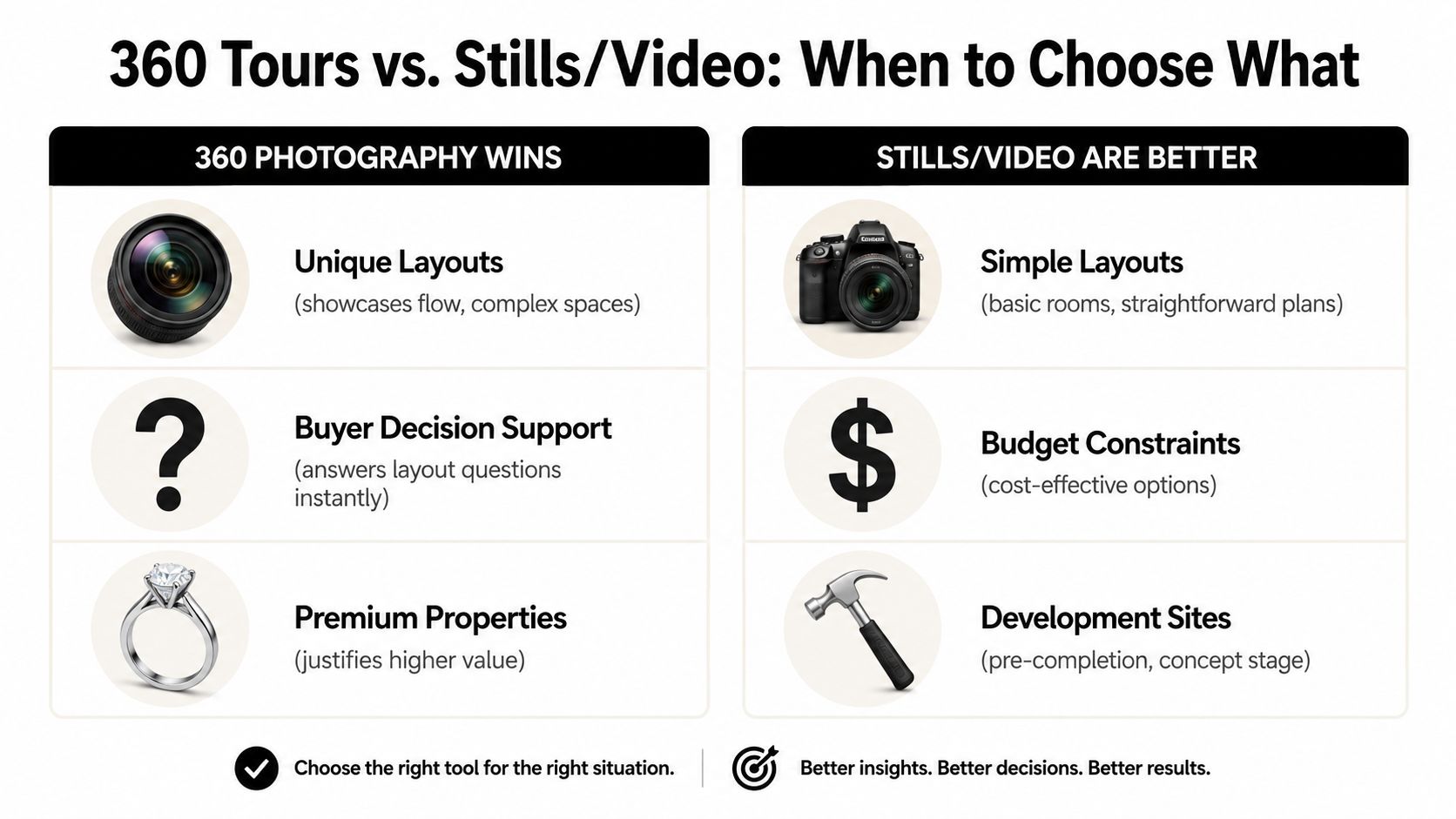
360 is strongest when the layout itself is part of the value. If a buyer needs to understand circulation, room relationships, or how an amenity space connects to the rest of the property, a virtual tour solves that faster than a gallery of stills. It's also a natural fit for remote sites, multifamily units, hospitality spaces, and commercial properties that aren't easy to visit on demand.
Where 360 clearly wins
- Unique layouts. Buyers can trace flow and room adjacency without mental guesswork.
- Decision support. A tour answers layout questions immediately, which reduces friction.
- Premium properties. Immersive presentation helps justify a higher-value listing.
Where stills or video are better
- Simple layouts. Straightforward homes and units often need only excellent editorial stills.
- Budget constraints. If the campaign can't support a full immersive package, stills are the efficient choice.
- Development sites. Pre-completion work often needs renderings, stills, or video rather than tour capture.
Video is the best option when the brief is emotion, movement, and pacing. It's especially useful for hospitality and lifestyle-driven brands, because it can sell atmosphere in a way that navigable panoramas can't. For a direct comparison with motion-driven content, see real estate photography video.
The practical decision rule
If the buyer's main question is “What does it feel like to move through this space?”, 360 usually wins. If the question is “How does the place look as a hero image?”, editorial stills win. If the question is “What vibe does the property project?”, video usually does the best job.
That's why the smartest marketing packages don't treat 360 as a universal replacement. They use it where spatial understanding drives action, then lean on stills and video where composition or emotion does more of the selling.
How to Hire the Right 360 Photographer for Premium Properties
A strong portfolio should look composed, not just technically correct. If every sample feels like a bare stitched sphere, the photographer may understand the software but not the architecture. You want someone who knows how to frame a room, preserve balance, and make the immersive sequence feel deliberate.
Ask what camera, stitching software, and hosting platform they use. A serious photographer should be able to explain why they chose the gear and how they handle HDR, nadir cleanup, and platform delivery. If they can't speak clearly about exposure in mixed-light interiors, they're probably leaning too hard on automation.
Questions worth asking before you book
- How do you handle bright windows and dark corners? You're listening for HDR awareness, not a sales script.
- Do you include floor plans or hotspots? That tells you whether they understand guided tours or just raw panoramas.
- What's included in editing and hosting? A low quote can become expensive once those items are added later.
- How do you avoid stitched seams and tripod artifacts? The answer should be specific, not vague.
Red flags that matter
A portfolio full of visible stitching problems is the most obvious warning sign. No mention of HDR is another one, especially for interiors with strong daylight contrast. Hosting only on the photographer's personal page can also limit how you use the tour later, particularly if the deliverable needs to support a broader marketing campaign.
Hire for editorial judgment, not just capture gear. Premium property work depends on composition as much as it depends on software.
For high-end architectural and commercial work, Jimmy Clemmons Photographer is the kind of studio to study for that editorial discipline. The right operator can make a 360 tour feel like part of a broader visual system, not a disconnected technical add-on.
If you're planning a listing, development launch, or commercial marketing refresh, Jimmy Clemmons Photographer can help you choose the right mix of immersive capture and polished still imagery. Visit Jimmy Clemmons Photographer to talk through a shoot plan that fits the property, the audience, and the level of presentation the space deserves.