

Real estate photography is the professional craft of creating images of built environments that communicate space, design, and value. In today's online-first market, that craft has clear business consequences: one industry roundup reports that 100% of homebuyers use the internet in their search, and listings with professional photos sell 32% faster.
If you're an architect, developer, property manager, or design-led brand team, you've probably seen the problem firsthand. The project is strong in person. The materials are well chosen, the circulation works, the daylight is controlled, the detailing holds up. Then the project goes online and suddenly it looks flat, smaller than it feels, and far less considered than it is.
That gap is where real estate photography matters.
For discerning clients, what is real estate photography isn't really a beginner's question about taking pictures of houses. It's a question about visual communication. It's about how photography translates architecture into something a buyer, tenant, investor, editor, or future client can understand quickly and trust immediately.
A good property image doesn't just show a room. It explains the room. It reveals proportion, sequence, light quality, finish, and use. It helps someone who has never stood in the space understand what it would feel like to move through it. In residential work, that can help a listing perform. In commercial and architectural work, it does something broader. It supports brand perception, clarifies design intent, and gives a project a usable visual life long after construction wraps.
An Introduction to Real Estate Photography
A common mistake is treating real estate photography as a commodity. Someone shows up, takes wide shots, delivers files, and the assignment is done. That mindset usually produces images that are technically acceptable and strategically weak.
For architecture and development clients, the better definition is simpler and more useful. Real estate photography is the professional creation of images of built environments for marketing, leasing, sales, documentation, and brand communication. The subject isn't just property. The subject is how a space works, how it feels, and why it deserves attention.
It starts where your audience first encounters the project
Most projects are discovered on screens, not on site. That changes the job. The photographs often become the first walk-through, the first design review, and the first credibility test.
A general explainer on the field notes that real estate photography is now broader than listing stills. It often includes video, drone imagery, and immersive tours, which matters for firms whose goal is stakeholder communication and brand-building, not just quick MLS activity, as discussed in StudioBinder's overview of real estate photography.
That broader definition is where many clients benefit from thinking more like publishers than sellers. An architecture firm may need portfolio selects, publication-ready hero images, and process-oriented support content. A developer may need leasing visuals, investor presentation imagery, drone context, and vertical assets for social placements. A hospitality brand may need mood-rich interior images that support both booking and press outreach.
Good real estate photography doesn't merely record square footage. It turns design decisions into something legible to a remote viewer.
The overlap with architectural photography
There's a reason discerning clients often move between these categories. Real estate photography and architectural photography overlap, but they aren't identical. One usually leans toward marketability and speed. The other often leans toward authorship, precision, and design interpretation. If you want a deeper look at that distinction, this guide to architectural photography is a useful companion.
What matters most is intent. If the assignment is “make the property look attractive,” the coverage will differ from an assignment that asks, “show how the facade rhythm relates to the surrounding site,” or “communicate why this tenant buildout feels premium.”
That's the fundamental shift in perspective. Real estate photography isn't just listing support. It's a strategic visual tool for anyone who needs the built environment to read clearly and persuasively online.
The Core Disciplines of Property Photography
Not all property photography solves the same problem. The visual language changes with the client, the audience, and the decision being influenced.
A broker marketing a single-family home wants emotional clarity and broad appeal. A commercial team needs evidence of utility, access, finishes, and scale. An architect may need images that preserve design authorship and hold up in editorial settings.
Three disciplines, three different jobs
Here's the simplest way to separate them.
| Discipline | Primary Goal | Typical Client | Visual Focus |
|---|---|---|---|
| Residential real estate photography | Drive interest in a home for sale or rent | Agents, homeowners, short-term rental operators | Warmth, spaciousness, lifestyle cues, easy room-to-room readability |
| Commercial property photography | Market a business, office, retail, industrial, or multifamily asset | Developers, brokers, property managers, leasing teams | Function, site context, circulation, amenities, tenant appeal |
| Architectural and editorial photography | Communicate design intent and create lasting portfolio or publication assets | Architects, interior designers, hospitality groups, publications | Composition, materiality, authorship, light, form, narrative sequence |
The reason clients get confused is that the same room can be photographed in three different ways depending on the assignment. A lobby image for a leasing brochure might prioritize openness and foot traffic logic. The same lobby for an architect's portfolio might emphasize the interaction between stone, glazing, and daylight. For editorial use, the frame may become even more restrained and intentional.
What works in one discipline may fail in another
Residential coverage often benefits from friendly, inviting images that help viewers imagine themselves in the space. Commercial work usually needs a cleaner read on how a property functions. Architectural work tends to require more patience, tighter composition, and stronger control of lines and light.
A few practical distinctions matter:
- Residential work often favors accessibility. The image needs to feel easy to understand within seconds.
- Commercial work usually needs contextual proof. Entrances, parking, adjacency, wayfinding, and common areas often matter as much as interiors.
- Architectural work needs authorship. The images should show what was designed, not just what was present.
Selection rule: Hire for the outcome you need, not for the category name alone.
This is also why many clients now commission mixed packages rather than one narrow service. A single assignment may include stills, short-form video, and aerial coverage because the asset has to perform across websites, leasing decks, social channels, and investor communications. This commercial guide to real estate photography and videography reflects that more integrated approach.
The discipline you need isn't the one with the most dramatic images. It's the one aligned to the decision your audience needs to make.
Why Professional Photography Is a Business Asset
A developer is preparing a leasing deck. An architect is submitting a project for awards. A hospitality brand is updating its website after a renovation. In each case, the first serious judgment usually happens before a visit, and the images shape that judgment.
Professional photography affects how clearly a project communicates value. In residential reporting, listings with stronger photography have been associated with higher asking prices per square foot, faster sales, and a market where relatively few properties use high-quality imagery, as noted in Better Faster Photo's real estate photography statistics. Those numbers come from home sales, but the underlying point applies much more broadly. Better images shorten the gap between seeing a project and understanding why it matters.
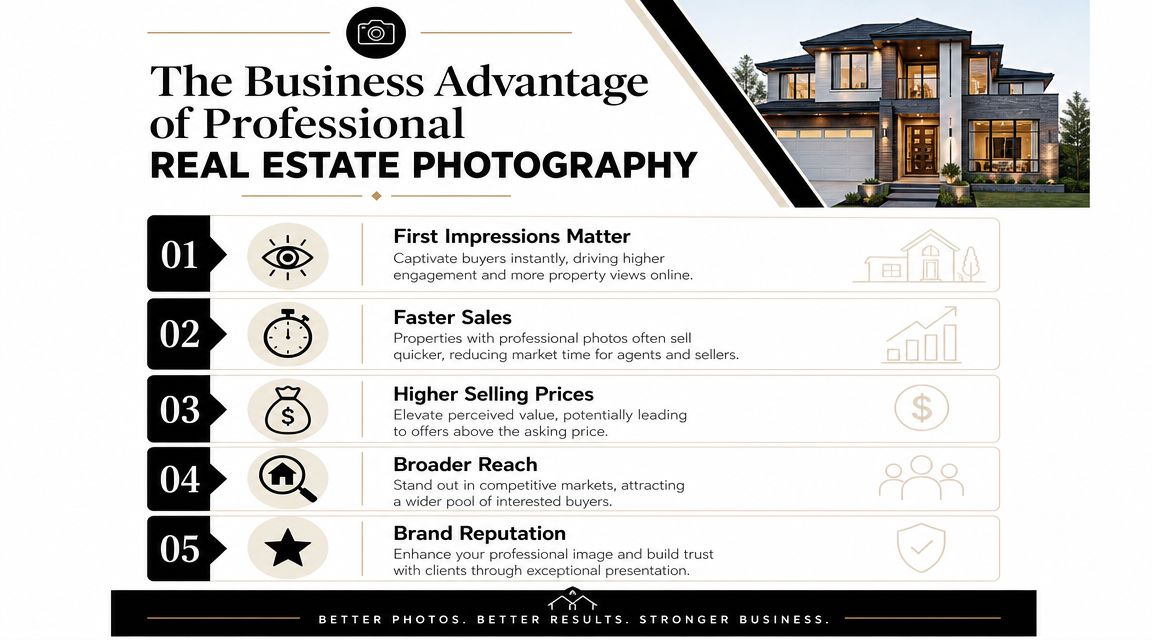
For non-residential clients, that business value shows up in different places.
Developers use photography to support lease-up, capital materials, press outreach, and long-tail marketing after opening. Architects and interior designers use it to show design intent, material quality, and built execution well enough to win the next commission. Commercial brokers, operators, and property teams use it to reduce uncertainty for prospects who need to assess access, condition, fit, and brand alignment quickly.
Good coverage also protects brand perception. If a well-designed asset is photographed carelessly, the work looks less resolved than it is. Finishes can feel cheaper. Proportions can read awkwardly. A premium project can look generic.
That is the fundamental trade-off. The cost of a shoot is visible on an estimate. The cost of weak imagery shows up later in slower leasing conversations, less persuasive presentations, weaker portfolio credibility, and marketing teams having to work around assets that never should have passed review.
Professional property photography works best when it is commissioned as a reusable business tool, not a one-time expense. One assignment can supply a website refresh, investor communications, an award entry, a leasing package, editorial outreach, and months of social and email use. That is why firms often evaluate the ROI of professional photography across multiple business uses, rather than judging it only by the shoot-day fee.
The Technical Craft and Stylistic Choices
Most clients can spot the difference between a phone photo and a professional image, but the reasons are usually technical. Space reads correctly only when the photographer controls perspective, light, timing, and post-production with discipline.
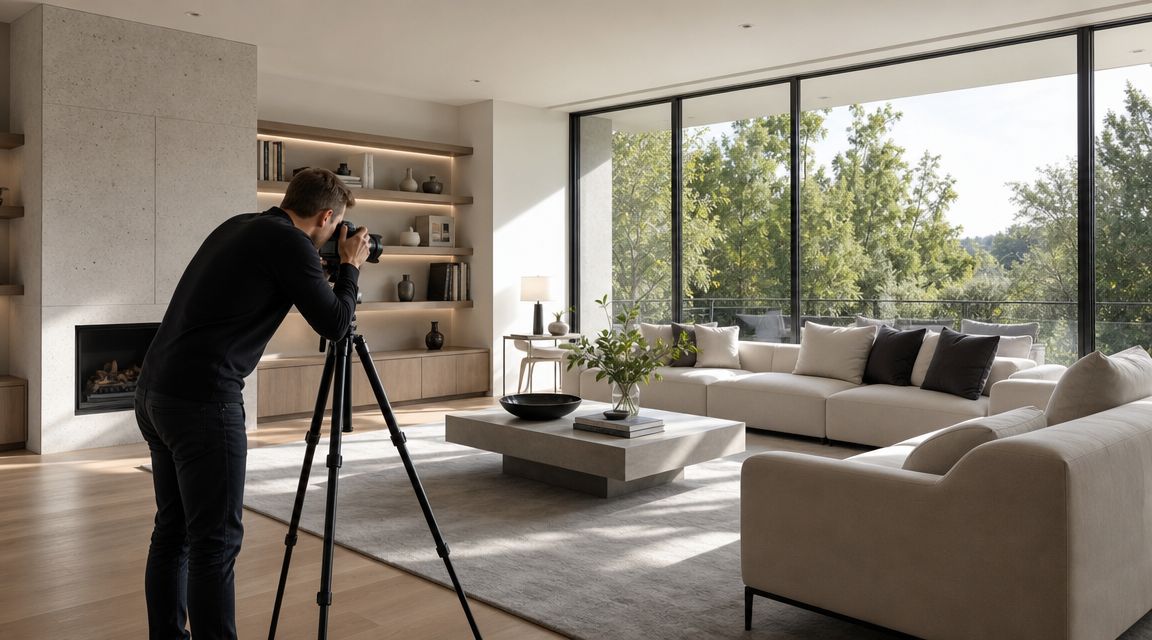
Lens choice and camera position decide whether the room feels believable
Interior photography usually relies on 16–35mm on a full-frame camera, with the camera mounted on a tripod and kept level so vertical lines stay straight, as outlined in HomeJab's camera settings guide for real estate photography. That setup sounds basic, but it affects nearly everything the viewer experiences.
A room photographed too wide can feel exaggerated and dishonest. A room photographed too tight can feel cramped and incomplete. A camera tilted carelessly makes walls appear to fall backward, doors distort, and millwork lose precision.
The tripod matters just as much as the lens. It slows the process down in a good way. It allows for cleaner exposures, repeatable framing, and deliberate composition. In architectural interiors, it also supports the one thing clients care about more than most photographers admit: trust. Straight lines suggest control. Control suggests accuracy.
Light and editing should support the architecture, not overpower it
Good property photography is polished, but it shouldn't feel synthetic. If windows glow unnaturally, wood tones shift, or a room is edited into something that doesn't resemble the built result, viewers notice. Maybe not consciously, but they notice.
A strong photographer balances ambient light, window exposure, and supplemental lighting to keep the space legible. The point isn't to create fantasy. The point is to make the architecture readable.
Practical rule: If the image makes the space look better but less believable, the edit has gone too far.
That balance between polish and realism has become more important as listing media has expanded. Guidance on current practice notes the rise of drone, video, HDR, and virtual staging while also warning against over-editing when viewers expect accuracy, as discussed in Xara's real estate photography tips.
For clients, style becomes a business decision. A luxury residential listing may tolerate more atmosphere. A commercial interiors assignment usually needs cleaner neutrality. An architect submitting to publications may want restrained color, faithful materials, and compositions that let the design speak.
Video also changes how these choices play out in motion. This example gives a useful look at how property visuals are constructed beyond a single still image.
What works and what usually fails
A few patterns show up repeatedly on successful shoots:
- Level compositions make interiors feel calm and trustworthy.
- Selective wide-angle use helps show layout without turning rooms into caricatures.
- Controlled styling keeps attention on architecture, not clutter.
- Moderate retouching cleans distractions while preserving credibility.
The failures are predictable too. Over-bright HDR, mixed color temperatures, careless verticals, and framing that ignores circulation all make a space harder to understand. The image may be flashy, but it won't be useful.
The Professional Photoshoot Process and Deliverables
A professional shoot goes smoothly when the client and photographer are solving the same problem. That starts before anyone unpacks a camera.
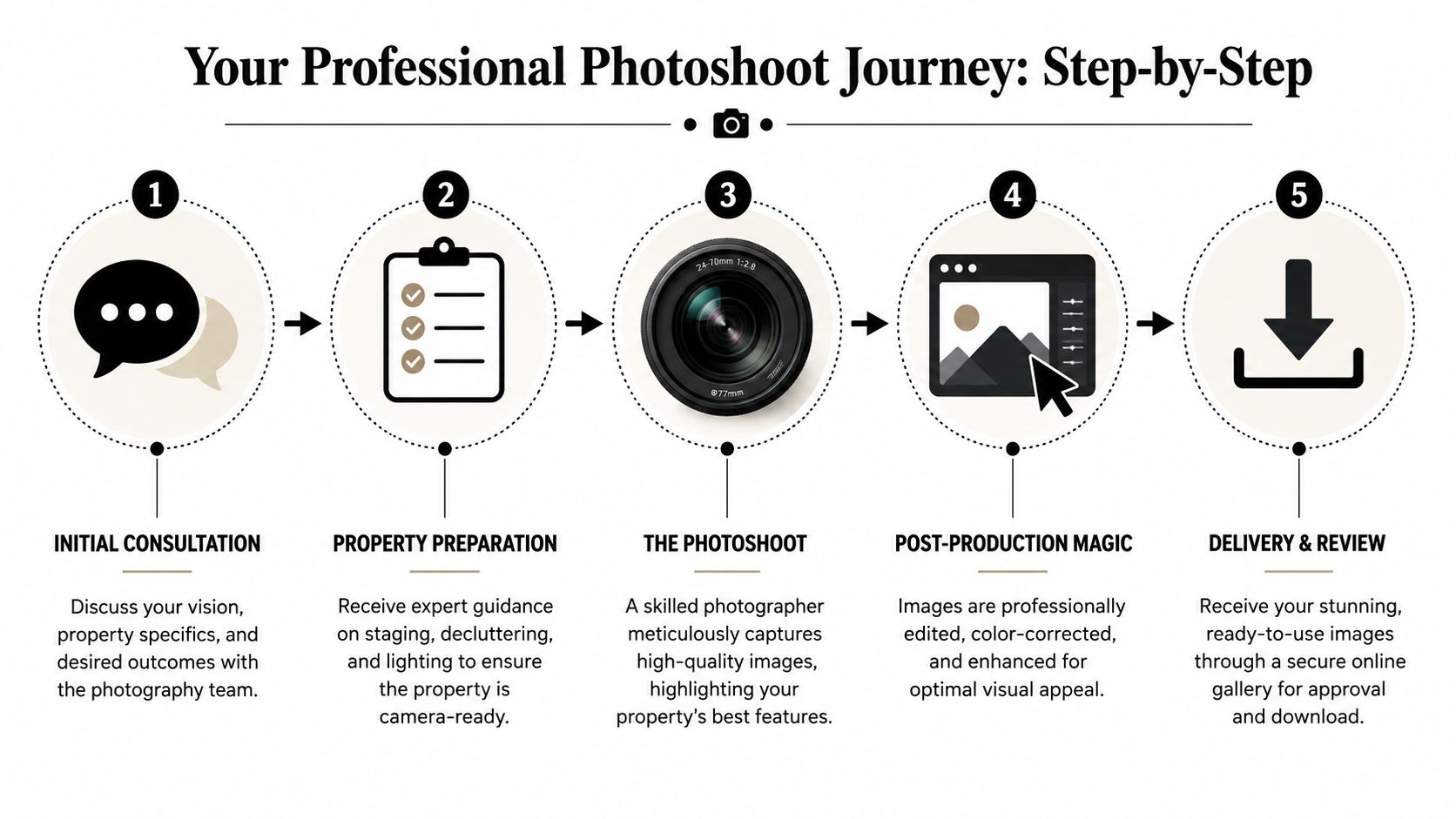
Before the camera comes out
The strongest engagements usually begin with a short planning conversation. What is being photographed, who needs to use the images, and where will they appear? A developer may need broad coverage of amenities, exteriors, and tenant spaces. An architecture firm may care more about a curated edit with a few hero images and several supporting details.
That conversation affects everything that follows, including timing. Exterior work may need a specific time of day. Interiors may need the space cleaned, staged, or partially styled. Occupied buildings often require coordination with tenants, facilities teams, or front-of-house staff.
A clear prep list usually includes:
- Access planning so the photographer can move efficiently through the property.
- Visual priorities such as key rooms, amenities, facade angles, or branded moments.
- Site readiness including cleaning, furniture adjustment, lighting checks, and removal of temporary clutter.
- Usage goals so the shoot matches website, editorial, leasing, social, or print needs.
The best shoots don't happen because the photographer improvises brilliantly. They happen because the brief is clear and the site is ready.
On-site production and what gets delivered
On shoot day, the work is part technical and part editorial. The photographer evaluates sightlines, balances light, makes styling adjustments, and decides which frames best explain the property. A disciplined shoot usually creates both hero images and supporting coverage so the final set is useful across formats.
After the shoot comes editing, file prep, and delivery. Clients should clearly understand two terms at this stage.
- Deliverables are the actual files you receive. That may include high-resolution images for print, web-resolution files for digital use, vertical crops for social, or selected video clips depending on the assignment.
- Licensing is the usage permission attached to those files. It defines how, where, and by whom the images can be used.
Those points shouldn't be treated as fine print. If multiple teams will use the imagery, or if the project may appear in media outreach, proposals, or paid campaigns, discuss that upfront.
Some studios also offer planning help beyond the camera itself. For example, Jimmy Clemmons Photographer works across architectural imagery, commercial brand content, and on-site direction for built environments, which is relevant when a client needs more than simple listing coverage. The key is matching the scope of service to the intended business use.
How to Select and Partner with a Photographer
The right photographer isn't merely the one with the prettiest portfolio. The right photographer is the one whose work consistently solves your kind of communication problem.
What to look for in a portfolio
Start with consistency. One strong sunset exterior doesn't tell you much. You're looking for repeatable control across interiors, exteriors, details, and mixed lighting situations. Vertical lines should be clean. Compositions should feel intentional. Materials should look believable.
Then look for alignment with your brand. If your work is restrained and design-forward, a heavily processed portfolio may be the wrong fit. If you need leasing energy and broad appeal, a very austere editorial style may not serve the assignment.
Ask practical questions as you review:
- Has this photographer shot projects like ours? Experience with homes doesn't automatically translate to hospitality, office, multifamily, or architect portfolio work.
- How do they handle light? You want someone who can explain their approach clearly, not someone who relies on vague style language.
- Can they sequence images well? A professional set should show both overview and detail, not twenty versions of the same angle.
How to create a better working relationship
Good clients improve the work when they share context. Tell the photographer which spaces matter most, what differentiates the project, and how the images will be used. If a stair, facade treatment, custom fixture, or tenant amenity is central to the story, say so early.
It also helps to settle licensing and deliverables before the shoot. That avoids the most common friction points later. If the images may appear in paid media, editorial submissions, signage, investor decks, or partner channels, bring that up in the initial proposal stage.
A productive partnership comes from clarity, not guesswork. The photographer needs to know what success looks like before the first frame is made.
Price matters, but only in context. Cheap coverage that misrepresents a strong project is expensive in practice. Better to evaluate value through fit, consistency, process, and whether the final work will remain useful long after the first campaign ends.
If you need visuals that do more than document a property, Jimmy Clemmons Photographer works with architecture, commercial, and brand-focused clients to create images of built environments that communicate design intent, business value, and a clear sense of place.