

You finished the project. The walls are clean, the lighting design is resolved, the millwork fits exactly as drawn, and the building finally says what you intended it to say. Then someone documents it with rushed, crooked, mixed-color photos that flatten every material choice and make the space feel smaller, duller, and less precise than it is.
That happens more often than it should.
For architects, developers, interior designers, contractors, and brand teams, photography is the last stage of translation. A built environment exists in three dimensions, in changing light, with movement, reflection, scale, and sequence. The photograph has to convert that lived experience into a frame that still carries the design intent. If it doesn’t, the work gets reduced to evidence instead of presentation.
That’s why high-end real estate photography matters well beyond residential listings. A hotel lobby needs to communicate brand atmosphere. A university building needs to show function and institutional credibility. A corporate headquarters needs to express culture, investment, and finish quality. A multifamily development has to persuade investors, tenants, leasing teams, and future buyers, often with the same image set.
Good enough photography creates friction. It makes strong work look ordinary. High-end real estate photography does the opposite. It clarifies proportion, reveals materials, controls visual hierarchy, and gives the viewer a reason to stop and look longer.
Your Best Work Deserves More Than a Snapshot
Clients commissioning photography already know when images feel wrong. They may not use technical language, but they recognize the symptoms immediately.
The lobby feels cramped even though it’s generous in person. The windows are blown out. Walnut millwork turns orange. Vertical lines lean. A carefully composed lighting plan disappears into flat overhead brightness. What took months to resolve gets communicated in seconds, and poorly.
Design intent has to survive the camera
A camera doesn’t automatically record architecture accurately. It records what the operator tells it to prioritize.
That distinction matters. A hurried operator documents surfaces. A trained architectural photographer interprets space. The work isn’t just to show that the room exists. The work is to show why the room feels the way it does, how materials relate to each other, and where the eye should go first.
A strong architectural image doesn’t merely prove a project was completed. It preserves the decisions that made the project worth completing.
For residential properties, that affects buyer response and perceived value. For commercial, institutional, and editorial clients, the stakes often extend further. The images may appear in proposals, investor decks, award submissions, press kits, recruitment materials, and portfolio pages for years.
Weak photos become a business liability
When photos are careless, the damage isn’t only aesthetic.
A developer may have trouble presenting a project at its full level of finish. An architect may lose the chance to show restraint, rhythm, or material contrast. A contractor may fail to demonstrate execution quality. A corporate marketing team may end up with pictures that don’t align with the brand they’ve spent years building.
That’s why high-end real estate photography isn’t an indulgence. It’s the final layer of authorship. It gives the completed project a visual record that matches the ambition behind the work.
Defining High-End Real Estate Photography
People often reduce the difference to gear. Better camera, better photos. That’s only partially true.
The better comparison is a Michelin-starred chef versus a line cook. Both may have access to quality ingredients. One follows a routine. The other controls sourcing, timing, temperature, sequencing, plating, and experience. The dish isn’t better because of one ingredient. It’s better because every decision serves the final result.
High-end real estate photography works the same way.
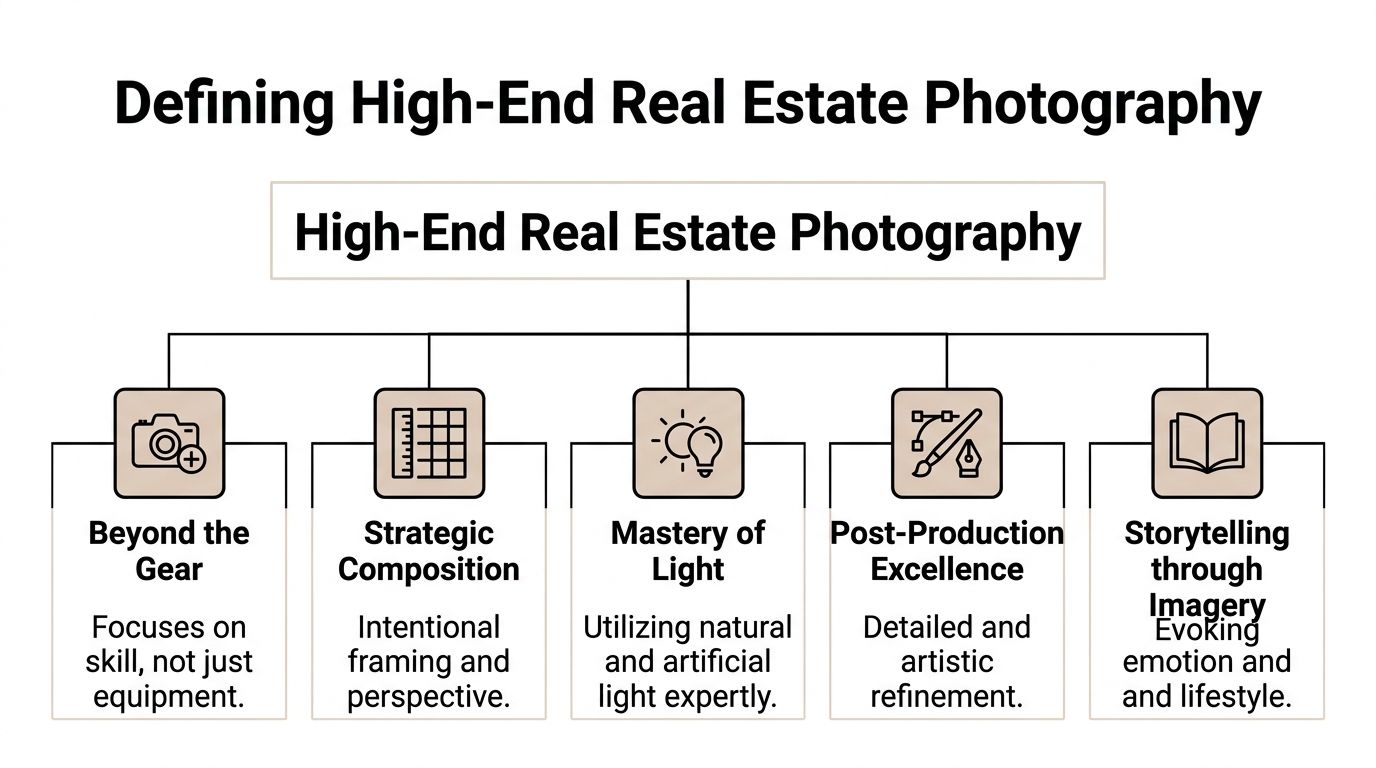
Narrative intent
Every serious shoot starts with a question. What is this place trying to say?
That answer changes the pictures. A luxury residence may need warmth, privacy, and material richness. A law office may need order, confidence, and restraint. A hospitality project may need flow, mood, and layered light. A school may need openness, usability, and institutional identity.
Without narrative intent, the photographer ends up collecting generic room views. Those images can be technically acceptable and still fail.
A strong set usually includes more than hero shots. It needs transitions, secondary spaces, and close details that support the larger story. A corridor can establish movement. A staircase can show structure and geometry. A detail of stone, metal, or joinery can prove the level of craft.
Controlled lighting
Amateur coverage tries to make a room bright. Professional work shapes the light so the room reads correctly.
Those are not the same thing.
Flat exposure wipes out depth. Overcorrected HDR often makes surfaces feel synthetic. Mixed color temperatures turn neutral interiors muddy. In high-end interiors, those mistakes are costly because the image stops resembling the actual design.
Controlled lighting means deciding what should be dominant. Sometimes window light carries the image and supplemental light only supports shadow areas. Sometimes the interior fixtures matter and need to remain believable. Sometimes a commercial environment needs added lighting to separate planes and preserve texture in dark finishes.
Practical rule: If every corner is equally bright, the image usually has no hierarchy.
High-end photography respects the lighting concept of the space. It doesn’t bulldoze it.
Deliberate composition
Composition in architectural work is less about decoration and more about structure.
The camera height affects how furniture reads and whether horizontal lines feel stable. Lens choice affects proportions. Positioning by a foot or two can clean up overlaps, reveal circulation, or turn visual clutter into a coherent frame. In large spaces, composition often depends on leading lines, negative space, and control of foreground objects.
This is also where many lower-end shoots go wrong. Operators lean on ultra-wide views because they seem impressive. In practice, they often distort architecture, stretch corners, and make rooms feel dishonest.
Post-production that supports the architecture
Editing is part of the craft, not a rescue operation.
In high-end real estate photography, post-production usually involves perspective correction, color balancing, exposure blending, cleanup of distractions, and sequence consistency across the set. The goal isn’t to make the building look unreal. The goal is to make the photograph feel as resolved as the design.
That’s the dividing line. Standard photography records a place. High-end real estate photography interprets it with discipline.
The Quantifiable ROI of Exceptional Imagery
A developer spends millions on site work, materials, consultants, and leasing. Then the project reaches the market with images that flatten the facade, muddy the interiors, and make the public spaces feel smaller than they are. I see that mistake in residential listings, but it costs even more in multifamily, hospitality, office, education, and civic work, where the photographs often need to sell the project to several audiences at once.
Professional imagery affects pricing power, time on market, inquiry quality, and future business. For architects, developers, brokers, and institutional teams, those outcomes are measurable.
Sale price and perceived value
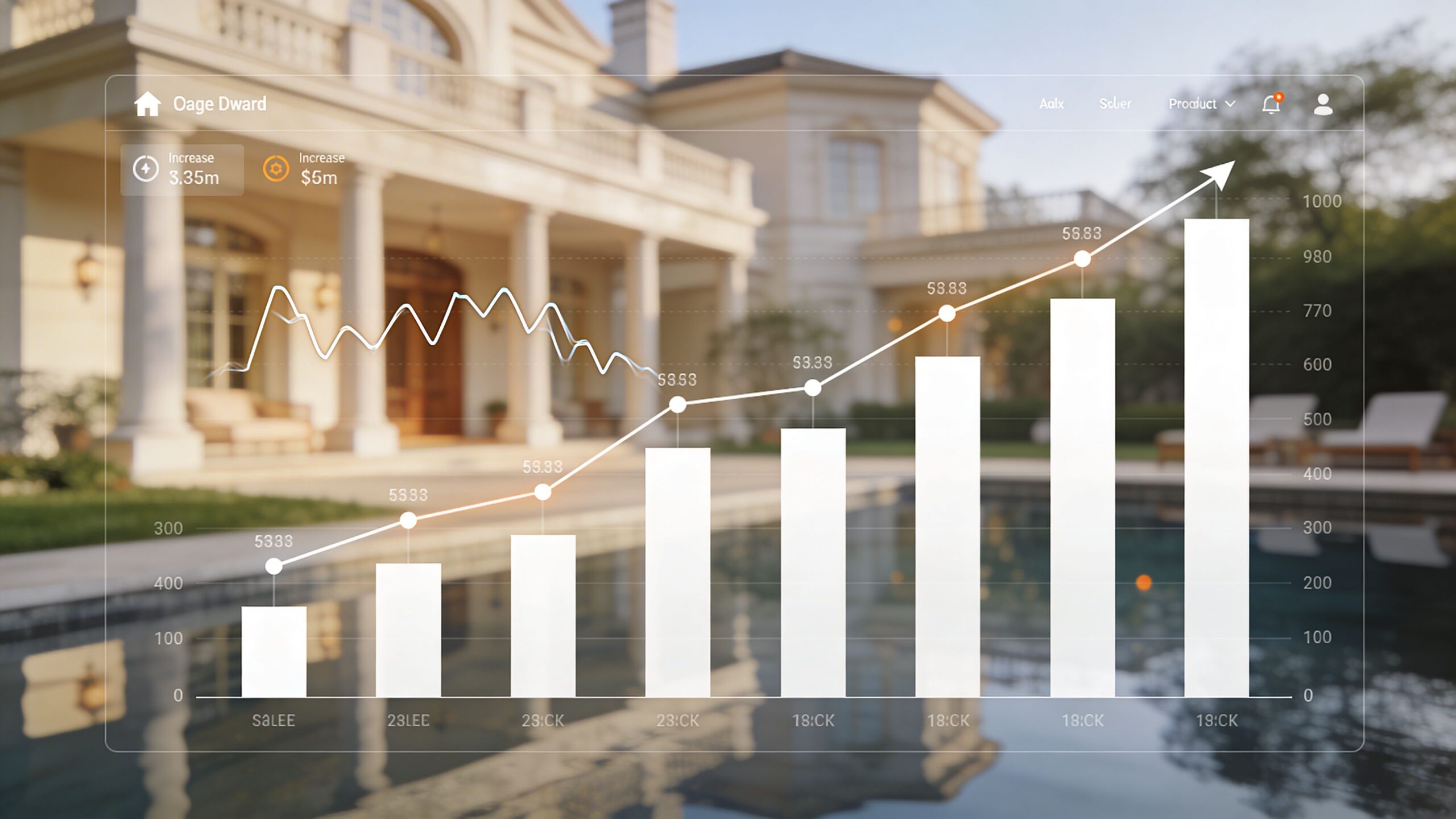
An analysis summarized by Imgix from VHT Studios research reviewed more than 200,000 listings and found that professionally photographed properties sold for 32% more, with sale prices ranging from $934 to $116,076 higher than comparable listings using weaker imagery. The same summary also reported a shorter average time on market, 89 days versus 123 days.
Those numbers matter because photography shapes perceived risk. Buyers, tenants, investors, and selection committees all make early judgments from the image set. If the work looks careless, people assume the asset, the management, or the design process might be careless too. In higher-value projects, that confidence gap shows up in offers, absorption, and who even makes the shortlist.
Attention comes before interest
People rarely read copy first. They scan images, decide whether the property feels credible, and only then keep going.
Industry figures collected by Visually Sold’s roundup of real estate photography statistics report that listings with professional photos receive 61% more views, and that 95% of homebuyers spend about 20 seconds on the first photograph. The same source notes that twilight photography can increase views for luxury listings, and that larger image sets can reduce average selling time compared with listings that show only a single photo.
The lesson extends beyond residential marketing. An architect submitting for publication, a developer pitching a mixed-use project, or a university promoting a new building all depend on the same first filter. Strong imagery gets the project taken seriously fast enough for the rest of the message to work.
Photography behaves like a business asset
Photography is often budgeted as a production expense. In practice, it behaves more like a revenue tool.
A strong set of images can support leasing pages, offering memorandums, investor decks, press outreach, award submissions, portfolio updates, and future proposals. That reuse matters in commercial and institutional work because the shoot is rarely serving one transaction. It may need to help attract tenants now, support refinancing later, and still represent the project accurately in an architect’s portfolio five years from now.
That is why cheap coverage usually becomes expensive coverage. The cost shows up in re-shoots, slower response, weaker presentation materials, and lost opportunities that are hard to trace back to the photography but easy to feel in the results.
For a practical breakdown of that business case, this overview of the ROI of professional photography explains how image quality affects downstream marketing and sales performance.
The cheapest shoot often becomes the most expensive set of images once the project needs to be re-shot, re-edited, or explained away.
The Anatomy of a Professional Photography Shoot
Most finished images look effortless. The work behind them never is.
A professional shoot has three distinct phases. Pre-production, on-site execution, and post-production. Skip any one of them and the final set feels incomplete, even if the individual frames seem polished at first glance.
Near the start of most assignments, the process looks quiet and methodical.
Pre-production decides what the camera can’t fix
The strongest shoots are usually won before the camera comes out.
That starts with understanding purpose. Are the images for leasing, editorial submission, an architect’s portfolio, a hospitality launch, a contractor’s bid package, or a mixed-use campaign that needs several audiences at once? The answer changes the shot list and the time spent on details.
For example, an architect may want strong overall compositions plus material studies and circulation views. A developer may need leasing-friendly hero images first. A corporate team may care about branded spaces, signage integration, and how people would move through the environment. A college may need a mix of architecture, function, and atmosphere.
A good pre-production conversation usually covers:
- Usage needs: Website, print, awards, social, proposals, investor decks, and press all require different emphases.
- Site readiness: Styling, cleaning, surroundings, screen content, bulb consistency, and access all affect the final images.
- Time of day: East-facing glass, shaded courtyards, dusk exteriors, and lobby interiors each have ideal windows.
- Priority frames: Not every room needs the same attention. Signature spaces do.
If the site needs preparation, this practical guide on how to prepare your project site for a professional photoshoot covers the details clients often miss until shoot day.
On site, the image is built, not grabbed
Once on location, the first job is usually editing with your feet. Move objects. Kill distractions. Turn lamps on or off selectively. Straighten chairs. Adjust blinds. Remove exit signs from the frame if they aren’t required. Clean reflective surfaces. Watch cords, bins, thermostats, and wall plates.
None of this is glamorous, but all of it matters.
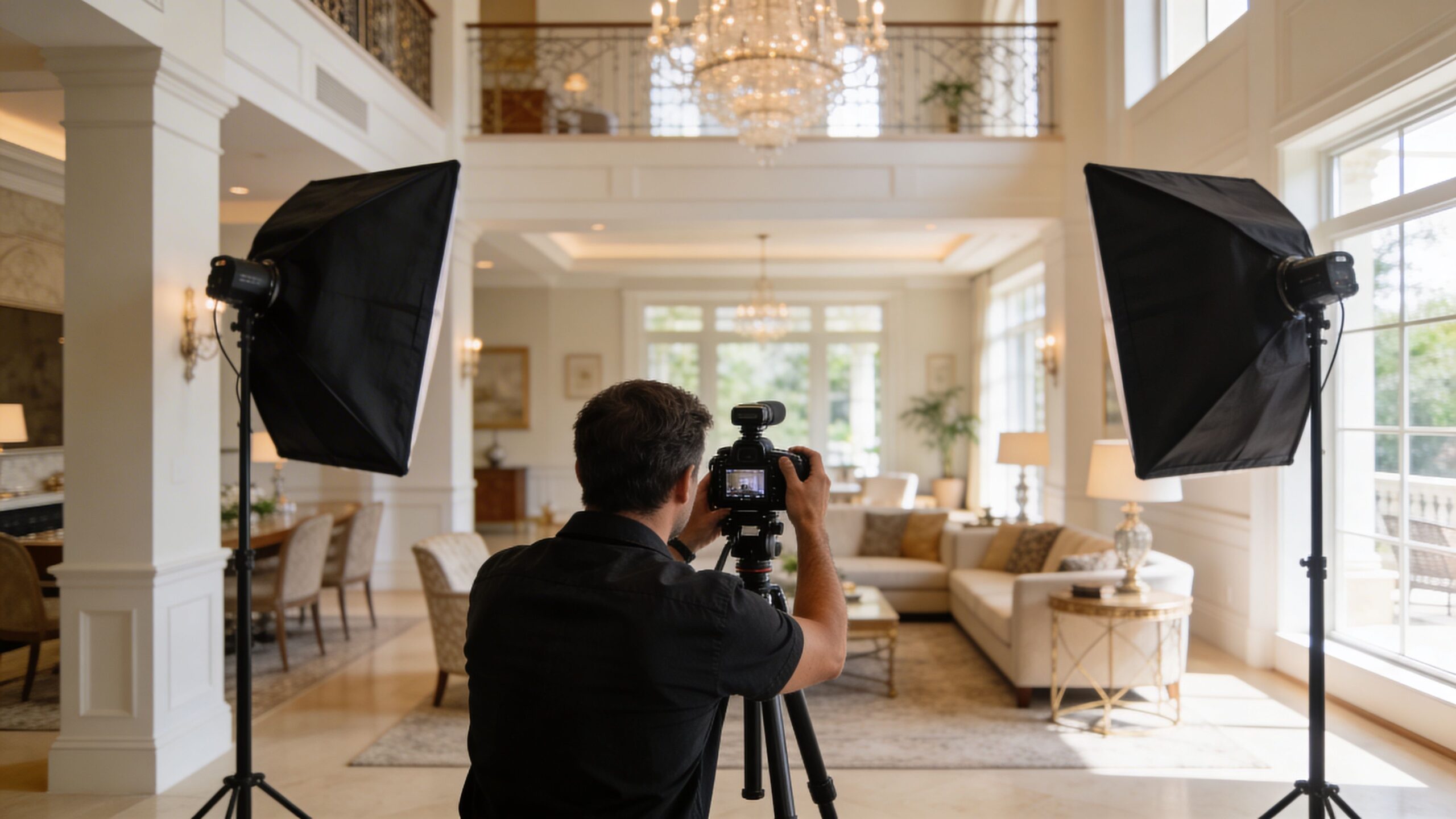
Then the camera setup starts. For high-end results, photographers often use full-frame cameras with 45+ megapixel resolution, such as the Canon EOS R5 or Nikon Z7 II, paired with 16-35mm lenses on a tripod. They typically shoot in RAW at f/8 to f/11 and blend 3 to 5 bracketed exposures in post-production to achieve 14 to 16 stops of dynamic range, according to Matterport’s guide to selecting the right camera.
That technical approach solves a real problem. Architectural interiors often contain both bright exterior views and dark interior materials. A single exposure rarely handles both convincingly.
Why lens discipline matters
Wide lenses are useful. They are also easy to abuse.
An ultra-wide frame may show more of the room, but it can also pull architecture apart. Cabinet lines bow, proportions feel inflated, and spaces read as larger than they are. In residential listing work, some people tolerate that. In high-end architectural work, it undermines trust.
The better practice is to use the widest focal length that preserves proportion. Sometimes that means stepping back. Sometimes it means making peace with showing slightly less, because what remains will feel honest and controlled.
Good architectural photography doesn’t shout space. It describes space accurately enough that the viewer wants to enter it.
Supplemental lighting should look invisible
Lighting on site isn’t about making a room look brighter than reality. It’s about making the photograph carry what the eye perceives naturally.
That may involve balancing window light with subtle flash, controlling reflections on polished surfaces, opening shadows under overhangs, or preserving the warmth of practical fixtures without letting the room go orange. In commercial spaces, it may also mean handling large reflective planes, dark ceilings, or mixed sources that would otherwise turn the image chaotic.
A strong photographer doesn’t add light indiscriminately. They decide where shape needs help and where restraint matters more.
Here’s a useful behind-the-scenes look at how those decisions play out in practice:
The shot list should breathe
A polished set isn’t just a pile of isolated hero frames. It needs rhythm.
One wide establishing image may set the overall character of the space. A medium frame can show transition from one zone to another. A tighter image might isolate joinery, stone texture, fixture design, or a custom detail. That variety makes the full gallery feel editorial instead of repetitive.
A simple breakdown looks like this:
| Image type | What it does | Common mistake |
|---|---|---|
| Hero wide | Establishes the primary room or facade | Going too wide and distorting the structure |
| Context medium | Shows flow between spaces | Letting foreground clutter dilute the frame |
| Detail close-up | Proves quality of materials and craftsmanship | Treating details as an afterthought |
| Exterior timing shot | Captures massing, light, and site relationship | Shooting at the wrong time of day |
| Sequence frame | Connects one area to the next | Making every image feel isolated |
Post-production is where consistency is earned
After the shoot, the job shifts from capture to refinement.
This stage usually includes blending exposures, correcting perspective, neutralizing color casts, retouching distractions, balancing brightness across the set, and preserving natural material character. The editor also has to maintain consistency so the project feels unified from first frame to last.
That editorial discipline matters when images are used together. A portfolio page, magazine spread, or project launch suffers when every frame has a different color mood or contrast style.
The best post-production is hard to notice. Vertical lines are stable. Whites are clean without looking sterile. Wood still looks like wood. Exterior views remain believable. The project feels coherent.
That’s usually the hidden difference people sense when they say an image looks expensive, finished, or trustworthy.
Beyond the Residence Adapting for Commercial Projects
A luxury residence and a commercial property don’t ask for the same visual language. Yet many shoots treat them as if they do.
That’s one reason so much commercial imagery feels generic. It borrows residential habits and applies them to spaces with completely different priorities.
Residential habits often fail in commercial environments
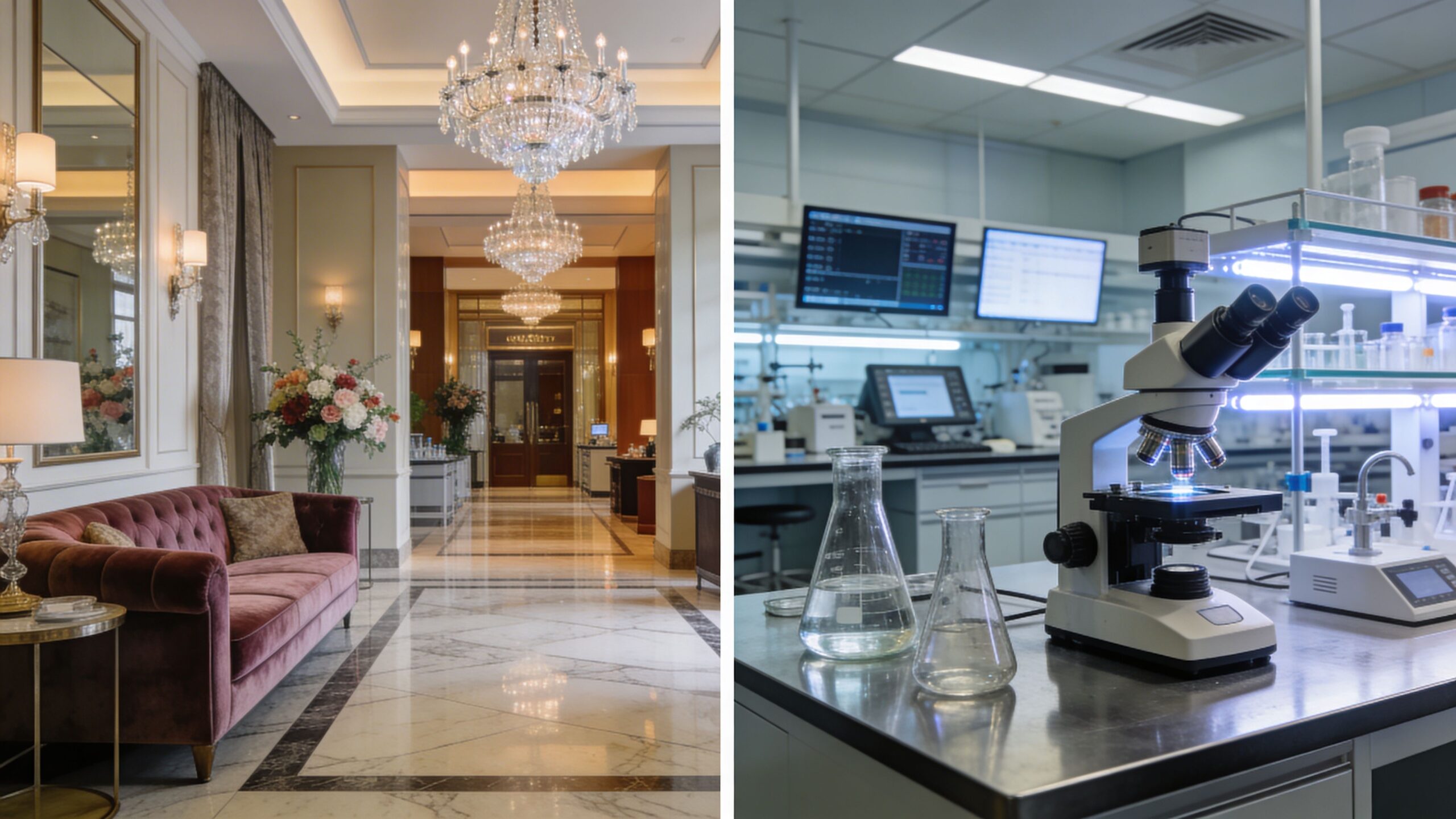
In homes, the usual goals are aspiration, warmth, and livability. In commercial and institutional settings, the goals may be scale, function, circulation, precision, compliance, identity, durability, or public trust.
Recent industry reports note that 70% of commercial real estate listings underperform visually, in part because the photography applies residential-style treatment instead of capturing scale and narrative through techniques such as dusk shots for material contrast and leading lines for flow, according to Sold in a Snap’s discussion of effective real estate angles.
That underperformance makes sense. A corporate lobby isn’t trying to feel cozy. A university lab isn’t trying to mimic a staged living room. A hospitality property needs mood, but it also needs operational clarity and brand alignment.
The narrative changes with the building type
Different clients need different proof.
For a hotel, photography often has to show arrival sequence, guest experience, texture, and atmosphere. For a contractor, the images need to show execution quality, alignment, material transitions, and scale of work. For an architecture firm, the set should clarify massing, detail, light behavior, and spatial rhythm. For a private school or college, the work may need to express both architecture and institutional identity.
Here’s where the one-size-fits-all approach breaks down:
- Corporate interiors: Need clean geometry, branded moments, and a sense of circulation.
- Hospitality spaces: Depend on layered lighting, mood, and guest perspective.
- Institutional buildings: Require clarity, function, and credibility more than lifestyle cues.
- Retail and showroom environments: Need product relationships, traffic flow, and reflective control.
- Large exteriors: Often benefit from timing, elevation choices, and longer lenses that preserve facade proportion.
Scale changes compositional choices
Large built environments can’t always be solved with the same lensing used in homes.
Open lobbies, atriums, classrooms, medical facilities, and campuses often need more disciplined camera placement to avoid stretched edges and collapsing lines. In many of these spaces, a slightly longer focal length creates a more convincing sense of depth than an aggressively wide one.
The storytelling also shifts. In residential marketing, a buyer may ask, “Could I live here?” In commercial work, the audience may ask, “Does this place reflect our standards?” or “Can this space support the way we work?”
Commercial architecture rarely benefits from being photographed like a house. It benefits from being photographed like a system of movement, purpose, and identity.
That’s why high-end real estate photography, when adapted properly, becomes more than listing support. It becomes visual evidence of brand strategy, design intelligence, and construction quality.
How to Choose Your Visual Partner in Atlanta
Choosing a photographer by price alone is one of the fastest ways to get a mismatched result. The better approach is to evaluate fit.
That means looking at how someone sees, not just what they charge or what camera they own. In Atlanta, where projects range from residential luxury to hospitality, corporate, education, and mixed-use work, that distinction matters.
Read the portfolio like a client would use it
A strong portfolio should do more than show a few dramatic exteriors at golden hour.
Look for consistency across different properties and lighting conditions. Check whether verticals are controlled, materials stay believable, and the image set feels intentional from frame to frame. One beautiful hero shot can hide a weak overall process.
Pay attention to whether the photographer includes detail studies as well as room overviews. Zillow’s guidance on luxury real estate photography notes that detail-focused imagery has shown 20% to 30% higher engagement on its platform, and emphasizes the need for an artistic eye that captures textures, fixtures, and craftsmanship rather than relying only on wide room views, according to Zillow’s best practices for shooting luxury real estate photography.
That matters for architects and designers because details often carry the signature of the project.
Ask process questions, not just delivery questions
Most clients ask about turnaround first. That’s understandable, but it won’t tell you much about the quality of the collaboration.
Better questions include:
- How do you plan a shoot for different end uses? A portfolio set and a leasing set aren’t identical.
- How do you handle mixed lighting and reflective materials? This reveals whether the photographer understands difficult spaces.
- What do you need from us before the shoot? Good answers usually involve styling, site prep, scheduling, and access.
- How do you decide between wide contextual frames and tighter detail shots? This gets to narrative judgment.
- How much post-production is part of your workflow? You want refinement, not casual batch processing.
Look for architectural sensitivity
A photographer doesn’t need to be an architect, but they do need to respect architecture.
That shows up in composition, restraint, and sequencing. It also shows up in whether the person understands how a building is experienced. Can they make circulation legible? Can they photograph a facade without turning it into a gimmick? Can they preserve symmetry when it matters and break it intentionally when it helps the frame?
For Atlanta-based projects, one option to review is Jimmy Clemmons Photographer’s real estate photography in Atlanta, which sits within a broader architectural and commercial practice. The useful thing to evaluate in any provider is the same. Whether the portfolio reflects editorial discipline, understanding of built environments, and a clear point of view.
The right visual partner doesn’t just arrive with gear. They arrive with judgment.
The shortlist should be small
If you’ve reviewed the work carefully, your shortlist usually narrows quickly.
At that point, the decision is less about who can take pictures and more about who can represent the project faithfully. That’s the photographer who will notice the alignment of sconces, the relationship between daylight and material finish, the importance of a detail shot in a stairwell, and the difference between a marketable frame and a meaningful one.
Conclusion An Investment in Your Visual Legacy
Buildings don’t stay frozen in their launch condition. Surroundings mature, tenants change interiors, branding evolves, and spaces get renovated. The photographs often outlast that first moment.
That’s why high-end real estate photography deserves to be treated as a long-term asset. It helps sell, lease, publish, pitch, archive, and remember the work. More critically, it gives the project a visual record that matches the level of thought that went into the design and execution.
For residential listings, the value is measurable in visibility, speed, and price. For commercial and institutional work, the return often shows up in a different but equally important form. Better proposals, stronger portfolios, cleaner brand communication, more persuasive case studies, and images that continue working long after the site is finished.
The common thread is simple. Weak photography asks the audience to imagine the quality that the image failed to show. Strong photography removes that burden.
If the project matters, the documentation should matter too. That’s not about extravagance. It’s about stewardship. The final images become part of how the work is judged, remembered, and trusted.
If you need imagery that treats architecture, interiors, and commercial spaces with editorial discipline, Jimmy Clemmons Photographer provides architectural photography, commercial brand content, location scouting, lighting design, on-set direction, and professional editing for clients in Atlanta and across the region.