
You know the feeling. The building is ready, the photographer delivered clean images, the brochure looks polished, and the portal listing is live. Then the inbox stays quiet, the broker calls slow down, and the only engagement is a few casual views from people who were never going to tour in the first place.
That gap usually isn't about the asset itself. It's about whether the marketing system around the asset helps the right tenant, broker, or investor make a decision fast enough to act. In commercial property marketing, the photo shoot, the listing copy, the property page, the follow-up sequence, and the proof points all have to work together, because space is judged long before anyone walks the suite.
The Moment a Listing Goes Quiet
A quiet listing often starts with a false win. The images look great, the space reads well in a brochure, and the team feels like the hard part is done. Then the listing gets impressions but no qualified tours, because the campaign answered the wrong question first.
That's common in commercial property marketing. Prospects aren't only looking for attractive interiors, they're trying to eliminate risk. They want to know whether the parking works, whether the zoning fits their use, whether the suite can be occupied on their timeline, and whether the economics make sense before they spend time on a call.
The problem is usually upstream
A lot of teams launch with visuals before they've assembled the facts that make the visuals useful. If the package doesn't include comps, occupancy status, lease terms, floor plans, and permitted use details, the listing becomes a teaser instead of a decision tool. In that setup, the person who inquires still has to ask the same questions everyone else asks, which slows down the funnel.
Practical rule: If the first email after launch is full of basic questions, the marketing package is incomplete, not the prospect.
The bigger issue is sequencing. A space can be photographed beautifully and still fail to move if the visual story doesn't support the specific action the asset needs, whether that's lease-up, sale, or capital raising. In practice, the campaign has to qualify interest, not just attract it.
Many properties get stuck here. The marketing team treats the gallery as the deliverable, while the broker needs the images to do a job. The difference sounds small, but in the field it decides whether a prospect sees a place to browse or a place to tour.
Why Commercial Property Marketing Has Changed
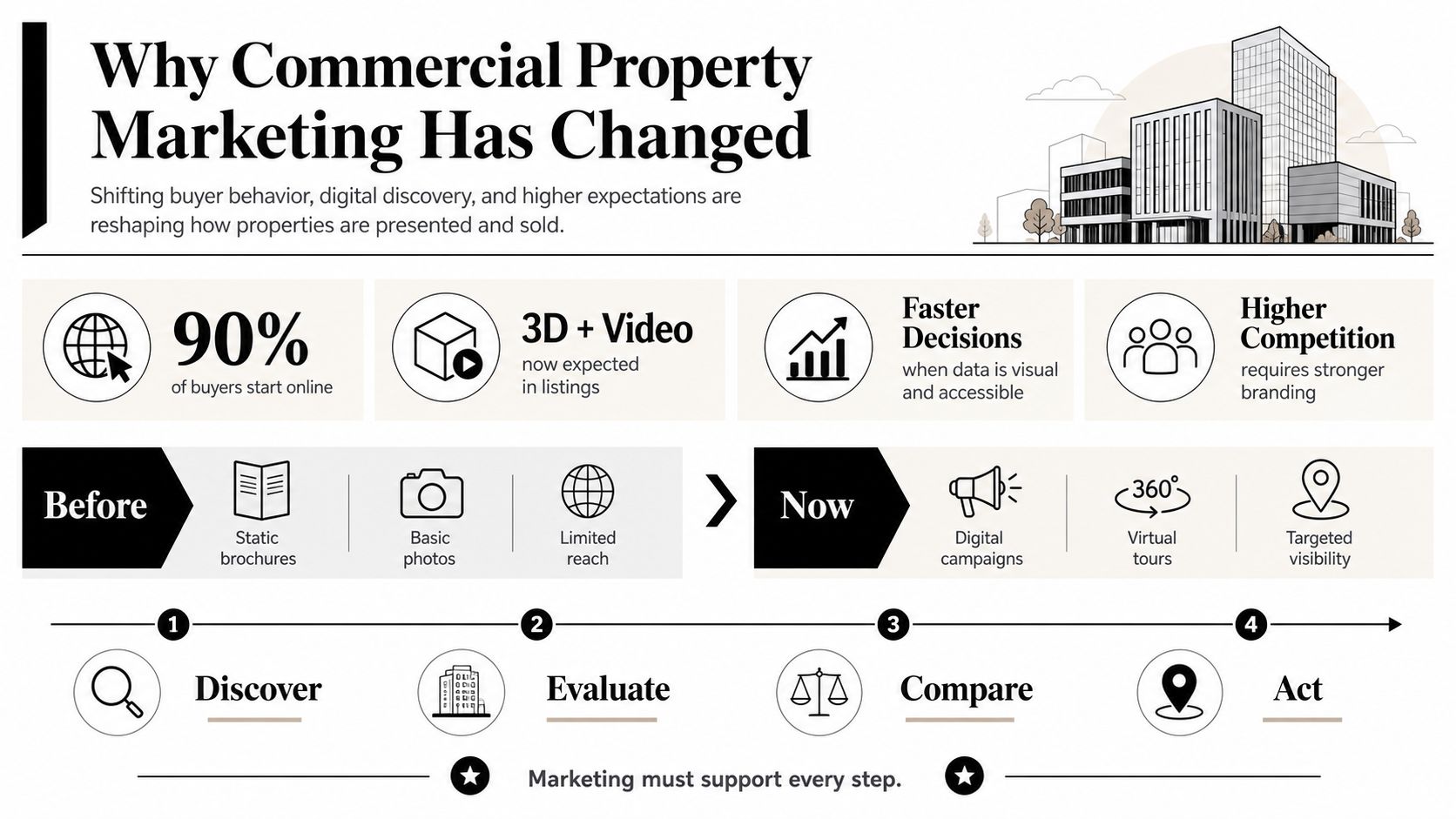
A listing can look polished and still fail if it reaches the wrong audience, in the wrong format, at the wrong point in the buying or leasing process. Commercial real estate now competes for attention in a market where investors, tenants, and lenders all expect faster answers and clearer proof before they pick up the phone. Mordor Intelligence estimates the global commercial real estate market at USD 6,345.2 billion in 2026 and projects it to reach USD 8,483.3 billion by 2031, while the U.S. market is estimated at USD 1.7 trillion in 2025, rising to USD 1.75 trillion in 2026 and USD 2.02 trillion by 2031. The same source also notes that total commercial real estate transaction volume fell to $647 billion in 2023 from $1.14 trillion in 2022, which puts more pressure on owners and developers to present assets in a way that earns trust quickly Mordor Intelligence commercial real estate market report.
Search behavior has changed the job too. In B2B markets, 76% of online experiences begin with a search engine, and B2B companies generate 2x more revenue from organic search than from other online channels such as social media or paid media InMotion Real Estate marketing stats. That is exactly how office, retail, and industrial prospects now research space before they ever agree to a tour. They are not browsing casually. They are comparing options, screening out weak fits, and looking for enough evidence to keep moving.
Search now shapes the first impression
For commercial space, discoverability and positioning now work together. If a prospect cannot find the asset during early research, the team loses the chance to explain the value later. That is why market updates, neighborhood pages, and property-specific content have moved from extra material to core campaign assets.
The content case is strong as well. Industry research reports that content marketing costs 62% less than traditional marketing while generating about 3 times as many leads, and that companies that blog get 55% more web traffic InMotion Real Estate marketing stats. Those figures matter because the commercial listing no longer lives only on a sign or a portal. It lives in search, in email, on a property page, and in the material a broker or investor reviews before deciding whether the asset is worth a closer look.
The strongest campaigns are built for how people actually research space, not for how teams used to hand out flyers.
That changes the marketing brief. Budget, photography, web content, and paid media need to work as one research system, not as separate tasks handed to different vendors. In a market this large, cyclical, and search-led, the campaign has to do more than look polished. It has to earn attention and reduce uncertainty. For the planning work that sits underneath that shift, see how to prepare your project site for a professional photoshoot.
Planning a Photo Shoot That Actually Sells Space
A commercial shoot should start with the decision the asset needs to support, not with a generic shot list. If the space is an office suite, the images need to help a tenant imagine team flow, natural light, and access. If it's industrial, the images need to make circulation, loading, and yard logic easy to read at a glance.
Build the shoot around the asset's use case
That's why pre-production matters. Recent comp context, current occupancy, zoning, floor plans, and known access issues should all shape what gets photographed and in what order. A photographer who understands commercial work will think like an editor, not just a camera operator, and that changes the image set from a gallery into a marketing toolkit.
On shoot day, I want the hero exterior early, then the interior sequence built around the way a prospect would move through the property. If there are tenant-style vignettes, they should show scale and function without cluttering the frame. Mixed-use and hospitality assets often need lighting decisions that hold together across very different environments, so the team has to protect consistency instead of chasing one dramatic shot per space.
A few details deserve explicit coverage:
- Access and circulation: Show entries, loading, corridors, parking, and wayfinding so the buyer or tenant can judge practicality.
- Signage and arrival: Capture what people see when they pull in, not only the nicest angle on the building.
- Operational proof: Include visual evidence that supports questions about how the space works, not just how it looks.
- Sequence discipline: Shoot the assets in an order that supports the brochure, property page, and offering materials later.
The planning guide on how to prepare a project site for a professional photoshoot is useful because it reinforces the same reality from the ground level, the shoot is only as strong as the prep behind it.
Field note: If you have to “fix it in Photoshop” because the space was never staged for its actual use, the campaign is already costing more than it should.
In practice, the best commercial shoots don't try to create fantasy. They create clarity. The images should answer the first round of due-diligence questions before the prospect has to ask them.
Turning Images Into Listings, Brochures, and Property Pages
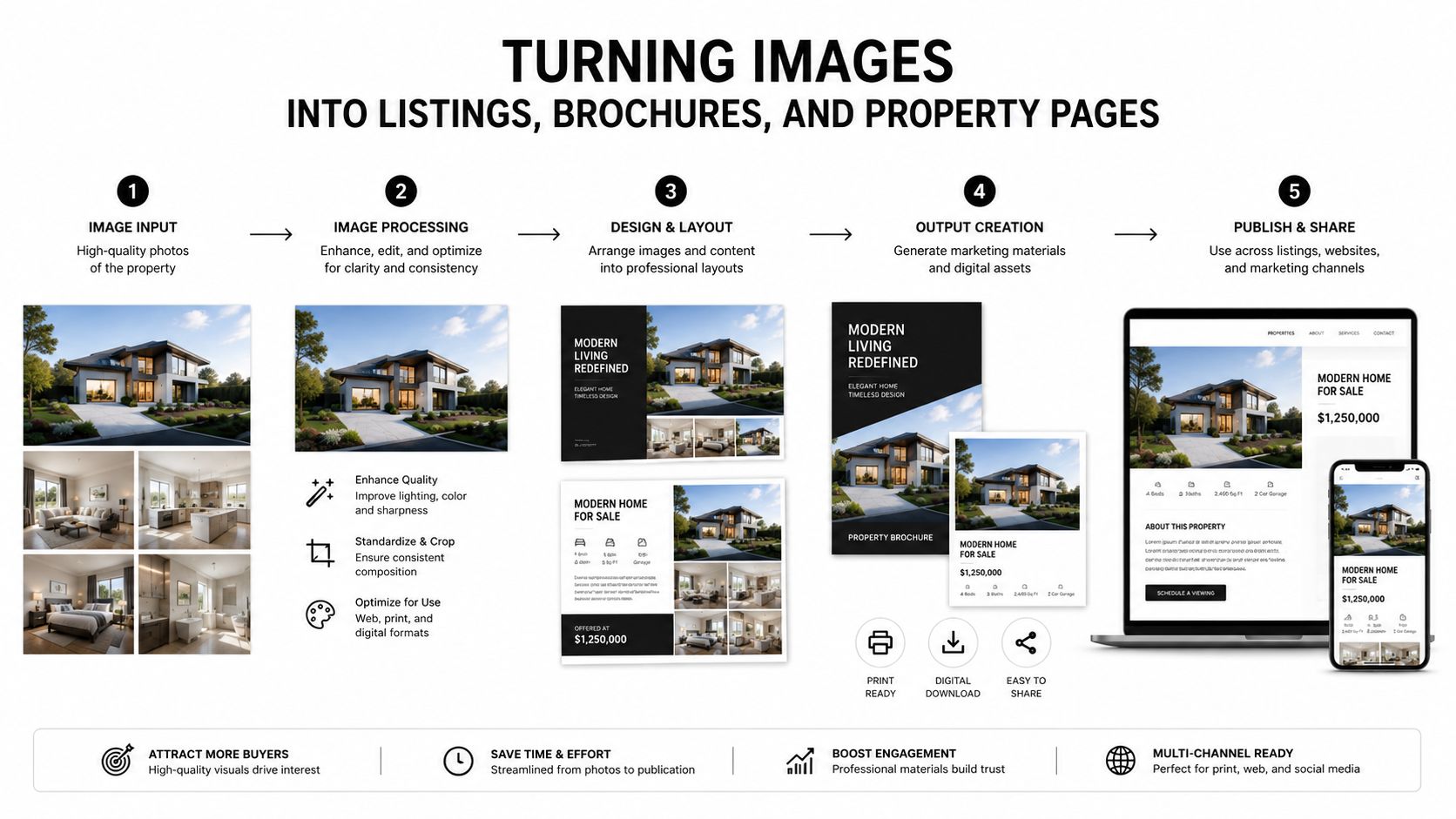
A strong image set only becomes useful when each photo is assigned a job. A portal listing needs fast orientation. A brochure needs a tight narrative. A property website or offering memorandum needs enough depth to help brokers, tenants, and investors decide whether the space deserves a tour.
Match each format to the decision stage
The portal listing should open with the strongest exterior and the cleanest summary data. That is where quick screening happens, so the copy has to be clear, easy to scan, and honest about the property's core fit. The brochure usually works best as a 2 to 4 page package that combines the most persuasive visuals with a concise property story and the facts a broker can share in a short conversation Bounti real estate marketing guide.
The property website or offering memorandum should carry the deeper load. Recent comparable sales and lease comps, occupancy details, zoning verification, floor plans, and lease terms belong there, because qualified prospects want hard numbers before they commit to a tour Bounti real estate marketing guide. If that material is missing, the team ends up answering the same questions over and over, and the marketing package never does its real job.
That same guide recommends a property-specific marketing budget of 1 to 3% of the first year's lease value or expected sale price as a practical benchmark for campaigns that include digital ads, brochures, and listing portals Bounti real estate marketing guide. I find that useful because it forces the team to treat production, distribution, and qualification as one spend, not separate line items that compete with each other after the fact.
The internal logic matters. Images should be sequenced to support each asset package, and each package should reduce friction at a different depth of the funnel. For a polished market presentation, the asset creation workflow has to account for where the images will live, not only how they look in isolation.
Running the Campaign Beyond Launch Day
The listing goes live, the first round of attention comes in, and then the real work starts. After launch, the campaign has to keep the asset visible, current, and easy to act on while prospects work through a longer approval process. In commercial property marketing, that follow-through is often what separates steady interest from a real pipeline.
Build a post-launch rhythm
Start with the channels that catch active demand. Listing portals, SEO-driven property pages, and Google Ads for high-intent searches should carry the top of the funnel. Email and retargeting keep the space in front of people who viewed it but did not inquire, which matters because many commercial buyers and tenants need repeated exposure before they commit.
One operating guide recommends weekly listing updates, immediate follow-up after inquiries, and CRM tracking of broker and buyer interest because serious prospects often expect financials, tenant mix, and due-diligence documents early SharpLaunch commercial real estate marketing strategy. That is practical advice. A slow reply can cost a tour, and stale information can make the listing look neglected.
Here's the cadence I would use on a live campaign:
- Portal visibility: Refresh the listing regularly so it does not look abandoned.
- SEO content: Keep the property page and neighborhood copy current so search traffic has a reason to land there.
- Paid search: Use Google Ads for direct intent, especially when the asset needs faster qualification.
- Email nurture: Send updates that answer likely objections, not just repeat the same listing headline.
- CRM follow-up: Log every inquiry, every tour request, and every document ask so the team can see where interest is leaking out.
Monitoring has to stay tight. One industry guide recommends watching views, inquiries, and engagement so tactics can be adjusted when those numbers fall [SharpLaunch commercial real estate marketing strategy]. That simple discipline is where many teams slip. If the listing stops producing, the fix might be fresh photography, a better lead form, or a faster response process, not just more budget.
The most common drop-offs are easy to spot. Slow replies kill momentum. Missing floor plans create friction. Stale photography makes the asset look like it has been sitting too long. Fix those first, and the rest of the campaign usually gets easier.

Trust Signals That Outweigh the Pretty Pictures
Pretty images still matter, but they're table stakes now. What often decides whether a corporate tenant, broker, or investor moves forward is whether the asset feels credible enough to justify time, diligence, and internal approvals.
Recent 2026 guidance around commercial property marketing points to automated review requests after tours, GenAI-assisted review responses, embedded reviews in listings, and repurposing social proof across email and social channels Birdeye commercial property marketing ideas. That's useful because it shows reputation management is becoming a formal layer of the marketing stack, not an afterthought tacked onto the end.
Proof reduces perceived risk
The strongest trust signals are usually boring in the best way. Transparent tenant mix, clear lease terms, relevant third-party data, and property-level certifications give prospects something concrete to validate. For corporate teams, those details answer the unspoken question, can we rely on what we're seeing here?
That's why a polished visual package should never stand alone. It needs to sit beside facts that make the visuals believable. For office, retail, and industrial assets, the decision often comes down to whether the team can show that the building functions as advertised.
A practical stack looks like this:
- Reviews and testimonials: Capture them after tours and place them where a prospect will see them.
- Third-party validation: Use data and certifications where they reinforce, not distract from, the property story.
- Transparent information: Make tenant mix, lease structure, and other due-diligence details easy to find.
- Cross-channel repetition: Reuse the same proof points in listings, email, and social so the message stays consistent.
The credibility gap is wider in commercial real estate than in most consumer categories, because the decision is bigger and the downside of a bad fit is higher.
The contrarian truth is that more content doesn't always solve the problem. Better proof does. If the property team can show operational reliability through the visuals, the facts, and the outside validation around the asset, the marketing starts carrying less friction and more authority.
Measuring What Actually Moves Occupancy
A useful measurement framework has to connect the marketing work to the business outcome, which is occupancy, lease-up, or sale. That means looking beyond vanity metrics and asking where the funnel is losing people.
The right place to start is with a baseline. If the asset already has portal views, inquiry volume, and some tour history, those numbers should define the starting point for any refresh. From there, the monthly review can separate problems of reach, interest, and conversion.
KPIs by funnel stage
| Funnel Stage | Primary KPI | What It Tells You |
|---|---|---|
| Top of funnel | Portal impressions and listing views | Whether the asset is getting discovered |
| Mid funnel | Inquiry rate and tour request rate | Whether the package is convincing enough to prompt action |
| Bottom funnel | Tour-to-LOI conversion and time-on-market | Whether interest is turning into deals |
| Brand level | Review velocity and organic traffic growth | Whether trust and discoverability are improving |
The most important habit is to tie each metric back to a decision. Low views can justify a distribution shift or a title rewrite. Good views but poor inquiries usually point to a mismatch in the listing copy, image sequence, or required information. If tours are happening but LOIs aren't, the issue may be the asset fit, the terms, or the proof package.
If you want a more direct lens on production quality and business value, the ROI of professional photography becomes visible when the visuals reduce friction, not just when they look sharp. Revisit photography whenever the tenant mix changes, major finishes are updated, or the market starts asking different questions about the space.
Keep the next review agenda tight:
- Check discovery: Are portal views and organic traffic holding up?
- Check response: Are inquiries getting answered fast enough?
- Check qualification: Are prospects asking for the right documents?
- Check conversion: Are tours turning into serious next steps?
- Check credibility: Are reviews and other trust signals being used consistently?
Jimmy Clemmons Photographer creates commercial property photography, exterior and interior imagery, and aerial visuals that support listings, brochures, and property pages. If you need a campaign that treats photography as a decision-making tool instead of a gallery filler, visit Jimmy Clemmons Photographer and see how the work can support your next lease-up or sale.