
The camera was on a tripod, the room was clean, and the light looked promising. Then the sun moved across the windows, changing the balance between the interior finishes and the view outside, so the composition had to wait.
That pause captures the reality of architectural photography services. The work isn't just a matter of arriving with a wide lens and producing attractive files. A professional studio interprets drawings, manages perspective, shapes light, coordinates people, and defines how the resulting images may be used. The strongest projects begin before the camera comes out and continue through licensing and delivery.
Why Architectural Photography Is a Specialized Craft
Architectural photography sits between fine art, commercial production, and technical documentation. A building has to remain believable, but the photograph also needs a point of view. Straight walls, accurate materials, controlled reflections, and a convincing sense of space all matter at once.
On location, the photographer may be working from floor plans rather than a simple list of rooms. A kitchen needs to read as a complete composition, while a stair, corridor, or façade may require a precise relationship between foreground, structure, and surrounding context. Small changes in camera height can alter the apparent proportions of a room. A few inches of movement can determine whether a mullion aligns with an edge or whether a ceiling line feels unintentionally tilted.
The work begins with interpretation
A general commercial photographer may be able to react quickly to a product or portrait setup. Architectural assignments often demand slower decisions. The photographer must understand how stone, glass, timber, metal, paint, and reflective surfaces behave under changing light. They also need to know when available light is sufficient and when supplementary lighting will reveal the design more clearly.
That requires collaboration. Architects may explain the design intention, interior designers may refine styling, contractors may need access to the space, and property managers may control when rooms can be cleared. A photographer who ignores those relationships can produce technically clean images that fail to communicate why the project matters.
Practical rule: A photograph should serve the design story, not merely prove that a building exists.
Why standard real estate expectations can fail
Real estate photography and architectural photography overlap, but their priorities often diverge. A listing may need broad coverage, fast delivery, and a clear representation of rooms and amenities. An architect, publisher, or developer may instead need a smaller group of carefully constructed images that show material decisions, spatial sequence, and the character of the finished work.
The history of the discipline reflects that distinction. Joseph-Philibert Girault de Prangey is widely regarded as the first architecture photographer, with known images of major Paris sites taken as early as 1841. By the 1860s, architectural photography had become an established visual medium, and by the early 1950s, architects were hiring more photographers for commissioned work, helping move the field toward recognized art practice, as described in this history of architectural photography.
The Four Core Service Types Explained
A useful brief starts by identifying what the images must accomplish. Most assignments combine several service types, but separating them clarifies the production requirements and the eventual license.
| Service Type | Typical Deliverables | Primary Client |
|---|---|---|
| Exteriors | Façade views, site context, daylight and twilight images | Architects, developers, contractors |
| Interiors | Room compositions, details, circulation, amenities | Architects, interior designers, hospitality groups |
| Editorial | Feature images, visual narratives, award submissions | Publications, firms, cultural institutions |
| Lifestyle or people-in-space | Occupied interiors, staff, residents, staged activity | Developers, brands, hospitality and workplace teams |
Exteriors establish the building in context
Exterior work covers the building envelope, façade, entries, and relationship to its surroundings. Daylight may show form and materials clearly, while twilight can balance an illuminated interior against the darker sky. Street access, traffic, landscaping, weather, and neighboring properties all influence the plan.
Perspective control is especially important here. A façade that leans backward because the camera was pointed upward can make an otherwise careful project look unstable. Technical lenses, raised camera positions, and deliberate framing help maintain credible geometry.
Interiors require control of space and light
Interior photography is less about fitting the widest possible angle into the frame and more about preserving proportion. A very wide lens may show more of a room, but it can also stretch furniture, exaggerate corners, and make materials appear less trustworthy. The photographer needs to decide whether the image should explain layout, emphasize atmosphere, or isolate a design detail.
Styling is part of the service. Chairs, objects, curtains, plants, and loose cables can change the visual hierarchy. The photographer may work with a stylist or direct the client's team, but someone must make those decisions before the final exposure.
Editorial and lifestyle assignments add narrative
Editorial work asks the photographer to interpret a project. A sequence might move from a contextual exterior to a circulation space, then to a detail that reveals the architect's material logic. Award submissions often benefit from images that show both the complete building and the experience of moving through it.
Lifestyle work introduces people, which changes production. Talent needs direction, wardrobe needs review, and the photographer must preserve the architecture while showing believable use. A person can provide scale and purpose, but an awkward pose or crowded composition can distract from the design.
Technical Approach and Lighting Discipline
Professional capture depends on controlling variables that are easy to overlook. Camera position, lens choice, exposure, color, and lighting all affect whether the final image feels spacious, accurate, and stable.
For exteriors, photographers commonly use technical cameras or perspective-control lenses. Focal lengths in the 24mm to 35mm range can provide a useful balance between coverage and distortion, while apertures around f/8 to f/11 help maintain depth across a façade. Interior work may require lenses from 14mm to 24mm, although the widest option isn't automatically the best choice. A wider frame can introduce stretching at the edges and make a room appear larger than it feels.
Perspective correction starts in camera
A level camera and optical shift correction keep vertical lines parallel. A tilt-shift lens can preserve straight building edges during capture, while software correction often requires cropping and resampling. That post-production process can reduce effective pixel count, especially near the edges of a wide frame.
High-source-resolution files, around 40 or more megapixels, tolerate stronger correction more comfortably because cropping and stretching are less likely to damage visible detail in façades, window mullions, and rooflines, according to this guide to correcting perspective in architectural photography.
Lighting is a measured compromise
An interior can contain a bright window, a shaded wall, dark cabinetry, and reflective flooring in the same frame. Controlled multi-exposure HDR capture is useful when the luminance range is too broad for one exposure. One expert workflow recommends a tripod, fixed white balance, ISO 100, an aperture around f/11, and 6 to 8 exposures with different shutter speeds. Architectural-space imaging research measured an example luminance gap of roughly 3,000 cd/m² indoors versus 50,000 cd/m² outdoors, which explains why a single exposure often fails to hold both areas, as documented in this Optica architectural imaging presentation.
Strobes, bounced or diffused through windows, can restore shape to darker surfaces. Twilight exteriors may combine ambient sky exposure with synchronized façade lighting across several frames. HDR shouldn't be automatic. If every image receives the same processing, contrast and atmosphere can become unnatural.
A studio's lighting decisions should support the project rather than advertise the lighting itself. For a broader discussion of choosing conditions for a location assignment, see this site-shoot lighting guide.
The Production Workflow From Scout to Delivery
A dependable assignment has a sequence. The sequence protects the client from avoidable delays and gives the photographer enough information to make creative decisions before the shoot day.
Scouting identifies problems early
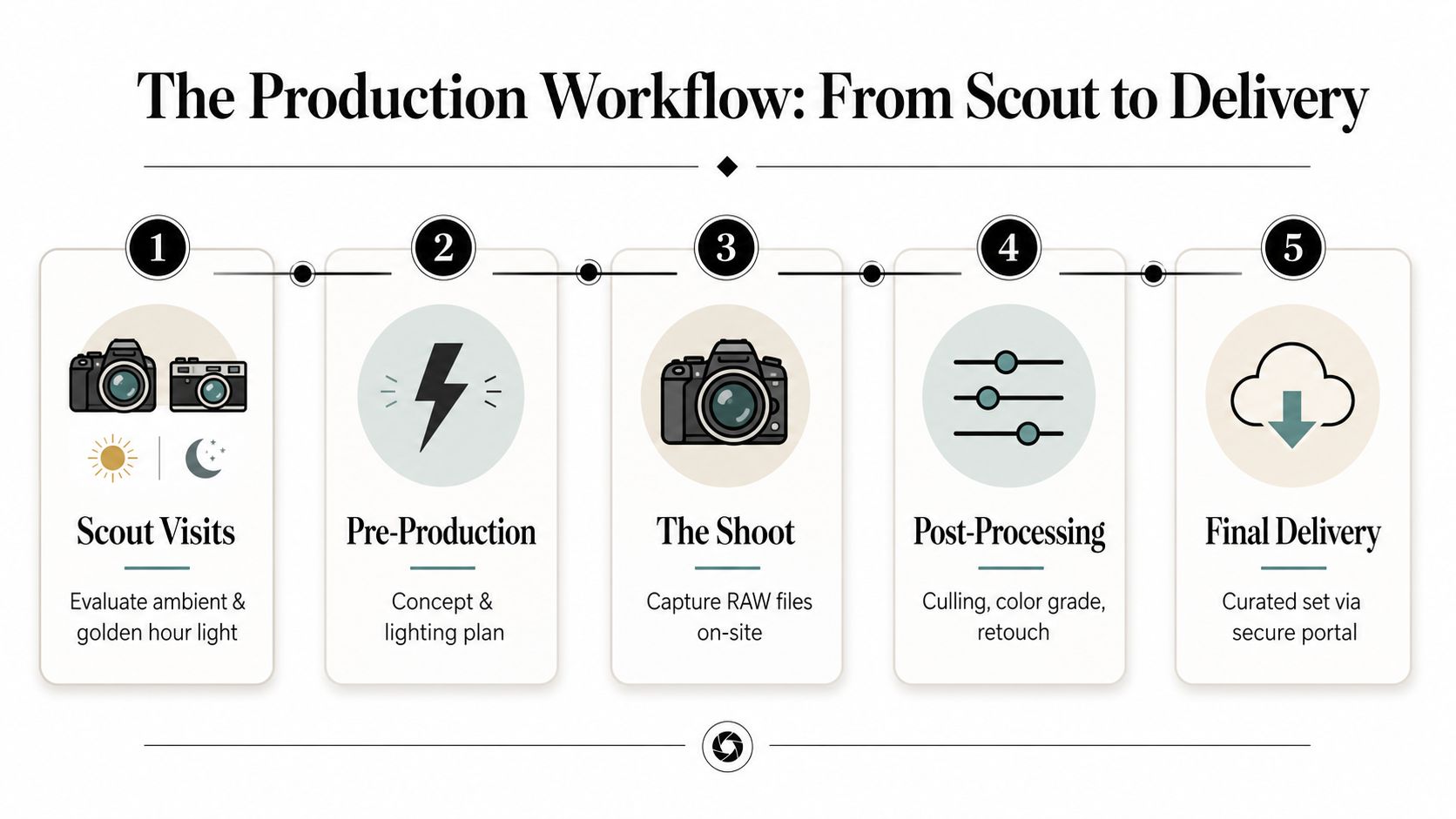
A scout should assess sightlines, access, clutter, available power, window direction, neighboring structures, and the condition of landscaping. Two visits can be useful, one in ordinary ambient light and another near the intended golden-hour or twilight window. That comparison reveals whether the desired exterior view is realistic and how quickly the light changes.
Pre-production then turns observations into a plan. The studio confirms access, coordinates cleaning and styling, checks whether permits or neighbor notifications are needed, and builds a shot list from drawings and floor plans. If a drone, street position, or additional crew is involved, those requirements need attention before the day begins.
The shoot follows priorities, not convenience
Priority exteriors often happen at sunrise or dusk, when the light is most useful. Interiors may follow under available ambient light, supplemented by strobes or continuous LED panels with diffusion. A tethered monitor can help the team review alignment, reflections, color references, and small objects that aren't obvious from the camera position.
The photographer doesn't complete a checklist and leave. Compositions are refined until verticals, edges, reflections, and visual balance hold together. A practical photo-shoot checklist helps clients prepare access, styling, personnel, and priorities before the crew arrives.
For a visual overview of the process, this production video shows how a professional architectural assignment can move from planning through capture and post-production:
Post-production has its own stages
Back in the studio, RAW files are culled before the selected images move through global color correction, perspective refinement, retouching, and compositing. Hero images may combine exposures or lighting frames, while secondary views may need only careful color and detail work.
Delivery should match the agreed use. A typical package might include edited high-resolution TIFF files, web-sized JPGs, and an organized gallery or secure portal. The studio should also explain whether RAW files are archived, included, or available under separate terms.
Understanding Pricing and What You Are Buying
A quote for architectural photography should separate creative or production fees, licensing, and expenses. A single day rate can look simple, but it often hides the most important question, which is what the client may do with the images.
| Component | What It Covers | Typical Range |
|---|---|---|
| Creative or production fee | Photographer time, expertise, assistants, equipment, and agreed production work | Varies by scope and complexity |
| Licensing fee | Media, territory, duration, exclusivity, and permitted users | Varies by intended use |
| Expenses | Travel, permits, rentals, assistants, additional retouching, and related costs | Billed according to project needs |
The creative fee reflects the work required to produce the images. A simple exterior may need less preparation than a multi-location assignment involving styling, talent, lighting assistants, and several lighting conditions. Production expenses can include travel, equipment rental, permits, crew, and post-production beyond the included allowance.
Licensing is not an administrative footnote
A firm using images on its own website has a different requirement from a developer using them in a regional sales campaign, paid advertising, signage, investor material, or a third-party brand campaign. Editorial publication, award submission, portfolio use, and commercial advertising may each require different permissions.
The ASMP architectural photography best-practices guidance supports the three-part commercial model and highlights why buyers should evaluate more than shooting time. The broader market around architecture-adjacent photography is substantial, with one 2026 projection estimating the U.S. real estate photography industry at $268.3 million, while broader research projects the global real estate photography market from $1.2 billion in 2022 to $2.8 billion by 2030, as reported by IBISWorld's industry overview.
Buyer question: Don't ask only, “What does the shoot cost?” Ask, “Which people, channels, locations, and time periods may use these images?”
Before signing, request a written estimate that identifies the creative fee, expenses, number of final deliverables, revision terms, and license. A photographer's photography price-list guidance can help organize the questions, but the final quote still needs to reflect the actual assignment.
How to Choose the Right Photographer
Start with the portfolio, but don't stop at taste. A photographer's work should show consistent verticals, controlled highlights, credible color, and accurate materials across different building types and lighting conditions.
Look for evidence that the photographer can handle the assignment you have, not merely a collection of attractive single images. Review interiors with windows, reflective finishes, complex ceilings, tight circulation, large façades, and people in occupied spaces. A portfolio that shows only ideal conditions won't answer how the photographer manages difficult ones.
Questions that reveal working standards
Ask for a complete project gallery rather than a few selected images. Then ask how the photographer handles:
- Perspective control: Does the workflow prioritize optical correction before software adjustment?
- Lighting decisions: When does the photographer use natural light, strobes, continuous fixtures, or exposure blending?
- Data protection: Are there two camera bodies, backup lighting, and an on-site storage plan?
- Shot planning: Does the team work from floor plans, drawings, a written brief, or a shared shot list?
- Revisions: Which corrections are included, and what counts as a new retouching request?
- Usage rights: Does the estimate separate creative work, expenses, and licensing?
Published editorial work can be a useful signal because it shows that images have met an external visual standard. It isn't a guarantee of fit, though. A photographer experienced in editorial storytelling may approach a property marketing brief differently from a photographer focused on detailed documentation.
Communication predicts the shoot
The photographer will spend substantial time inside the project, often directing stylists, contractors, assistants, and client representatives. A short pre-call can clarify who makes decisions, how the team handles changes, and who has authority to approve styling or access.
Jimmy Clemmons Photographer is one Atlanta-based option for clients seeking architectural imagery, commercial brand content, location scouting, lighting design, on-set direction, and professional editing. The right choice depends on portfolio fit, production method, availability, and the license required for the project.
Building Long-Term Visual Value for Your Brand
A finished project often needs images long after the original launch. The same visual library may support a website, press release, award entry, proposal, social campaign, investor presentation, or future development pitch. That makes the assignment more valuable when the studio plans for different crops, orientations, subjects, and usage contexts from the beginning.
A strong library also documents change. A property may need images before occupancy, after styling, during active use, or across different seasons. Those states answer different communication needs. An empty interior explains architecture, while an occupied space can show how the design supports people and operations.
Consistency becomes a brand asset
Working with one studio across multiple projects can create continuity in framing, color treatment, perspective, and visual tone. That consistency helps a firm's portfolio feel intentional even when the buildings differ in scale and purpose. It also reduces the need to explain the brand's visual language from scratch on every assignment.
The value isn't limited to the final gallery. A well-planned shoot can produce hero views, details, contextual images, and people-in-space frames that serve different audiences. The client should discuss those future needs before the shoot, because adding a missing category later may require another visit, another lighting setup, or a new license.
Editorial discipline expands possibilities
Architectural photography services become strategic when the images can withstand close review and still communicate design intent. Editorial-grade images can support awards, monographs, feature stories, and brand campaigns, while practical documentation can serve everyday marketing and sales needs.
The investment, then, isn't only in attractive files. It's in a durable visual record of how the firm designs, builds, manages, or inhabits space. That record shapes how clients, press, partners, and the wider industry understand the brand.
Common Questions Buyers Actually Ask
Will the photographer disclose AI-assisted editing?
Ask before the assignment begins. AI-assisted tools may help with masking, cleanup, object removal, noise reduction, or virtual staging, but those uses don't all carry the same representational risk.
Recent coverage estimates that virtual staging can cost as little as $5 to $30 per image and may produce savings of up to 95% compared with physical staging, while reporting that 71% of real-estate photographers use AI tools and some report editing speeds up to 90% faster, according to this 2026 overview of AI in real estate photography. Those figures describe an evolving market, not a reason to replace accurate capture.
For architectural work, the contract should identify whether AI may alter furnishings, views, finishes, geometry, or people. Authentic photography plus clearly disclosed post-production is safer than presenting a materially changed building as a factual record.
What usage rights are included?
A standard license should state the permitted media, territory, duration, users, and whether paid advertising, press, awards, signage, resale, or third-party use is included. An extended buyout may be appropriate for broad campaigns, but it shouldn't be assumed.
Ask for separate treatment of portfolio use, architect use, developer use, publication, and advertising. If another organization wants to use the images, obtain written permission rather than assuming the original client can transfer the rights.
What should happen before shoot day?
Assign one decision-maker and complete cleaning, landscaping, styling, access coordination, and occupancy clearance before the crew arrives. Confirm lighting controls, parking, permits, security procedures, elevator access, and the rooms that must remain available.
Also confirm delivery formats, turnaround expectations, RAW-file retention, and the revision process. Editorial and commercial schedules can differ, so agree on priority images if the entire gallery can't be completed at once. If people will appear, decide who handles casting, wardrobe, releases, and direction. Some photographers can art-direct talent and stylists, while others expect the client to provide that production support.
For architectural photography services that combine scouting, lighting design, on-set direction, and carefully edited imagery, visit Jimmy Clemmons Photographer. Share your project type, location, intended uses, and timeline to begin a practical conversation about the right production and licensing plan.