
You're probably here because you've felt the same pressure most commercial photographers and clients feel before a serious shoot. The location is booked. The client has opinions. The light window is tight. Everyone wants polished images, but nobody wants the day to drift into improvisation and missed frames.
That's where shot list photography stops being a basic checklist and starts becoming a production tool. In architectural and commercial work, a shot list isn't just a reminder of what to photograph. It's the document that turns client goals, design intent, site logistics, lighting conditions, and crew coordination into a workable plan.
The difference matters most when the subject is a built environment. A portrait session can often absorb a little spontaneity. A hospitality space at sunrise, a corporate interior with mixed lighting, or a commercial exterior with limited access can't. If the right angle gets missed when the light is right, you don't always get a second chance.
Why a Professional Shot List Is Your Blueprint
A weak shoot usually looks organized right up until the first problem appears. The client asks for a hero exterior they assumed was obvious. The assistant is setting up the wrong lens. A room that should have been photographed before housekeeping traffic is now unusable. The team starts reacting instead of executing.
A professional shot list prevents that spiral because it functions as a definitive strategic document. It maps every required shot, tracks the technical and logistical details behind each frame, and gives the crew a shared operating plan. In practice, that means the photographer isn't making every decision from scratch on site.

What the document actually does
A proper shot list does more than say “wide shot of lobby” or “detail of facade.” Industry standards define it as tracking core details for each shot, including shot number, scene number, shot type, camera angle, movement, framing, location, and production notes. That level of detail protects the narrative intent of the image set and keeps the crew aligned.
It also gives the client something concrete. Abstract requests like “make it feel premium” or “show the space flowing well” can be translated into specific frames with specific priorities. Once that happens, the brief becomes actionable.
Practical rule: If a shot matters to the client, it should exist on the list before the crew unloads a case.
Without that roadmap, shoots often suffer from inefficiencies that can extend production time by 20 to 30%, directly increasing labor and equipment costs. The fix is simple but disciplined. Group shots by camera setup rather than scene order, which reduces resets and protects the day's budget.
Why pros group by setup, not by story order
Clients tend to think in finished images. Crews need to think in sequences of effort. If three shots in different deliverables require the same lens, similar framing height, and one lighting setup, those shots belong together on set even if they appear in different parts of the final campaign.
That's the operational value of shot list photography. It turns a creative brief into a workflow.
A good list also separates priority shots from optional coverage. That gives you room to capture alternate angles and details without risking the essentials. If weather shifts, a room becomes unavailable, or the client adds a last-minute request, the list tells you what cannot be sacrificed.
For a practical pre-production companion, a detailed photo shoot checklist for commercial projects helps support the same discipline from packing through final walkthrough.
The Foundation Defining Your Photographic Goals
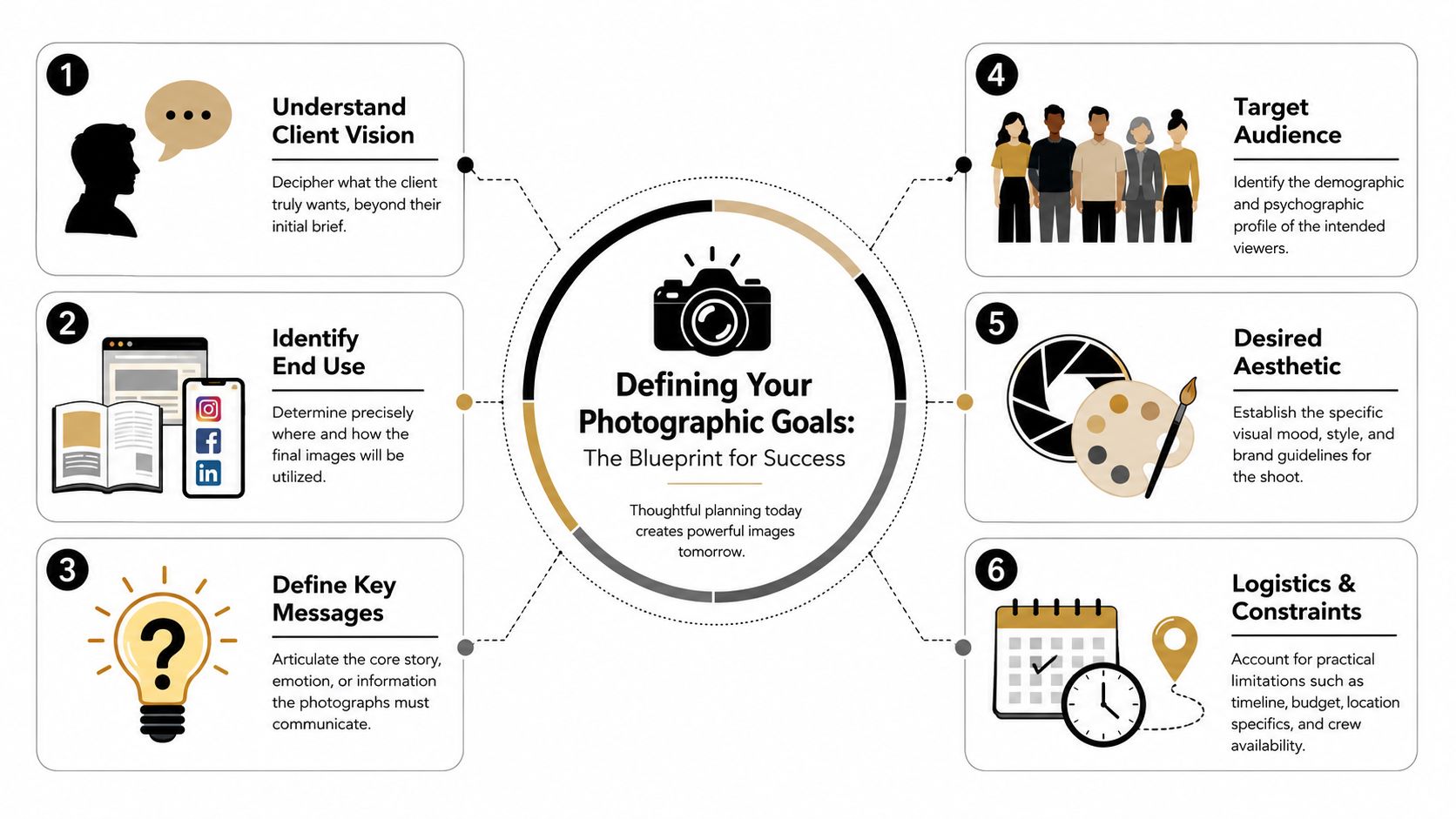
A client walks you through a finished space and says, “We need the lobby, two offices, the conference room, some exterior views, and a few detail shots.” That sounds clear until specific questions arise. Which image has to carry the website header? Which frame needs room for a headline? Which space only looks right for 18 minutes before the sun flattens it?
That is where a usable shot list starts. In commercial and architectural work, the list has to do more than name subjects. It has to connect business goals, audience, timing, lighting, and final deliverables before anyone sets a tripod.
Start with end use, not the room list
Rooms do not determine the shot list by themselves. Usage does.
A website hero banner needs width, clean negative space, and composition that survives responsive crops. A social vertical needs a different camera height and a different balance of ceiling, floor, and subject. A print spread gives more room for subtle detail, but it also exposes weak styling and small perspective errors that slide by on a phone screen.
The first planning call should answer a set of practical questions:
- Where will the images appear: Website banners, project pages, social posts, print features, proposals, or signage.
- What format is required: Square, horizontal, or vertical.
- Will designers need copy space: Text overlay changes framing decisions immediately.
- Who is the audience: Prospective tenants, investors, hospitality guests, editorial readers, or a corporate recruiting team.
- What must the images communicate: Luxury, efficiency, warmth, scale, material quality, occupancy, or brand culture.
Those answers affect lens choice, camera position, styling tolerance, and exposure strategy. They also tell you which frames need backup versions. If the client needs one image to serve both web and print, I plan for that early because it often means a looser composition, tighter control of verticals, and more retouching discipline later.
Define the communication goal before listing frames
A strong shot list begins with intent. The building is the subject, but the assignment is usually about something more specific.
A law firm may want images that feel established and private. A hotel group may need warmth, flow, and guest experience. A developer may care about leasing appeal, natural light, and the relationship between amenity spaces. I can photograph the same lobby three different ways depending on which of those goals matters most.
That is why I write the communication target before I write the frame list. Once the message is clear, the shot choices become easier. So do the lighting decisions. If the client wants the space to feel bright and open, I may schedule for directional morning light and plan softer fill to hold contrast in check. If they want mood and material richness, I may protect shadow depth, wait for lower ambient levels, and build the frame with more controlled supplemental light.
The best shot list starts with what the images need to accomplish, then works backward into framing, timing, and exposure.
This is also where high-stakes work separates itself from generic checklist shooting. A list that says “conference room wide shot” is incomplete. A professional note says whether that frame needs to show video capability, daylight quality, premium finishes, seating density, or copy space for a brochure cover. It should also note whether the room reads best with ambient light only, with added strobe, or as a blended exposure.
Build one working document that supports the day
Scattered notes create missed shots. One working file keeps the crew aligned.
For architectural and commercial assignments, that file usually combines the creative brief, shot list, stakeholder requests, reference images, access notes, and timing windows. If a stylist, designer, marketing lead, and property manager are all involved, their input needs to land in one place. Otherwise the crew spends the day answering preventable questions on site.
I also include production notes that affect how the image will be made. Window direction. Best time for exterior sun angle. Whether practicals should stay on. Whether a hero interior needs exposure brackets, flash composites, or a single ambient frame. Those are not technical footnotes. They are planning decisions that protect the schedule.
Here's a useful companion video that reinforces that planning mindset:
What belongs in the master planning file
A usable planning file often includes these elements:
Client objective
A plain statement of what success looks like.Audience message
What the viewer should understand or feel after seeing the images.Deliverable map
Final use, orientation, crop needs, and composition notes for each asset type.Visual references
Mood images, prior campaign examples, or marked-up screenshots.Lighting and exposure notes
Time-of-day targets, window strategy, practical-light plan, and whether the frame calls for ambient, strobe, or blended capture.Constraints
Access hours, weather dependency, occupancy, site readiness, and styling limits.Timing buffer
Setup time, capture time, and contingency built into the day.
That foundation turns a shot list into an on-set plan the crew can use. It also gives you a way to adjust under pressure without losing the client's priorities.
Building Your Shot List with Categories and Sequences
A usable shot list does two jobs at once. It tells the client what will be covered, and it tells the crew how to get it done without wasting light, labor, or setup time.
That only happens if the list is organized around production reality.
Use categories that match image function
For architectural and commercial assignments, I group shots by what the image needs to accomplish. Clients approve images by purpose. Art directors do the same. They are looking for the lead frame, the supporting frame, the detail that sells material quality, and the context shot that explains how a space works.
A category structure that holds up on set usually includes:
Establishing shots
Wide views that define the site, building, or room in context.Hero shots
The frames carrying the campaign, listing, or portfolio set. These usually get the best light window, the most styling attention, and the tightest exposure control.Detail and vignette shots
Materials, fixtures, signage, finishes, and smaller compositions that add texture to the story.Contextual shots
Frames that explain circulation, adjacency, use, or how one space connects to another.
That grouping keeps the list tied to business purpose. It also makes approvals cleaner because everyone can see which images are required, which ones support the hero set, and which alternates can wait if the day tightens.
Build each line item for execution
A shot list fails when it reads like a wish list. The crew needs enough detail to prep the room, choose gear, and anticipate the lighting approach before the camera goes on the tripod.
I treat each row as a small production brief.
If a west-facing conference room is scheduled for late afternoon, that row should already tell me whether the practicals stay on, whether window pull is part of the plan, and whether the frame is intended as a clean ambient image or a blended exposure. That kind of thinking starts before the shoot, not while clients are standing behind the monitor. For location work, a clear plan for choosing the best light for a site shoot keeps those calls from getting pushed into crunch time.
Useful columns often include:
| Field | Why it matters |
|---|---|
| Shot number | Gives the team a shared reference during capture and review |
| Location or scene | Prevents confusion on larger properties or multi-room sites |
| Shot description | States what the frame must communicate |
| Shot type | Separates hero, establishing, detail, and context images |
| Angle and framing | Reduces repeated testing from nearly identical positions |
| Camera position notes | Helps assistants place support gear and protect composition continuity |
| Lens choice | Maintains perspective discipline across the set |
| Lighting and exposure plan | Flags ambient, strobe, blended capture, brackets, and practical-light decisions |
| Priority | Shows what gets protected if access or light changes |
| Production notes | Covers styling, props, access limits, occupancy, and client-specific requests |
Sequence by setup efficiency
The strongest shot lists are rarely shot in the order the final gallery will appear. They are built around effort, gear movement, and changing light.
On a commercial interiors job, I may start with the hero lobby view at the exact time the window light is usable, then stay locked into that side of the building long enough to capture supporting angles, details, and alternate crops before moving stands or furniture. If the list is written in final presentation order, the crew ends up bouncing between floors, revisiting rooms, and rebuilding the same setup twice.
A better sequence often looks like this:
- Capture time-sensitive exterior angles during their specific light window.
- Move into rooms that share the same exposure strategy and lighting footprint.
- Finish supporting details while the main composition is still dressed and lit.
- Leave lower-priority alternates for the end of each setup.
One rule saves a lot of time. Get every frame available from a locked camera position before changing anything.
That includes verticals, horizontals, tighter crops, and detail cutaways that depend on the same styling and light balance. Once the room shifts, the original frame usually costs more to rebuild than photographers expect.
Good shot-listing is not static paperwork. It is a working sequence that accounts for access, styling resets, lighting transitions, exposure method, and crew effort. That is what turns a list of desired images into an on-set plan that can survive a real production day.
A Pro Template for Architectural and Commercial Shoots
A client signs off on a clean, polished shot list in pre-production. Then the execution challenges arise. The west facade only works for a short window, the lobby needs supplemental fill to hold the view outside, and the conference room glass turns every light stand into a reflection problem. If the template only tracks subject and location, it falls apart the moment technical decisions start affecting schedule.
That is why architectural and commercial shot lists need to function as production documents, not simple checklists. The list has to carry the exposure approach, lighting intent, lens choice, and timing for each setup so the crew can execute without stopping to solve the same problems from scratch on site.
What generic templates leave out
Many templates cover the obvious fields: location, subject, and a short description. For built environment work, that is not enough. The harder decisions usually sit behind the frame. How much of the ambient do you want to keep? Are practicals part of the composition or just background fill? Does the shot need a tilt-shift lens for perspective control, or is a standard wide lens acceptable because the final use is casual marketing rather than a strict architectural portfolio image?
I usually record aperture, bracketing needs, and any supplemental lighting plan before the shoot. In architectural work, a frame often lives in the middle aperture range for lens performance and depth of field, but that is a working recommendation, not a rule you copy into every scene. The right choice depends on the space, the lens, the output size, and whether the shot needs strobes, ambient layering, or exposure blends.
That missing technical layer causes predictable problems:
- Lighting gets decided too late, after the room is styled and the crew is waiting.
- Lens choices drift, which makes the final set feel inconsistent.
- Key scenes miss their best light, because no one marked a real capture window.
- Exposure decisions become reactive, which slows production and increases post work.
Photographers who want to tighten that planning process should pair the shot list with a clear approach to choosing the best light for a site shoot.
A working template
Use a template that gives the technical plan its own space.
| Shot # | Priority | Location/Scene | Shot Description | Shot Type | Angle/Framing | Lighting Plan | Lens Choice | Time of Day | Notes |
|---|---|---|---|---|---|---|---|---|---|
| 01 | Must Have | Front Exterior | Main entrance with signage visible | Hero | Slight low angle, horizontal | Natural light, interior lights on | 24mm tilt-shift | Early morning | Clean driveway, confirm no parked cars |
| 02 | Must Have | Lobby | Reception desk and seating | Establishing | Eye level, wide | Ambient plus bounced fill | 24mm | Mid-morning | Hide cords, align chairs, balance window exposure |
| 03 | Nice to Have | Corridor | Material transition at wall and floor | Detail | Tight crop | Available light, flag reflections | 50mm | Flexible | Watch specular highlights |
| 04 | Extra | Rooftop | Amenity area with skyline context | Contextual | Wide, open framing | Natural light | 35mm | Late afternoon | Check occupancy and wind |
Why these columns matter
Priority protects the assignment. If access changes or weather cuts the day short, the team knows which frames carry the job.
Lighting plan affects crew time, gear movement, and exposure method. A note like "ambient only" leads to a different setup than "strobe through diffusion, hold window detail."
Lens choice keeps perspective under control across the set. That matters in architecture because one careless focal length can make a room feel distorted next to the rest of the gallery.
Time of day keeps the list tied to actual site conditions. Morning side light, flat overcast, dusk practicals, and sun-tracking across an interior all create different pictures.
Notes are where production realities live. Styling resets, access restrictions, occupancy concerns, and reflection issues belong in the template because they affect whether the shot is easy, expensive, or impossible at that moment.
A strong template does more than name the picture. It tells the crew how the picture gets made.
On-Set Workflow and Adapting in Real Time
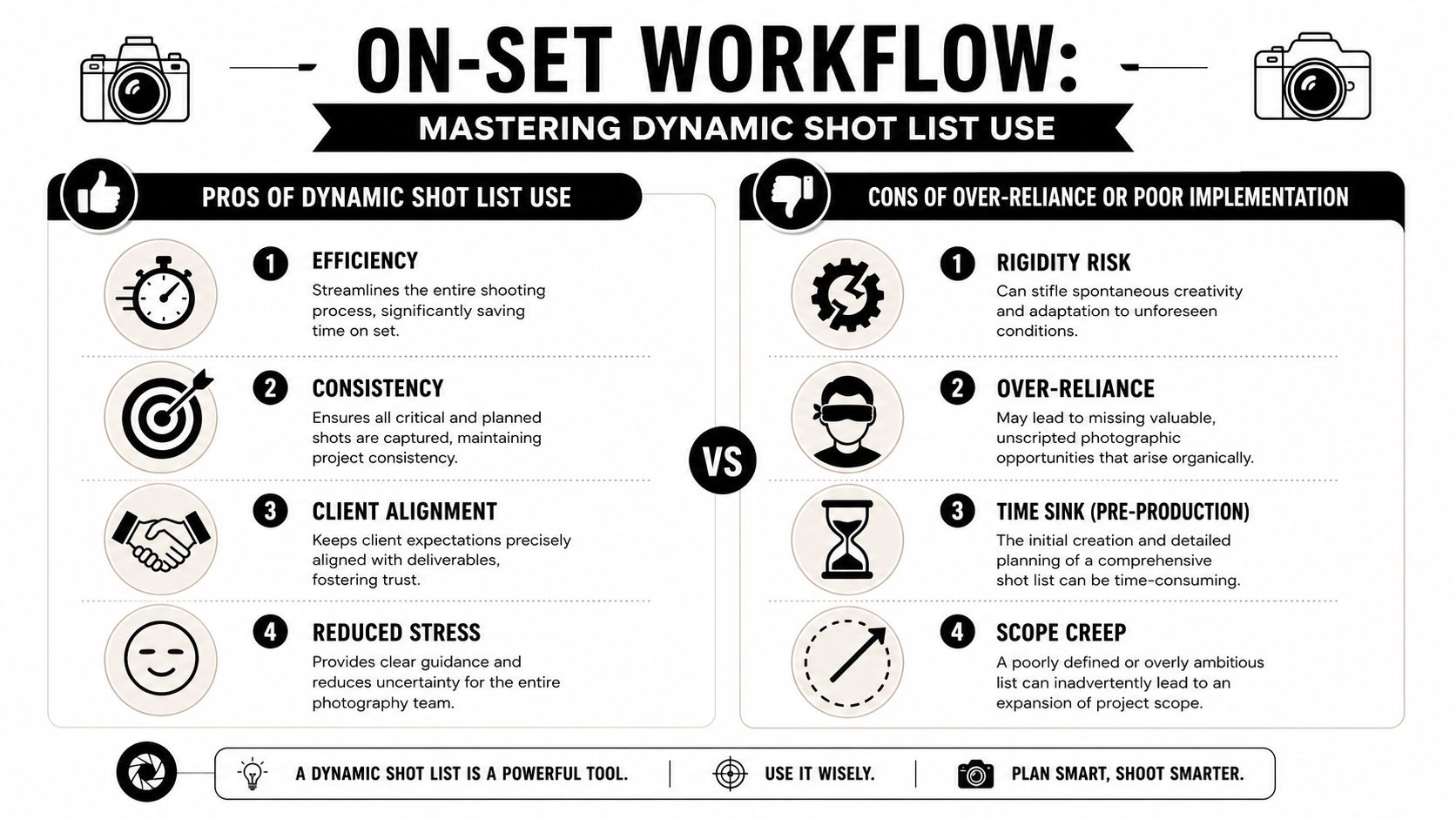
A good shot list shouldn't lock you into rigidity. It should give you a controlled way to adapt when the day changes. That distinction is where one might either overvalue the list or abandon it too quickly.
On site, the list has to behave like a live production document. You'll mark progress, reorder sequences, and sometimes cut shots. The key is that those changes happen against a known priority structure.
A real-world workflow for a changing site
Take a typical architectural assignment. You arrive for a sunrise exterior, but service vehicles are still on site. The low-angle facade shot is blocked. If your list is static and chronological, the crew stalls. If your list is adaptive, you pivot to a prepared secondary setup, maybe a tighter detail facade or an interior scene that works in early light.
That's why commercial shot lists need to be easily modifiable and broken into categories like Must Haves and Extras. Organizing by setup complexity instead of by item also reduces excessive equipment changes, as noted in this guidance on flexible shot list use in live environments.
What adaptation looks like without losing control
An adaptive workflow usually follows this pattern:
Walk the site first
Confirm what has changed since scouting. Light, access, styling, and occupancy always shift.Lock the must-haves early
If the day collapses later, the assignment is still covered.Shoot in setup clusters
Finish every viable frame from one camera position or lighting build before moving on.Reclassify in real time
A planned hero frame can become an extra if weather or obstructions make it weak.Communicate changes out loud
Clients and crew stay calm when they understand the trade-off.
Don't protect the list at the expense of the job. Protect the job by using the list to decide what changes.
Where photographers get into trouble
The common failure isn't flexibility. It's unstructured flexibility. Someone starts chasing every idea, the order collapses, and suddenly the team is burning time on lower-value images while the critical frames remain unfinished.
That's why I prefer a three-tier priority system in practice:
| Priority tier | On-set meaning |
|---|---|
| Must Haves | Required deliverables. Missing these is not acceptable. |
| Details | Supporting frames that deepen the story and help editors or marketers build layouts. |
| Extras | Opportunistic shots if time, light, and access cooperate. |
This is also where site prep matters. A better-prepared location gives the shot list room to work. If furniture isn't placed, surfaces aren't clean, or access routes are blocked, the best sequence on paper won't hold. A planning resource on how to prepare your project site for a professional photoshoot can save a lot of friction before the crew even arrives.
The list should absorb surprises, not deny them
The irony of shot list photography is that the stronger the plan, the easier it is to notice and capture the unexpected. Once the essentials are covered, you can respond to the good surprise. A reflection appears in the glass. Clouds break at the right moment. A corridor suddenly clears. A hospitality space gains life when staff movement falls into place.
Those frames often become favorites, but they happen more reliably when the must-haves are already under control.
Conclusion Bringing Your Photographic Vision to Life
A shot list doesn't reduce creativity. It protects it.
When the planning is weak, the shoot day gets consumed by avoidable decisions. Which room comes next, what lens should be on the camera, whether the client expected a vertical crop, whether the exterior should've been photographed earlier. None of that is creative work. It's operational drift.
Shot list photography's chief value is that it moves those decisions upstream. It translates strategy into sequence. It gives the crew a common language. It tells the client their priorities have been heard. And for architectural and commercial assignments, it brings lighting, lensing, timing, and exposure into the same document instead of scattering those choices across emails, memory, and guesswork.
What works and what doesn't
What works is a shot list built from the final use of the images, organized by priority, grouped by setup, and detailed enough to guide technical execution.
What doesn't work is a generic checklist full of vague prompts, no lighting plan, no exposure notes, and no room for adaptation once the site conditions change.
A strong shot list is invisible in the final images, but you can feel its discipline in every frame.
That's why the best photographers in this space treat the list as both a creative brief and a production map. It keeps the day efficient, but above all, it keeps the visual story intact. The final image set feels coherent because the thinking behind it was coherent.
If you want more from your shoots than a pile of decent coverage, the shot list is where that standard begins. Not as paperwork. As craft.
If you need architectural, commercial, or brand imagery planned with that level of precision, Jimmy Clemmons Photographer brings an editorial eye, disciplined lighting strategy, and a production-first approach that helps clients get purposeful images without chaos on set.