
Your website is polished. Your proposals are sharp. Your team does good work. Then someone opens the About page, the recruiting deck, or the new development brochure and sees a mix of stock images, headshots from different years, phone snapshots from job sites, and interiors that don't match the quality of the spaces you design or manage.
That disconnect costs more than is often realized.
In architecture, development, hospitality, and corporate branding, photography often gets treated like a line item to fill after the important work is done. In practice, it shapes how buyers, tenants, partners, editors, and prospective hires read your brand before they speak to anyone. Strong visuals don't just document a project. They explain taste, standards, scale, and trust.
That's why corporate photography packages are worth looking at as a strategic build, not a commodity purchase. If you're weighing options, this guide should help you separate a simple photo session from a package that supports your brand narrative.
Your Brand's Visuals Need an Upgrade
A common scenario goes like this. The marketing team is preparing a website refresh. Leadership wants updated portraits. The business development group needs images for a conference deck. The architecture team wants the newest project photographed before award submissions go out. Then everyone realizes the image library is a patchwork.
Some files are too old. Some were shot under office fluorescents with no direction. Some don't fit the current brand at all.
That's usually the moment when the conversation starts with price. It makes sense. Budgets are real. But the more useful question is what the imagery needs to do. A corporate portrait can signal confidence or indifference. A photograph of a workplace can communicate design intelligence or visual noise. An exterior shot can make a building feel iconic or forgettable.
For firms that sell expertise, environment, and reputation, the gap between those outcomes matters.
A strong package solves more than one problem at once. It creates a coherent visual language across leadership portraits, team culture, built spaces, details, and brand moments. It also reduces the hidden cost of constantly scrambling for “good enough” images before each new campaign, announcement, or pitch.
Good corporate photography doesn't just make a company look better. It helps the company explain itself faster.
If you're assessing whether it's time to invest, this perspective on the ROI of professional photography is a useful place to start. The practical shift is simple. Stop asking whether you need photos. Ask whether your current visuals are helping your business present the level of work you already deliver.
What Is Inside a Corporate Photography Package
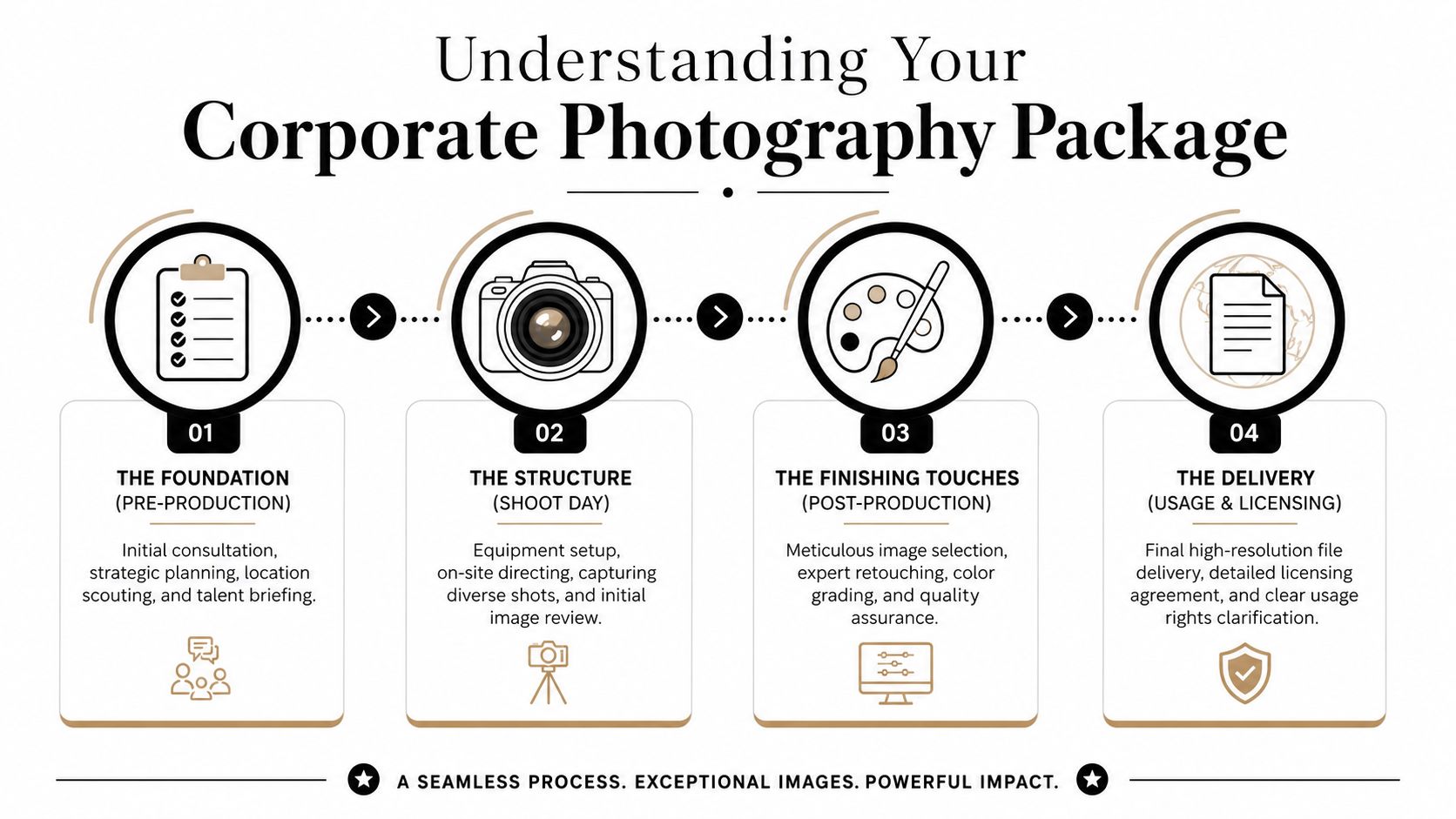
A solid package works like an architectural project. First comes the plan. Then the build. Then the finish work. Finally, there's the handoff and documentation that tells everyone how the asset can be used.
That's why corporate photography packages vary so much. You're not only buying camera time. You're buying planning, control, editing judgment, and a delivery structure that supports real business use.
The Foundation in Pre Production
The strongest shoots are usually won before anyone unpacks a light stand.
This stage includes the consultation, creative brief, scheduling, location review, shot planning, and coordination with your internal stakeholders. For an architecture firm, that may mean deciding whether the assignment is documenting design intent, creating editorial-style imagery, or producing a clean marketing library for proposals and website use. For a brand team, it may include wardrobe direction, office styling, product placement, and deciding whether the images should feel formal, candid, or campaign-driven.
A useful way to evaluate package quality is to ask what happens before the shoot. If the answer is vague, the results usually are too. Teams comparing options often benefit from reviewing examples of brand photography services for business use because the planning differences are easier to see there than in a simple price sheet.
The Structure on Shoot Day
Shoot day is where preparation gets tested.
This part of the package may include crew, lighting, location access, staging, on-site direction, tethered review, and multiple setups across portraits, spaces, and detail shots. In high-end architectural and brand work, direction matters as much as equipment. The photographer has to read lines, reflections, color casts, clutter, sightlines, and how people move through a frame.
What works:
- Clear shot priorities: Hero images get protected first, then supporting frames are built around them.
- On-site decision making: Furniture moves, blinds shift, practical lights are adjusted, and compositions are refined in real time.
- Enough time for transitions: Rushed moves between locations almost always show up in the final gallery.
What doesn't work:
- Treating every image the same: A CEO portrait, a lobby interior, and a construction-progress detail don't need the same approach.
- Skipping art direction: Even authentic brand imagery needs guidance.
- Assuming “we'll fix it later” in editing: Good post-production improves files. It doesn't rescue weak planning.
A quick visual overview helps:
The Finish Work and Delivery
After the shoot, the package moves into culling, color work, retouching, file prep, and delivery. During these stages, consistency gets built. Architectural imagery often needs careful perspective control, color neutrality, and cleanup without making the space feel artificial. Brand portraits need polish without making people look over-processed.
The final component is delivery and usage structure. That includes the selected file set, export types, and the licensing terms that define where and how the imagery can be used. That last piece gets overlooked far too often, and it shouldn't.
Understanding Photography Pricing and Investment Ranges
Price matters, but price alone doesn't tell you what you're buying.
Some corporate photography packages are built around a half-day or day rate. Others are quoted as a project fee tied to scope, deliverables, and usage. Neither model is automatically better. The right one depends on whether the assignment is simple and contained or layered and multi-use.
What the Market Range Actually Tells You
In major U.S. markets, corporate photography packages typically range from $3,000 to $5,000 for high-demand professionals, while national or global projects can exceed $10,000 because they involve more production expense and specialized talent. Those packages commonly include 20 to 30 high-resolution digital images with advanced editing and digital delivery, based on commercial and corporate photography pricing benchmarks.
That range is useful, but only if you understand what drives movement within it. A simple executive portrait day inside one office is very different from a multi-location brand shoot involving interiors, leadership, employee culture images, and architectural exteriors timed around light.
What Pushes a Package Up or Down
The biggest pricing variables are usually scope and control.
- Project complexity: More visual objectives require more planning, more setups, and more selective post-production.
- Location demands: Travel, access windows, weather coordination, and active workplaces all increase production load.
- Crew and gear needs: A solo portrait session and a production with assistants, stylists, or specialized lighting aren't priced the same.
- Licensing breadth: Broader commercial use generally carries more value than narrow internal-use rights.
- Retouching depth: Basic cleanup is one thing. Detailed composite work, perspective refinement, and image-by-image polishing take more time.
Practical rule: If two quotes look far apart, compare the process, the image count, the retouching standard, and the usage terms before you compare the totals.
Day Rate or Project Fee
A day rate can work well when the assignment is flexible and the client needs coverage within a fixed block of time. It's straightforward, especially for recurring corporate work.
A project fee is often better for architecture and brand narrative assignments because it accounts for the full build. That includes planning, shot list development, location considerations, editing, and the intended use of the final imagery. It also reduces the temptation to judge the work by hours on site alone.
If you need a baseline for local budgeting, a published photographer price list can help frame the conversation. The smarter comparison, though, is whether the package is built to create assets your team can use across web, print, proposals, editorial outreach, and recruiting.
Example Packages for Architecture and Brand Teams
Most buyers don't need a generic menu. They need a package that matches the kind of story they're trying to tell. A leadership team needs authority and consistency. A marketing department needs a flexible content library. An architecture or development team often needs photographs that show form, light, materials, and use with precision.
Here's a practical way to think about sample corporate photography packages.
Sample Corporate Photography Packages
| Feature | Tier 1 The Leadership Portfolio | Tier 2 The Brand Narrative | Tier 3 The Architectural Record |
|---|---|---|---|
| Primary purpose | Executive and team portraits | Multi-use brand content library | High-end documentation of built environments |
| Typical subjects | Leadership, department heads, selected staff | Leadership, staff interactions, workplace culture, products or service moments | Exteriors, interiors, design details, contextual images |
| Shoot structure | Focused portrait session in one location | Broader assignment with multiple setups and scene changes | Time-sensitive shoot planned around light, access, and space readiness |
| Art direction level | Moderate | High | High, with strong emphasis on composition and spatial clarity |
| Retouching approach | Portrait polish and consistency | Mixed retouching across people, spaces, and brand moments | Detailed correction for lines, color balance, and environmental distractions |
| Licensing fit | Website, bios, decks, press materials | Website, social, campaigns, recruiting, internal communications | Portfolio, awards, editorial submissions, marketing, leasing, and stakeholder presentations |
| Best for | Firms updating their public-facing leadership presence | Companies building an image library for ongoing content use | Architecture firms, developers, hospitality groups, and property teams documenting a project properly |
How to Choose the Right Tier
The mistake I see most often is under-scoping the assignment.
A company needs portraits, then adds culture images. Then someone asks for office interiors. Then the sales team wants banner images for a trade event. By the time the request is complete, the original package no longer fits the job. That creates pressure on time, editing, and final consistency.
Use these filters instead:
- Choose Leadership Portfolio if your main need is polished portraits with a unified look across executives or key staff.
- Choose Brand Narrative if marketing needs a versatile image bank that supports multiple channels over time.
- Choose Architectural Record if the images must communicate design quality, materiality, scale, and atmosphere with care.
A package should match the communication goal, not just the calendar slot.
What High End Architecture Work Requires
Architectural imagery usually needs a different production mindset from general corporate coverage. The building has to be ready. Styling decisions matter. Reflections, window balance, exterior timing, occupancy, and line control all affect the final image.
That's why a serious package for architecture or real estate teams often feels less like event coverage and more like a measured editorial production. The output may still live on a website or in a brochure, but the standard is closer to publication work than casual business content.
The Professional Photography Workflow and Timeline
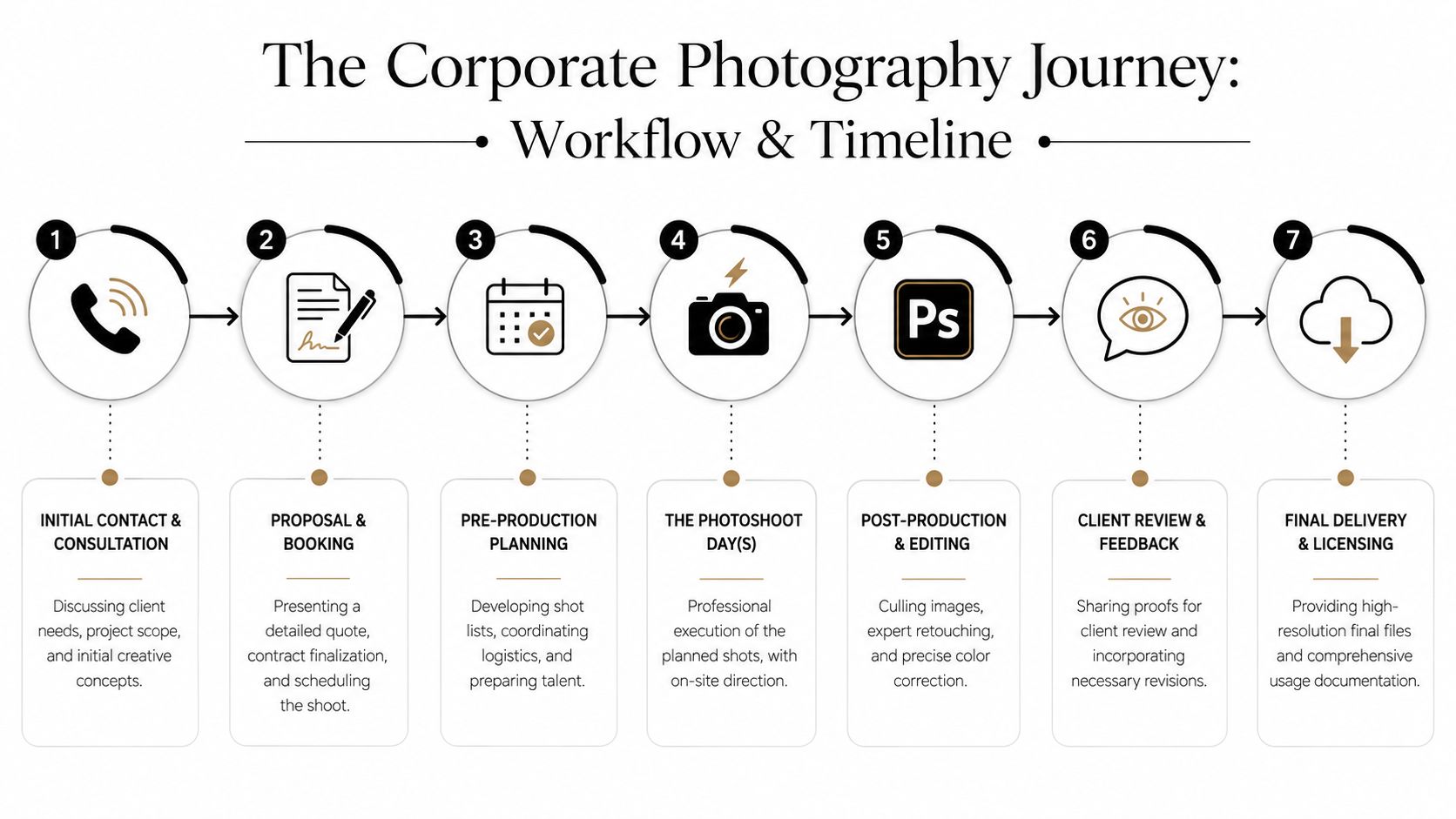
The client experience should feel organized from the first call to the final file delivery. If the process is loose, the work usually is too. Professional workflow matters because it protects time, budget, expectations, and the image assets themselves.
From Inquiry to Booking
The first conversation should identify the true assignment. Not just “we need photos,” but what kind, for whom, where they'll be used, and what has to be true for the project to feel successful.
After that comes the proposal, scope confirmation, scheduling, and contract paperwork. At this stage, professional standards matter. According to industry guidance on client standards for photographers, expert-level packages should clearly disclose turnaround time, payment terms, total cost estimate, required contract documents, deliverable types and quantities, and delivery method. The same guidance also says professionals should maintain a backup system with one hard drive backup, a cloud backup, and an accessible working copy, and carry professional-level liability insurance.
Those aren't administrative extras. They're part of risk management.
Pre Production Through Review
Once booked, the project moves into active planning. During this stage, shot lists, site logistics, contact roles, wardrobe notes, access timing, and production priorities get locked in. For architecture and interiors, this phase often includes identifying the best time of day for each view and confirming that the space is camera-ready.
On the shoot day itself, the team executes the agreed scope. Depending on the assignment, that can mean portraits first, spaces second, or the reverse if daylight is the controlling factor.
After capture, the workflow continues in a sequence that should feel predictable:
- Initial cull: The photographer narrows the raw capture set to viable proofs.
- Client selection: The client reviews a proof gallery or contact set and marks finals.
- Retouching and finishing: Selected images are refined to the promised standard.
- Delivery: Final files are exported, organized, and sent in the agreed format.
If a photographer can't explain the workflow clearly, it's harder to trust the schedule, the handoff, or the protection of your files.
Why Timelines Need Breathing Room
Clients often focus on the shoot date. The better focus is the full timeline. Corporate photography packages don't end when the camera is packed. Review cycles, internal approvals, retouching, and file prep all affect when the images become usable for a launch, submission, or campaign.
The best projects leave margin. That protects quality and gives the client room to make good selections instead of rushed ones.
Navigating Image Licensing and Usage Rights
This is the part of corporate photography packages that causes the most confusion and the most avoidable friction.
A client often assumes that paying for the shoot means owning the images outright. In most commercial photography arrangements, that isn't how it works. The photographer typically retains copyright and grants the client a license that defines how the images may be used.

Why This Deserves More Attention
This issue isn't minor. A 2026 survey summary says 60% of business clients report confusion over image rights, while only 15% of photographer FAQs clearly explain copyright ownership versus licensing terms, according to this discussion of headshot photography FAQs and image rights. That gap creates disputes and weakens trust.
If the package language only says “final edited images delivered,” that's not enough. The contract should state who owns the copyright and what the client is allowed to do with the files.
What a License Should Spell Out
A useful license answers practical questions, not legal riddles.
- Where can the images appear such as websites, social media, digital ads, printed collateral, editorial submissions, or internal communications.
- Who can use them such as the parent company, subsidiaries, franchisees, development partners, or outside PR agencies.
- For how long the usage applies.
- Whether there are restrictions on resale, transfer, or third-party distribution.
Some clients need broad, long-term commercial rights because the imagery will support campaigns, leasing materials, investor decks, and ongoing web use. Others need narrower use for a specific launch or internal purpose. Those aren't the same value proposition, so they shouldn't be treated as if they are.
Clear licensing protects both sides. The client knows what they've paid for, and the photographer knows the agreed scope of use.
The Question to Ask Before You Sign
Ask this directly: What exactly are we licensing, and where can we use it?
If you need photos for a company website today and a national ad campaign later, say that up front. If an architecture firm plans to submit the work for awards, publish it in a monograph, and share it with consultants, that should be written into the agreement. Ambiguity feels convenient at the start. It becomes expensive later.
For some buyers, this is also the point where they compare providers by process rather than headline rate. A studio such as Jimmy Clemmons Photographer can be evaluated on that basis because the work spans architectural imagery, commercial brand content, and professional portraits, which often require different licensing discussions under one assignment.
Frequently Asked Questions About Corporate Photography
How far in advance should we book
Book as early as your internal timeline allows, especially if the project involves multiple stakeholders, active commercial spaces, or architecture that needs to be shot under specific conditions. Strong photography depends on access, readiness, and coordination. Last-minute scheduling usually reduces options.
What if we have multiple offices or properties
That's common. The cleanest approach is to treat the work as one coordinated project with a shared visual standard. The package should account for travel, scheduling across locations, and consistency in lighting, framing, and post-production so the final image library feels unified instead of assembled from unrelated shoots.
What happens if we need more images than planned
This should be addressed before the shoot. Some packages define a fixed number of final files with the option to add more selections later. Others are built around broader coverage with post-shoot image selection. The key is clarity. If your marketing team expects a long-term content library, scope for that from the start.
Can we include both portraits and architectural imagery in one package
Yes, if the production plan supports both. It can be efficient to combine them, but only if the schedule respects what each image type needs. Portraits require subject coordination and direction. Architectural work depends on space readiness, composition control, and often very specific light conditions. Combining them works best when the package is designed around that reality.
Do we need to prepare the space before the photographer arrives
Absolutely. Photography sees everything. That includes uneven staging, burned-out bulbs, wrinkled signage, clutter, fingerprints on glass, and furniture that's slightly off axis. In architecture and interior work, the final result often depends as much on site readiness as on camera technique.
Can we get physical products as part of the package
Yes, and more clients are asking for them. A 2026 industry report summary says 72% of corporate clients expect premium tangible products in photography packages, while 89% of photographer websites and package descriptions don't mention those add-ons, according to this portrait and package FAQ discussion. If your team wants presentation prints, branded keepsakes, or gift-ready photo products for leadership, employees, or clients, raise that early so it can be planned properly.
What should we ask before approving a package
Use this short checklist:
- Ask about scope: Confirm what subjects, locations, and final uses are included.
- Ask about process: Make sure planning, shoot execution, proofing, and retouching are all defined.
- Ask about delivery: Clarify file formats, gallery method, and timeline.
- Ask about licensing: Get the usage rights in writing.
- Ask about contingencies: Confirm how additions, rescheduling, and location complications are handled.
The best corporate photography packages don't just answer these questions. They anticipate them.
If you're planning updated portraits, architectural imagery, or a broader brand content library, Jimmy Clemmons Photographer offers corporate and design-focused photography for teams that need visuals built with the same intentionality as the spaces and brands they represent.