

A lot of construction firms are in the same spot right now. The work is strong, the team is experienced, the projects are real, and the bid list is healthy. Then a major opportunity slips away, not because the firm lacked capability, but because the portfolio looked like an afterthought.
That happens more often than is typically admitted. A prospective client opens a portfolio hoping to answer a few quiet questions. Can this contractor handle complexity? Will they protect schedule and budget? Do they understand projects like mine? If the portfolio offers only a loose gallery of jobsite photos and short captions, those questions stay unanswered.
A strong construction company portfolio does something far more valuable than display finished work. It builds confidence before the first meeting, supports the sales conversation, and gives your business development team evidence they can use.
More Than a Gallery Why Your Portfolio Is a Business Tool
I've seen firms present exceptional projects with weak visual structure, thin descriptions, and no clear proof of outcomes. The result is predictable. The client remembers one or two photos, but not why the builder was qualified, disciplined, or different.
That is the core mistake. A portfolio is not a scrapbook. It is a business development document disguised as a visual piece.
Construction is too competitive for passive presentation. The U.S. recorded US$2.152 trillion in construction spending in April 2025, and global construction projects accounted for about US$13 trillion in output in 2023, or roughly 7% of global gross output, according to Hexagon's discussion of construction project portfolio management. In a market at that scale, buyers compare not only price and qualifications, but also how clearly a firm proves its reliability.
Your portfolio has to answer practical buyer questions fast:
- Relevant experience: Have you delivered this kind of project before?
- Control: Do you document scope, schedule, and constraints clearly?
- Judgment: Can you solve ugly problems without losing the narrative?
- Quality: Does the finished work reflect care, precision, and consistency?
A weak portfolio forces the client to imagine your competence. A strong one removes the guesswork.
That's why visual quality matters, but only as part of a larger proof system. Photography gets attention. Narrative holds it. Measurable outcomes close the credibility gap. If you want a clearer sense of how visual quality supports business outcomes, the ROI of professional photography is worth reviewing in that context.
The firms that win the right projects don't merely show buildings. They show decision-making, execution, and results.
Curation Strategy Selecting Your All-Star Projects
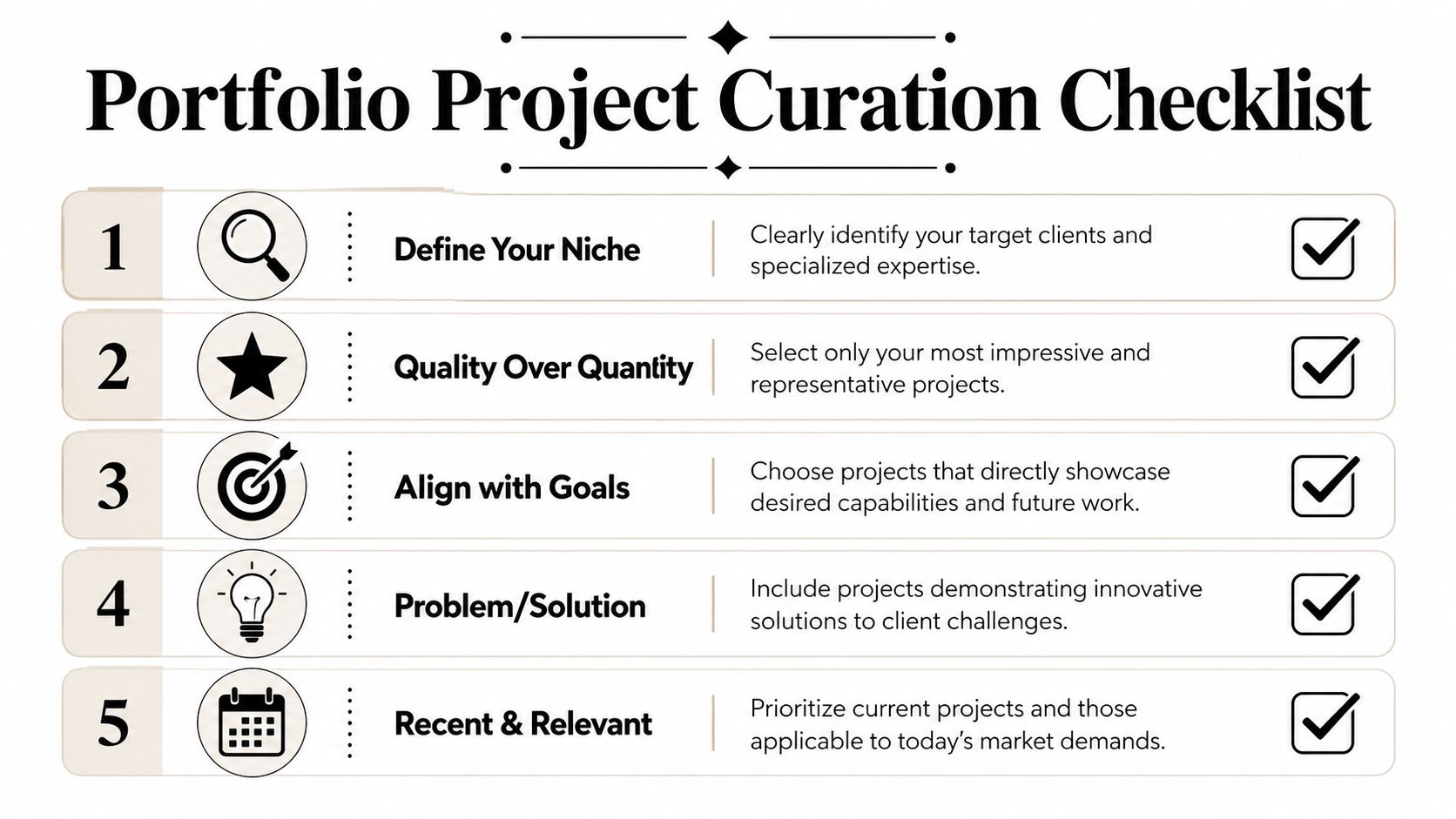
The fastest way to weaken a construction company portfolio is to put everything in it.
Long galleries feel safe internally because nobody has to make hard choices. They feel weak externally because the client has to do the editing for you. Most won't. They'll skim, get lost in repetition, and leave without a clear sense of what your firm does best.
Recent industry behavior from 2024 to 2025 shows top-tier commercial firms adopting a curated micro-portfolio strategy, often limiting public-facing project grids to just 3 to 5 high-impact case studies. That shift reflects a simple reality. B2B buyers spend less time scrolling and more time analyzing the projects that seem most relevant.
What to cut first
Start by removing projects that are only “pretty” but strategically unhelpful. A handsome building with no clear story, no meaningful constraints, and no useful outcome proof doesn't earn its place.
Projects usually belong in the archive, not the front-facing portfolio, when they have one or more of these problems:
- Wrong market fit: The project doesn't support the sectors you want to win next.
- Thin documentation: You don't have strong photography, drawings, details, or client-approved story material.
- No differentiator: The job was completed competently, but it doesn't show a challenge you solved especially well.
- Outdated signal: The work no longer reflects your current level, process, or positioning.
What earns a featured spot
A featured project has to do more than photograph well. It has to carry strategic weight.
Use a short decision table before you lock your selections:
| Criterion | What strong looks like | What weak looks like |
|---|---|---|
| Visual quality | Clear exterior, interior, detail, and context imagery | Only phone photos or inconsistent coverage |
| Business relevance | Supports target sectors and future bids | Reflects work you no longer pursue |
| Story value | Includes challenge, response, and outcome | Reads like a generic project summary |
| Technical proof | Shows coordination, systems, complexity, or process discipline | Offers aesthetics without substance |
| Client confidence | Includes approved testimonial, repeat work, or strong relationship context | No trust signal beyond your own claims |
Practical rule: If a project can't help a sales lead say “they've done our kind of work,” it probably shouldn't lead the portfolio.
Most firms will get stronger results from a small, deliberate set of project stories than a giant gallery. Publicly, that may mean 3 to 5 case studies. For a broader credentials deck, a slightly wider set may still make sense, but each project should earn its space.
If you're planning a reshoot or building a shortlist for future portfolio coverage, 10 must-have shots for your next portfolio is a useful way to think about visual completeness before you publish.
Choose for where you're going
The smartest portfolio curation is directional. If you want more education work, lead with projects that show circulation, occupancy, campus context, and phasing discipline. If you want hospitality, lead with atmosphere, finish quality, guest experience, and operational constraints.
Don't build your portfolio around nostalgia. Build it around the work you want next.
Commissioning Photography That Proves Quality
A prequalification package lands on an owner's desk. Two firms have similar project types, similar scale, and similar claims about craftsmanship. The difference often shows up in the images first. One portfolio reads like site documentation. The other makes quality visible, with clear evidence of finish control, coordination, and how the building performs for the people using it.
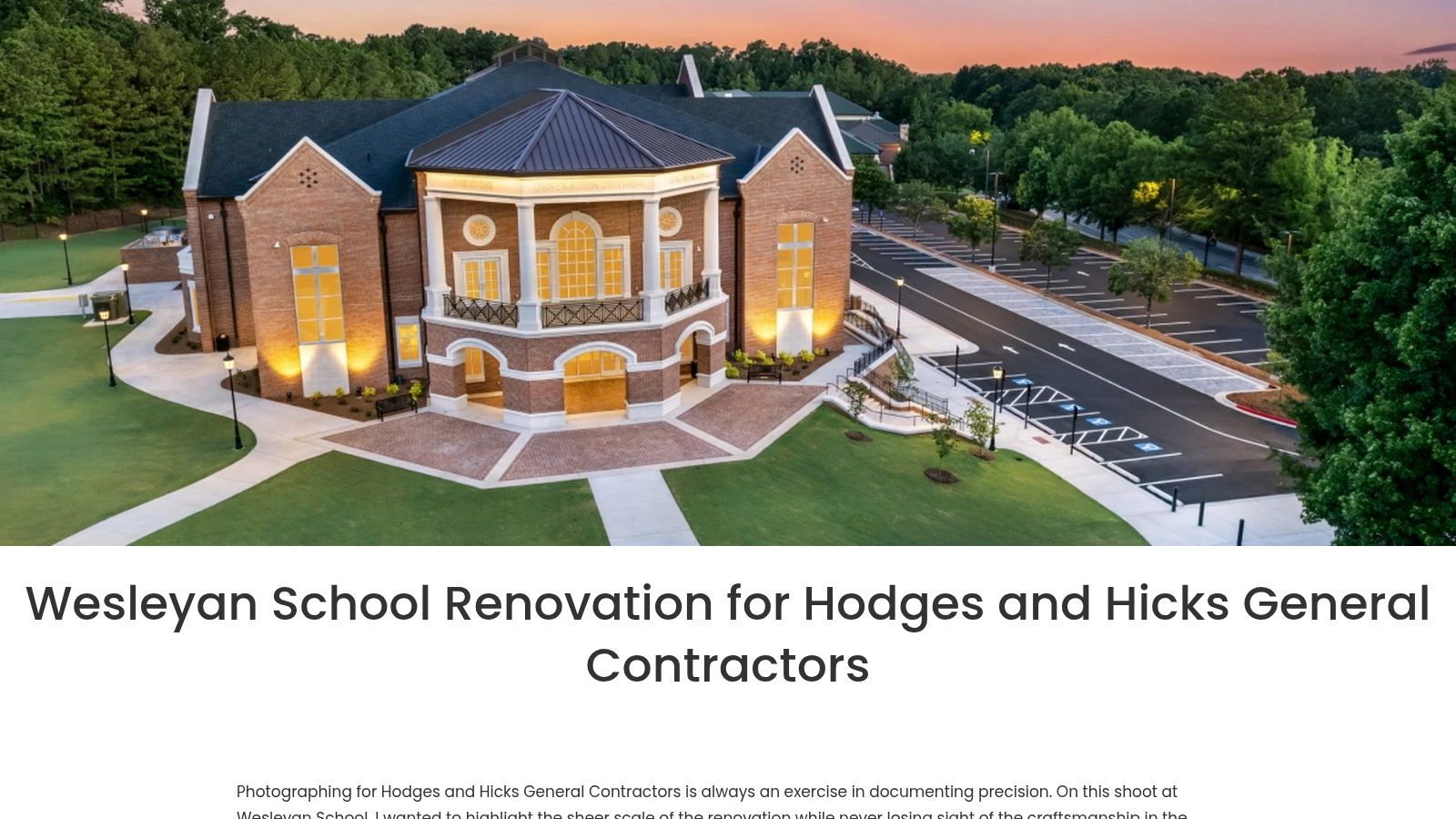
That is the job of portfolio photography. It should do more than prove a project was completed. It should help a buyer see how your team builds, what you notice, and why your standards hold up under scrutiny.
What professional photography should capture
Strong construction photography works on two levels at once. It has to attract attention quickly, and it has to hold up when an architect, owner, or procurement team studies the details.
That means covering more than the obvious hero shot. A useful set shows site context, approach, sequence, material transitions, tolerances, daylight, circulation, and the moments where careful execution becomes visible. The image set should also leave room for business use, because the same photos may need to serve a proposal, a qualifications deck, a project page, a trade feature, and a recruiting piece.
A solid brief usually asks for coverage in these categories:
- Establishing views: Exterior angles, site approach, and context within the neighborhood or campus
- Experience shots: Entry sequence, circulation paths, lobby views, and user perspective
- Craft details: Joinery, materials, specialty fabrication, lighting integration, and edge conditions
- Performance clues: Coordination zones, structural expression, building systems, or construction tolerances where visible
- Brand utility: Vertical crops, banner-friendly compositions, team-safe negative space, and image sets sized for web, print, and bid decks
The best photographers ask pointed questions before shoot day. What was difficult to execute here? Which details would another team miss? Where does the project show restraint, precision, or problem-solving? Those answers shape the shot list, and they often determine whether the final edit feels generic or persuasive.
How to commission the right photographer
Hire for judgment and process, not style alone.
A polished portfolio matters, but construction firms also need someone who can work a live site, coordinate with project teams, read a floor plan, and make smart choices under schedule pressure. Ask for examples that show controlled verticals, consistent exposure, and a mix of architectural views and construction-specific detail. Then ask how the photographer plans a day on site. The serious ones will talk about access, sun path, occupancy, safety requirements, staging, weather contingencies, and deliverables before they talk about gear.
Large campuses, mixed-use projects, and phased developments require even tighter coordination. This guide to hiring photographers for large developments is a useful reference if your team is scheduling multiple buildings, stakeholders, or milestones.
Clean photos are not enough. The image set has to support sales, branding, and technical credibility at the same time.
There is a trade-off here. A purely editorial shoot can produce beautiful images that say little about constructability. A purely documentary shoot can capture facts without creating confidence. The strongest portfolio coverage does both. It frames the building well, then backs that visual impression with details that show control, complexity, and finish quality.
Build a shot list like a strategist
The shot list should follow the logic of the project story.
Start with arrival and context. Move into threshold moments, major spaces, and the points where user experience depends on construction discipline. Then close in on the details that prove quality, such as alignment, material transitions, integrated systems, and places where tolerance mistakes would be obvious. That sequence gives your marketing team a visual narrative instead of a folder full of disconnected images.
A short film can support that narrative if it is tied to the same story and used with discipline.
Here's an example of how motion can support the visual presentation:
Without that planning, firms usually end up with too many wides, too few proof points, and very little material that explains why the work deserves trust. Strong photography closes that gap. It turns finished buildings into evidence.
Crafting Compelling Project Narratives
A preconstruction director opens your portfolio the night before a shortlist meeting. The photography gets attention first. The project story decides whether your firm looks expensive, dependable, risky, or worth the call.
That is why the written narrative cannot read like a closeout log. Sector, square footage, completion date, and delivery method help with reference, but they do not explain pressure, judgment, or results. A serious buyer wants to know what had to go right, what could have gone wrong, and how your team handled the job without losing control of cost, schedule, or trust.

The strongest portfolios pair editorial-quality visuals with project narratives built around evidence. The image creates interest. The story gives the image business value. Without that second layer, even excellent photography can feel decorative.
Use challenge, response, outcome
This structure works because it follows the questions owners, developers, and selection committees already ask.
Challenge should define job pressure. An occupied renovation, a constrained urban site, a compressed procurement window, a difficult authority having jurisdiction, or a handoff between trades with no room for error. Name the condition that made the project hard in practical terms.
Response should show how your team made decisions. Explain the sequencing plan, coordination method, site logistics, communication cadence, prefabrication strategy, or material choice that reduced risk. These details demonstrate a construction firm's competence. Generic language about dedication or excellence does not do that.
Outcome should close the loop with approved facts. Show what improved for the client. That may be on-time turnover, protected operations during construction, fewer punch list issues, faster occupancy, cleaner coordination, or a testimonial that speaks to reliability. If the result cannot be measured precisely, describe it in operational terms the buyer can recognize.
What every project story needs
A useful project narrative usually includes:
- Project frame: sector, location, scope, and timeline
- Client objective: what the owner needed to achieve
- Constraint: the condition that created risk or complexity
- Construction response: the specific actions your team took
- Result: the business or operational outcome
- Proof: photography, drawings, detail shots, team quotes, or approved client language
That structure does more than organize copy. It turns a finished project into a case study. For high-stakes pursuits, that difference matters.
Write like someone who understands the job
Portfolio copy should sound like it came from a superintendent, project executive, or marketer who participated in the coordination meetings. Buyers can tell when a description has been polished past usefulness.
Skip claims like “world-class craftsmanship” unless the page shows exactly what that means. A better line is specific: the team phased demolition and finish installation to keep patient areas operational, or coordinated MEP reroutes above an active ceiling grid to avoid shutdowns during business hours. Those details carry weight because they reflect trade-offs, not slogans.
One more rule helps. Keep the client at the center of the story. Your firm is not the hero. Your firm is the reason the client achieved the outcome with less risk and more confidence.
Good narratives do not compete with the visuals. They explain why the work mattered, why it was difficult, and why your team was trusted to deliver it.
Showcasing Technical Mastery and Key Metrics
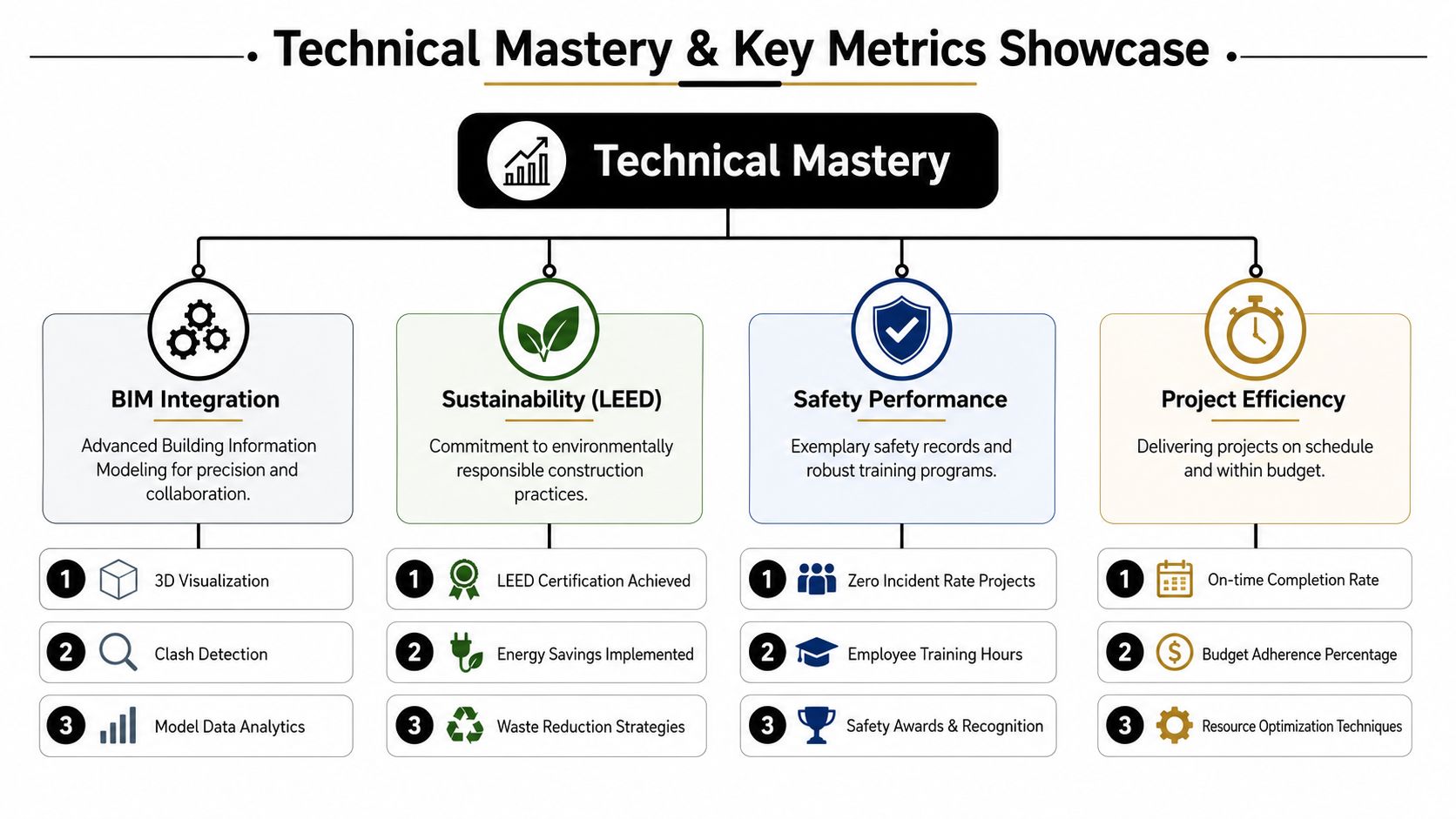
A traditional photo gallery is no longer enough for many serious buyers. They want visual confidence, but they also want technical proof. If your portfolio shows beautiful finished spaces without any evidence of coordination, systems thinking, or performance discipline, it can feel polished but thin.
That's why the strongest construction company portfolio today behaves less like a gallery and more like a digital product. Photography draws the client in. Technical layers help them evaluate risk.
Industry reports from 2024 to 2025 highlight that 68% of commercial developers now require portfolios to include interactive virtual tours or digital twins to verify project feasibility before bidding. That changes the expectation. Interactive content is no longer a novelty in many commercial contexts.
Add data layers without turning the page into a spec sheet
Most firms go wrong in one of two directions. They either hide all technical information behind generic captions, or they dump jargon onto the page and bury the story.
The middle ground is better. Use selective data layers that support the visuals:
- BIM callouts: Show where modeling improved coordination, clash review, or stakeholder visibility
- Sustainability elements: Present certification goals, material strategies, or energy-related design decisions in plain language
- Safety and execution discipline: Include process indicators only if they are current, approved, and easy to interpret
- Schedule and budget outcomes: Use only verified numbers and frame them in relation to the client objective
A cleaner structure for technical proof
Try this layout inside each case study:
| Layer | What it does |
|---|---|
| Visual overview | Gives immediate confidence in design quality and finished execution |
| Project summary | States scope, client need, and delivery context |
| Technical callout box | Highlights one to three meaningful capabilities such as BIM coordination or phasing complexity |
| Outcome panel | Shows measurable results or qualitative impact |
| Optional interactive element | Lets buyers explore the space or system in more depth |
This structure keeps the page readable. It also respects how clients review material. They want to scan first, then dive deeper where needed.
A virtual tour should extend the story, not interrupt it. If the transition feels abrupt, the portfolio architecture is wrong.
Use interactivity with editorial discipline
Interactive tools work best when they answer a clear question. Can the buyer inspect spatial logic? Can they understand sequence? Can they verify feasibility in a complex environment?
What doesn't work is bolting technical links onto the bottom of a project page with no explanation. That creates a disjointed experience. A viewer sees a refined set of photos, then hits a wall of unlabeled files or software exports. Confidence drops fast.
The better approach is to introduce each interactive element with one sentence of context. Tell the viewer what they're about to see and why it matters. That keeps technical sophistication from becoming technical noise.
Designing for Impact and Strategic Distribution
A construction company portfolio can have excellent photography and strong stories and still underperform if the layout is careless. Design is not decoration here. It is the mechanism that controls pacing, hierarchy, and trust.
A strong construction portfolio supports credibility with evidence such as high-quality photos, testimonials, and measurable results. That matters in a market where U.S. construction spending reached US$1.98 trillion in August 2023, up 7.4% year over year, according to BluEnt's construction portfolio guidance. In that environment, firms need to show operational discipline, not just visual polish.
Build hierarchy before you build pages
Clients don't read portfolios in order. They scan, stop, compare, and return. Your design has to support that behavior.
The practical layout sequence usually works like this:
- Strong opener: One image and one clear statement about the project or firm capability
- Quick orientation: Sector, project type, location, and role
- Proof block: A concise narrative with outcome evidence
- Technical support: Drawings, detail images, metrics, or process callouts
- Next action: Contact, related project, or credentials request
When every page uses a different logic, viewers waste energy figuring out where things are. Consistency is part of professionalism.
Format by channel, not by convenience
One portfolio should feed multiple versions. The website is not the bid deck. The bid deck is not the leave-behind. The leave-behind is not the interview board book.
Use different formats intentionally:
- Website case study: Shorter, image-forward, easy to scan, built for first impressions
- Formal PDF: More detailed, more context, suitable for procurement and stakeholder circulation
- Meeting leave-behind: Tighter and more selective, designed for discussion rather than deep reading
- Sector-specific packet: Designed for education, healthcare, hospitality, multifamily, or industrial pursuits
Distribution should be targeted
A portfolio only on your homepage is underused.
Your business development team should be able to send specific project stories based on sector, project type, or challenge. Marketing should be able to pull individual case studies into proposals, presentations, and outreach. Leadership should have a short printed version ready for in-person meetings where attention is limited and clarity matters more than volume.
The test is simple. If someone on your team asks, “Do we have a project story for this kind of client?” the answer should be immediate.
Measuring Performance and Evolving Your Portfolio
The most useful portfolio mindset is operational, not archival. Treat it like a system that needs inputs, review, maintenance, and refinement.
The Construction Institute recommends treating the portfolio as a single system: establish portfolio KPIs tied to business goals, standardize reporting formats, and document lessons learned at the end of each project cycle, including causes of variances and corrective actions, as outlined in its playbook for managing a portfolio of projects. That advice applies directly to marketing portfolios because credibility depends on consistency.
What to measure
Not every firm needs a complicated dashboard. You do need a repeatable way to tell whether the portfolio is helping sales.
Review questions like these on a regular schedule:
- Engagement: Which case studies get attention from prospects and partners?
- Relevance: Which sectors are overrepresented, and which are missing?
- Sales utility: Which projects do your business development team send?
- Narrative quality: Where do clients ask follow-up questions because the story was incomplete?
- Visual freshness: Which pages no longer reflect your current standard?
A portfolio can look current while being strategically stale. That usually happens when the imagery is still attractive, but the sectors, methods, or story emphasis no longer match the work you want.
Build a review rhythm
Industry guidance recommends refreshing the portfolio every 6 to 12 months as the business evolves. That cadence is practical because it forces firms to retire weak material, add stronger work, and update project outcomes after closeout.
A simple review workflow looks like this:
| Review point | Decision |
|---|---|
| New project completion | Archive, shortlist, or feature |
| Photo delivery | Approve final selects and define usage rights |
| Project closeout | Capture lessons learned and verified outcomes |
| Midyear review | Remove underperforming or outdated projects |
| Annual review | Rebuild sector balance and refresh messaging |
Standardize before you scale
Most portfolio problems are process problems. One project manager provides a great summary, another sends three sentences. One team logs changes carefully, another doesn't. One project has final photography, another has only progress shots and no permissions sorted out.
That inconsistency weakens the whole portfolio.
Your portfolio is only as credible as the reporting discipline behind it.
Create one intake template for every candidate project. Include scope, duration, budget context if approved, client goals, key challenge, your solution, verified outcome, image status, testimonial status, and technical assets available. Once that structure becomes routine, portfolio updates stop feeling like a scramble.
A construction company portfolio should show your best work. It should also reflect how your company thinks, documents, and improves. Firms that keep it current tend to present themselves as firms that stay in control.
If your firm needs portfolio images that do more than document a finished building, Jimmy Clemmons Photographer provides architectural photography and brand-focused visual content built for case studies, proposals, and project-driven marketing. The work is designed to help construction teams present craftsmanship, process, and project value with clarity.