
An office building's exterior is much more than a structural shell—it's the most powerful piece of marketing a company owns. Think of it as the cover of a book or a firm first handshake. It sets expectations and tells a story long before anyone ever steps through the front door.
The First Impression Modern Office Building Exteriors Make
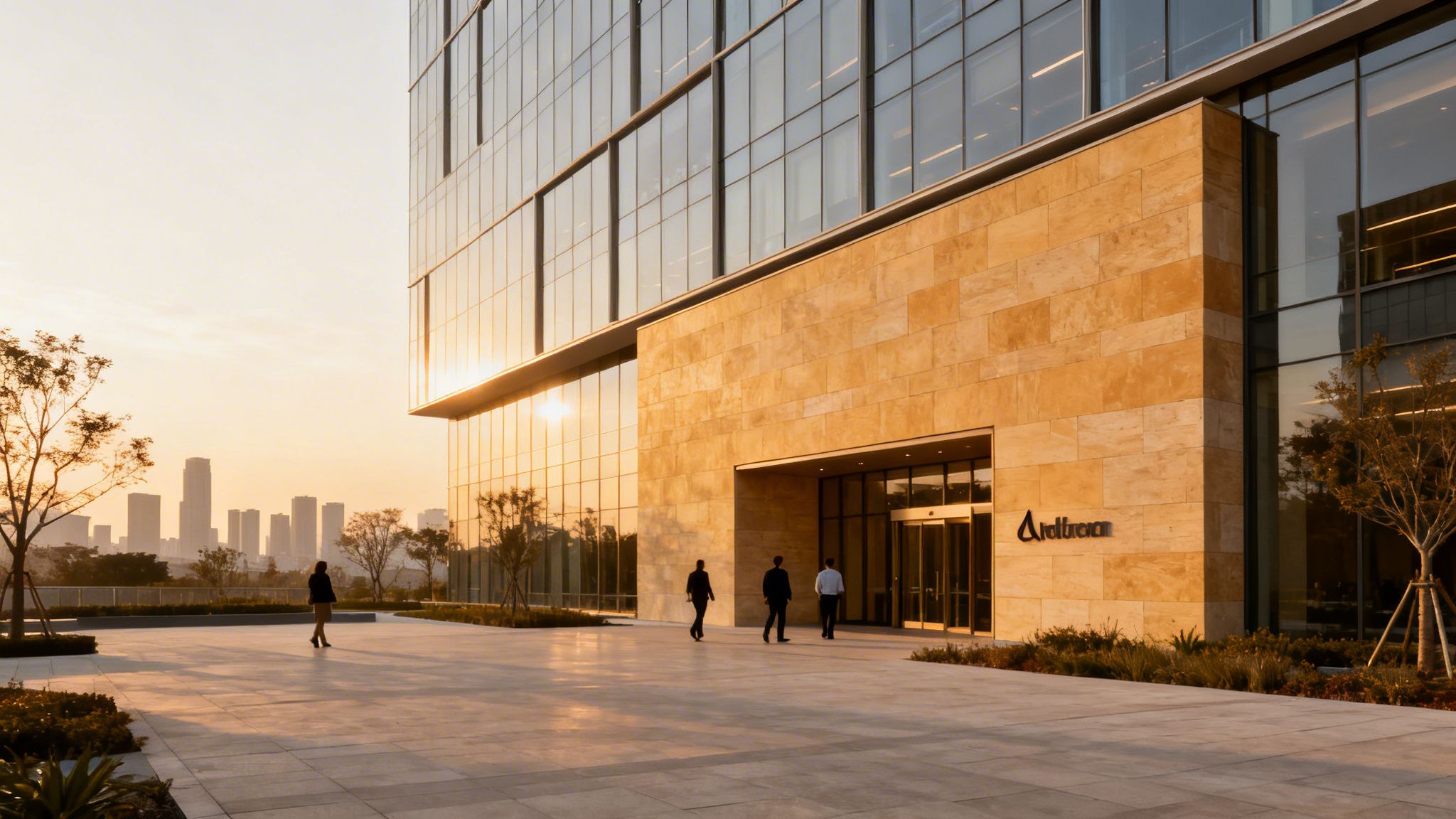
In my work, I’ve seen firsthand how a building's facade has become a critical business asset. The days of putting up anonymous, purely functional glass boxes are over. Today’s market demands more. The exterior is now a key tool for attracting top talent, broadcasting brand values, and hitting ambitious environmental targets.
This shift isn't just a trend; it's a massive investment. The global façade market, valued at roughly $254.6 billion in 2025, is expected to climb to $441.0 billion by 2035, with an annual growth rate of about 5.5%. This explosive growth shows just how central the building exterior has become to modern architecture. If you're curious, you can review the full market projections on this topic to see the sheer scale of this industry shift.
Why Facades Are Now Critical Business Assets
A modern facade has to do a lot of heavy lifting. It’s no longer just about looking good; it's about performance, identity, and the experience it creates for everyone who sees it. The most successful designs I photograph are the ones that balance all these needs into a single, cohesive statement.
Here’s how a facade really operates on multiple levels:
- Brand Ambassador: A sleek, glass-and-steel exterior can signal innovation and transparency, perfect for a tech firm. On the other hand, a solid brick or stone facade projects a feeling of stability and tradition, which is often the goal for a financial institution.
- Talent Magnet: In the fierce competition for great employees, a workplace's appeal begins at the curb. An inviting, modern exterior with visible green spaces and plenty of natural light tells potential hires that this is a company that cares about their well-being.
- Performance Engine: High-performance facades are also essential for sustainability. They use advanced glazing, superior insulation, and smart solar shading to cut down on energy consumption, lower operating costs, and earn those all-important green building certifications.
The role of a modern office building's exterior has expanded far beyond simple aesthetics. It's a complex system that communicates, performs, and attracts. We've summarized these crucial functions in the table below.
Key Functions of a Modern Office Exterior
| Dimension | Primary Function | Impact |
|---|---|---|
| Brand Identity | To visually communicate the company's values and mission. | Builds brand recognition and trust with clients and the public. |
| Talent Attraction | To create an appealing and desirable workplace environment. | Gives a competitive edge in recruiting and retaining top employees. |
| Sustainability | To optimize energy efficiency and reduce environmental footprint. | Lowers operational costs and meets regulatory and social responsibility goals. |
| User Experience | To enhance the well-being of occupants with light and connection to the outdoors. | Boosts productivity, creativity, and employee satisfaction. |
Ultimately, a facade is a promise—a declaration of purpose and vision that resonates with clients, employees, and the community at large.
An office exterior is the first and most lasting promise a company makes to its clients, its employees, and its community. It must communicate purpose, permanence, and vision all at once.
In this guide, we'll dive deeper into the materials and design trends shaping modern architecture, from living walls to parametric designs. You'll learn how to read a building’s story through its facade and, just as important, how expert architectural photography can capture that narrative for the world to see.
Materials and Trends Shaping Modern Facades
The materials an architect reaches for are more than just building blocks; they're the first words in a building's story. They dictate the aesthetic, of course, but also how the structure performs, how it feels to approach, and how it interacts with the city around it. That palette is always expanding, pushed forward by new technology and a real hunger for buildings that are both smarter and more distinctive.
Right now, a handful of core materials are driving the most exciting conversations in architecture. They’re the foundation for the design trends that are completely redefining what an office building can be.
The Core Material Palette
Choosing a material is about setting a tone. A sleek glass tower feels open and futuristic, while a textured concrete facade communicates a sense of permanence and gravity. Getting a feel for these materials is the first step to really seeing the artistry in modern facades.
High-Performance Glass: This isn't your average window pane. Modern glazing is a sophisticated system that can be coated to bounce heat, tinted to slash glare, or even engineered to produce its own power. Its real magic, though, is transparency—flooding workspaces with natural light and dissolving the barrier between inside and out.
Precast Concrete: There’s a beautiful honesty to concrete. It provides a feeling of solidity and history. Thanks to modern precasting, architects can now create panels with stunning precision, embedding intricate patterns, textures, and colors that give a building a grounded, almost sculptural quality.
Metal Composite Panels: These are the true shape-shifters of the architectural world. Made of a lightweight core pressed between two thin metal sheets, they can be finished in nearly any color or texture imaginable. Their clean look and versatility make them a go-to for creating the sharp, dynamic lines that define so many modern office building exteriors.
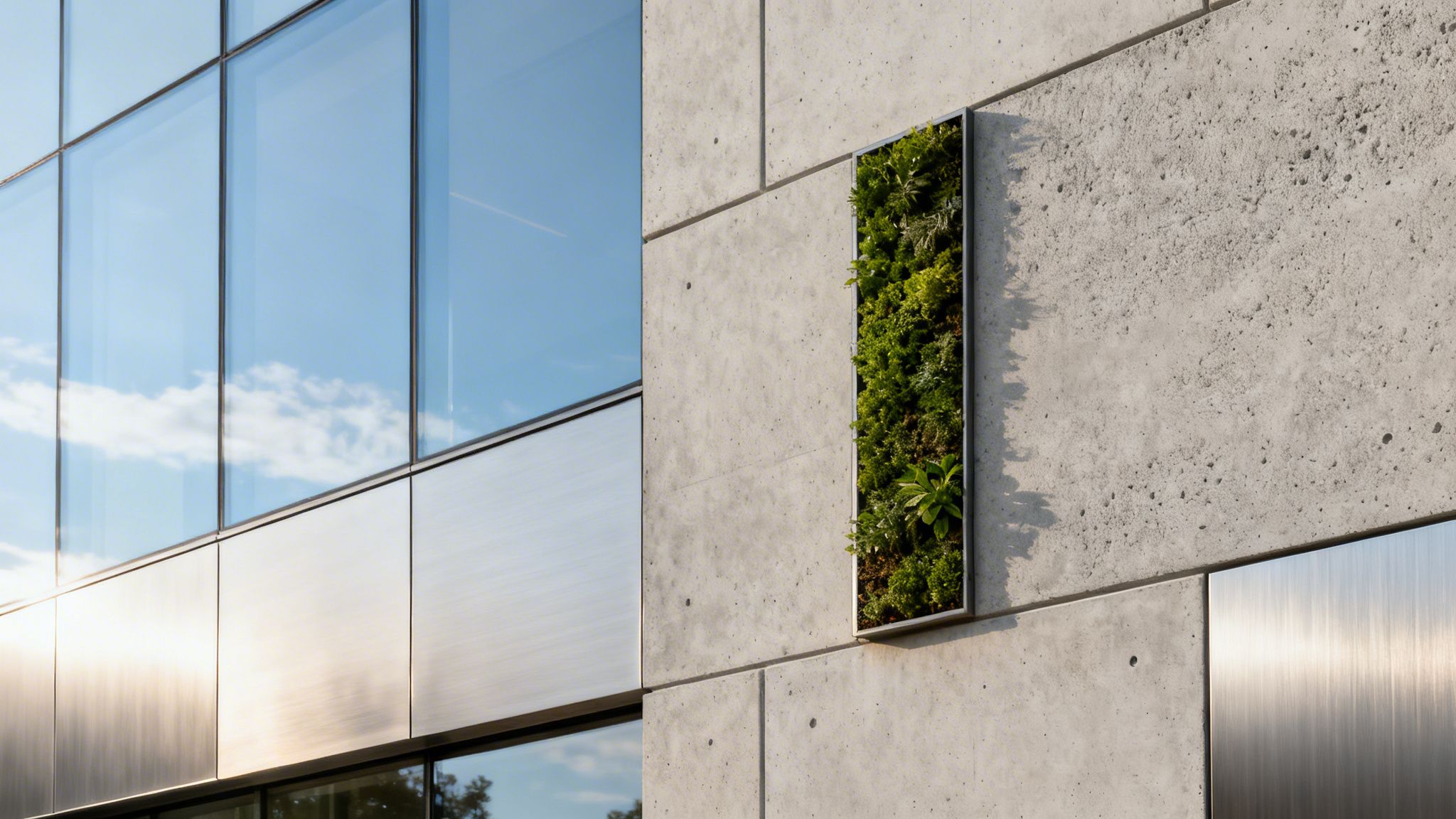
The best facades are almost always a conversation between materials. It’s the cool, reflective sheen of glass playing off the raw texture of concrete, or the crisp lines of metal framing a soft, living wall. That interplay is what creates real visual depth and tells a compelling story.
These materials aren’t just used on their own. They’re the key ingredients in larger design movements that are pointing the way toward a new generation of office buildings—structures that are more attuned to people and the planet.
Key Trends in Facade Design
Three major trends are changing how architects use these materials. Each one is a response to a different modern demand, from our well-being at work to the need for data-driven efficiency.
Biophilic Design and Living Walls
Biophilic design is all about weaving the patterns and forms of nature into our built world. On a facade, you see this most dramatically in living walls or vertical gardens. These are so much more than decoration. They actively clean the air, cool the surrounding environment, and give people a direct connection to nature that’s been proven to lower stress and spark creativity. Architects are literally designing buildings that can breathe.
Parametric and Data-Driven Facades
This is where architecture gets really futuristic. Using powerful computer algorithms, designers can generate incredibly complex and fluid forms that would be impossible to dream up by hand. Parametric design allows a facade to be shaped by specific environmental data, like the path of the sun or prevailing wind patterns. The result is a building that’s not only visually striking but also perfectly tuned to its environment, with self-shading fins or aerodynamic curves that are as functional as they are beautiful.
Kinetic and Responsive Exteriors
What if a building could react to the weather like a living thing? That’s the idea behind kinetic facades. These exteriors have moving parts—like panels that rotate, louvers that adjust, or screens that shift—all in response to real-time conditions. They can open up to welcome the morning sun, close down to block harsh afternoon glare, or change position to manage ventilation. It’s about creating a smart, dynamic skin that actively helps manage the building’s interior climate.
How Exteriors Communicate Brand and Function
Long before a client ever walks through the front door, a building has already told you its story. The exterior is the most powerful first impression a company can make—it’s the book cover that signals the identity, values, and purpose of the entire organization.
Think about the immediate gut feeling you get from different designs. A sleek, all-glass tower housing a financial trading floor just screams speed, transparency, and a modern mindset. On the other hand, a law firm set behind a solid stone or precast concrete façade gives off an undeniable sense of stability, tradition, and authority. These aren't accidents. The materials, lines, and scale of office building exteriors are a deliberate language, translating brand values into a physical form that speaks directly to its audience.
Form Follows Function and Brand
A building's skin isn't just about looking good; it's a direct reflection of what happens inside and the culture it was built to support. The old saying "form follows function" is more relevant than ever in corporate architecture, but I’d add a modern twist: form follows function and brand.
You see it everywhere once you start looking:
- Expansive Windows for Collaboration: Tech campuses with huge, floor-to-ceiling glass walls are designed to feel open and transparent. The message? Ideas flow freely here, and we have nothing to hide.
- Fortified Ground Floors for Security: When you see a financial institution or data center with a solid, almost fortress-like base, it’s meant to communicate security and trustworthiness. It’s a visual promise that your assets are safe.
- Integrated Greenery for Wellness: Companies that put a premium on employee well-being often build in biophilic elements like living walls or green roof terraces. This tells a story of a brand that cares about health, sustainability, and a balanced life.
This deep connection is a fundamental piece of a company’s visual identity. For anyone looking to capture this architectural narrative, understanding the core principles of brand photography services provides crucial context. The exterior truly sets the stage for the entire brand experience.
"When I photograph a building, I'm not just capturing steel and glass. I'm translating the architect's narrative into a visual story that amplifies the brand's message. My job is to find the angle, the light, and the moment that makes the building's intended purpose feel undeniable."
Today, this architectural storytelling is getting even more sophisticated. Exteriors are no longer just passive shells; they're becoming active, performance-driven systems. Smart façades reflect a major shift toward buildings that are as agile as the companies inside them. We’ve seen a big rise in smart facades and energy-efficient products, which makes sense when you learn that 88% of organizations recently identified business agility as a key goal. This evolution means a building’s skin can now communicate both its core brand identity and its operational intelligence at the same time.
Designing Sustainable and High-Performing Facades
In modern architecture, sustainability isn't just a buzzword or a pricey add-on anymore. It's the baseline for any high-quality design. Today’s best office building exteriors are expected to be intelligent, high-performing systems that deliver real, measurable returns—both for the planet and the balance sheet.
This is about moving beyond simply slapping a "green" label on a building. It's about creating facades that are smarter, cheaper to run, and healthier for the people working inside them. The core idea is simple: a building’s outer skin should work for you. Instead of brute-forcing the temperature with mechanical systems, a well-designed exterior actively manages the building’s relationship with the world around it. This is how you start to achieve ambitious goals like Net-Zero Energy, where a building actually produces as much energy as it uses.
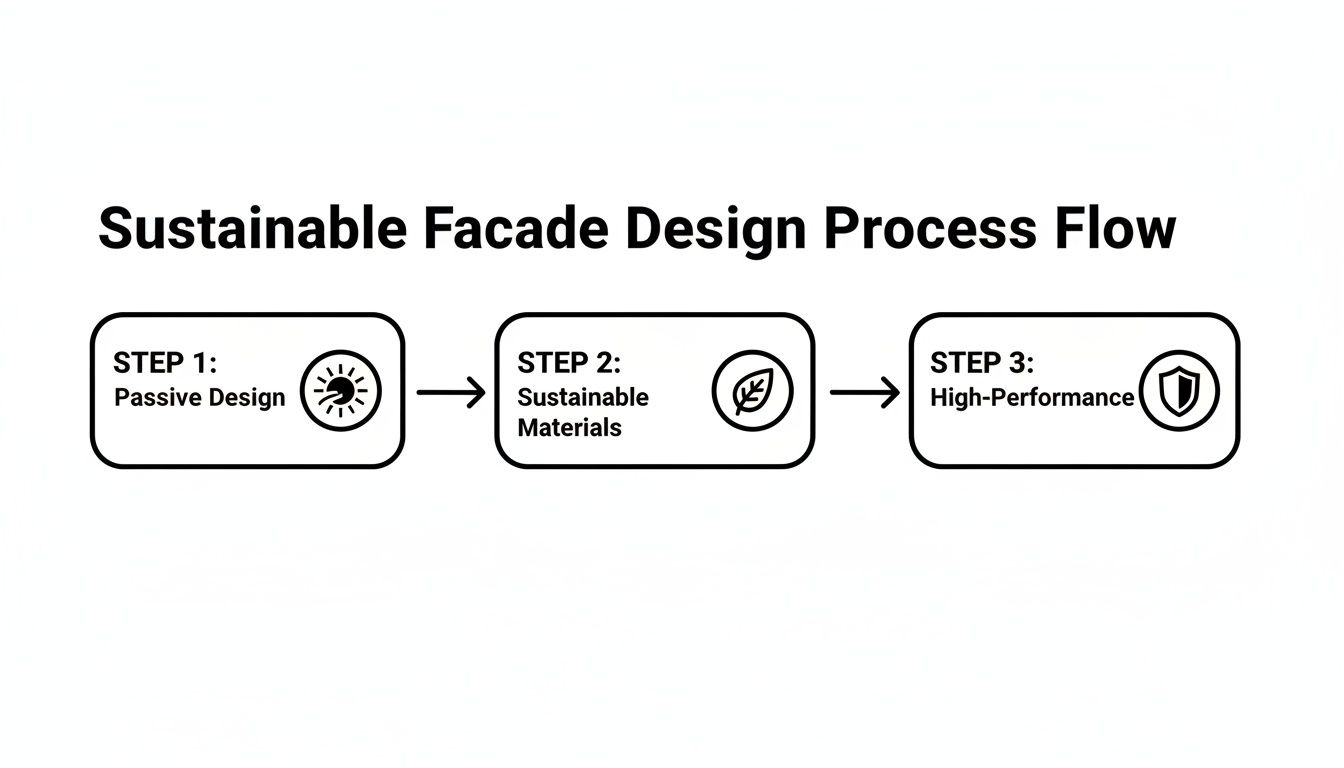
The Power of Passive Design
Passive design is really just the art of using a building's architecture to stay comfortable without gobbling up energy. Think of it like dressing for the weather. On a blazing hot day, you seek shade and wear light colors. On a cold, clear day, you find a sunny spot to warm up. A building’s facade can do the exact same thing.
A few key passive strategies make all the difference:
- Building Orientation: This is the first, most critical step. Simply positioning a building to catch the winter sun for warmth and shield it from the summer sun for cooling can have a massive impact.
- Solar Shading: Overhangs, fins, and louvers are your best friends here. They can be angled perfectly to block the high, hot summer sun while letting the low winter sun stream in to warm the interior.
- Natural Ventilation: Something as simple as operable windows and thoughtfully placed vents can create cross-breezes that slash the need for air conditioning, especially in more temperate climates.
These aren't just feel-good environmental moves; they translate directly into lower utility bills and a much more pleasant experience for everyone inside.
A truly sustainable facade isn't the one with the most solar panels. It’s the one so intelligently designed that it barely needs them in the first place. Performance always begins with form.
High-Performance Materials and Systems
Beyond the big-picture passive strategies, the specific materials and systems you choose are what bring it all home. The building envelope—that physical barrier between inside and out—has to be a perfect shield, keeping conditioned air in and extreme temperatures out.
This focus on efficiency has completely reshaped the market. Across the board, energy performance is a top priority, driving the adoption of low-VOC paints, recycled materials, and advanced systems to cut down on long-term operational costs. You can see how these standards are influencing everything by exploring how office design trends are evolving.
This laser focus on the building envelope has spurred some incredible advancements. Let's break down a few of the most common strategies that turn a standard facade into a high-performing one.
The table below compares some of the most effective strategies architects use to boost a facade's performance, turning environmental goals into tangible financial benefits.
Comparing Sustainable Facade Strategies
| Strategy | Description | Key Benefit (Environmental & Financial) |
|---|---|---|
| High-Performance Glazing | Double or triple-paned glass with special coatings (like Low-E) that reflect heat while letting visible light pass through. | Slashes heating and cooling loads, resulting in 10-25% energy savings and lower monthly utility costs. |
| Superior Insulation | Using advanced insulation materials inside the wall assemblies to dramatically reduce heat transfer. | Creates a stable indoor temperature, reducing HVAC strain and cutting year-round energy bills. |
| Recycled & Low-Carbon Materials | Incorporating materials like recycled steel, reclaimed wood, or low-carbon concrete to lower the building's embodied carbon footprint. | Minimizes the project's upfront environmental impact and often helps secure valuable green building certifications (like LEED). |
By weaving these elements together, architects and developers are proving that office building exteriors can be both visually stunning and financially sound. It's a clear-eyed approach that boosts the building’s long-term value, making sustainability one of the smartest business decisions you can make.
My Approach to Photographing Office Building Exteriors
A great shot of an office building does more than just show what it looks like; it tells you the story of its design. When I approach a building, my job is to translate that massive, three-dimensional structure into a two-dimensional image that carries the same weight and impact. It’s a process that’s part technical skill and part intuition, all centered on capturing the architect’s original vision.
This isn't just about pointing a camera and clicking. It’s about truly understanding how light falls across different materials, how a certain angle can guide the eye, and how to solve the visual puzzles each building presents.
Working With Light and Time
Light is everything in this line of work. It’s the tool that sculpts the building, brings out texture, and sets the entire mood of the shot. The same facade can feel completely different throughout the day, and knowing how to use that to my advantage is key.
Golden Hour: I’m always chasing the light, and this is the best of it. That brief window right after sunrise or just before sunset gives you this soft, warm glow. It minimizes harsh shadows and wraps the building in a way that highlights its shape without any distracting glare.
Blue Hour and Twilight: The moments just before the sun is up or right after it’s gone down are pure magic. The sky turns a deep, rich blue, and it's the perfect time to balance the building's interior lights with the sky. A well-lit entryway during twilight just feels incredibly inviting and alive.
Direct Sunlight: This one’s a bit trickier, but you can’t always avoid it. Instead of fighting it, I use it to create bold, graphic images full of contrast and deep shadows. It works beautifully for emphasizing strong geometric patterns or the powerful form of a concrete structure.
Deciding when to shoot is a creative choice that defines the final image. If you want to go deeper on this, I’ve laid out more of my process in my guide on choosing the best light for a site shoot.
Finding the Right Composition
Once the light is right, it's all about composition—how I arrange everything in the frame to tell a clear, compelling story. It’s about creating order and drawing the viewer’s eye right where it needs to go.
A great architectural photograph isn’t just a record of a building; it’s an interpretation. It’s about finding the one perspective that perfectly captures the architect’s intent and the structure’s soul.
I rely on a few core techniques to get there:
- Leading Lines: I use walkways, roads, or even lines in the architecture itself to lead the eye toward a focal point, like the main entrance.
- Symmetry and Balance: Sometimes, the most powerful shot is a perfectly centered one. It creates this sense of stability and permanence, which is perfect for communicating strength.
- Framing: I often use things like trees, other buildings, or foreground elements to create a natural frame around my subject. It adds a ton of depth and gives the building context.
Tackling the Technical Side
Photographing massive buildings, especially modern ones, comes with some unique technical hurdles. Glass creates all sorts of weird reflections, and tall structures can look like they’re falling backward if you’re not careful. This is where specialized gear becomes non-negotiable.
My tilt-shift lenses are my secret weapon here. They let me correct for that perspective distortion, so all the vertical lines in the building stay perfectly straight instead of converging at the top. This keeps the building’s true proportions intact.
Reflections on glass are another big one. A polarizing filter is my go-to for cutting through that glare. It lets the camera see into the building to show the activity inside and also makes the sky pop with more color and contrast. You can see how important highlighting these features is, especially when dealing with modern, sustainable design.
When a building has advanced sustainable features, my job is to make them the hero of the shot. It’s about using light and composition to prove the building isn't just beautiful—it's smart, too.
You’ve poured everything into designing and building a remarkable structure. Now, how do you capture it? Choosing the right architectural photographer isn’t just about getting a few nice pictures for the website; it’s about finding a partner who can see the soul of your project and translate your architectural vision into a powerful, lasting image.
Your first stop will always be the portfolio, but you need to know what you’re looking for. It’s about more than just a gallery of impressive buildings. A truly professional portfolio shows an absolute command of the technical craft.
The Non-Negotiables: Technical Precision
Great architectural photography is built on a foundation of technical skill. It’s what separates a quick snapshot from a meticulously crafted image that does justice to the building. When you’re reviewing a photographer’s work, look for the details.
Here’s what I see as the true marks of a pro:
- Perfectly Straight Verticals: Buildings need to stand straight and true in a photo, not look like they’re falling backward. This is a dead giveaway. A professional achieves this in-camera with specialized tilt-shift lenses, correcting perspective distortion right at the source.
- A Masterful Use of Light: Look for a variety of lighting conditions. Does the portfolio include the soft warmth of golden hour, the dramatic mood of twilight, and even the crisp, revealing light of midday? A great photographer knows how to work with any light to tell the right story.
- Crisp, Flawless Detail: Zoom in. Every texture, from the grain of the concrete to the reflection in the glass, should be tack-sharp and clear. This demonstrates a deep understanding of exposure, focus, and an exacting post-production process.
A portfolio is more than a resume—it’s proof. It should show not only that a photographer can make a building look good, but that they can solve the complex visual puzzles architecture presents, like controlling reflections on a glass curtain wall or capturing the true texture of a stone façade.
The X-Factor: A Collaborative Spirit
Beyond the technical skills, the right photographer is a true collaborator. They should be asking you smart questions—about the story behind the design, the key features you’re most proud of, and what you want these images to communicate for your brand.
Think of it as bringing a new expert onto your team. They should be just as invested in the outcome as you are. The best shoots I’ve been on are two-way conversations where we build the shot list together, blending my photographic expertise with the client’s deep knowledge of the project. A little preparation goes a long way, and when clients know how to prepare your project site for a professional photoshoot, it lets me focus entirely on capturing the best images possible.
Ultimately, you’re not just hiring someone to take pictures. You’re investing in your project’s legacy. Find the photographer whose work doesn’t just document your building, but elevates it.
Answering Your Questions About Office Exteriors
Even the most buttoned-up project plans come with questions. When it comes to capturing the exterior of an office building, architects, developers, and marketing teams often run into the same practical hurdles. I hear these questions all the time, so let's clear them up.
What Is the Best Time of Year to Photograph a Building?
There's no single "best" season—the right time depends entirely on the story you want the building to tell. That said, I almost always recommend spring and autumn if the schedule allows.
In these seasons, the sun sits lower in the sky. You get that beautiful, soft light and long shadows that really carve out a building’s shape and give it depth. The landscaping is also working for you, either with fresh spring greenery or rich fall colors. Winter can be striking and dramatic, but you're rolling the dice with dead landscaping and unpredictable weather.
How Does Facade Material Affect Photography?
A building's skin dictates how I approach the shoot. You wouldn't photograph a mirror the same way you’d photograph a rough stone wall, and the same principle applies here. Each material demands its own kind of light.
- Reflective Glass: With a glass curtain wall, my goal is to control the reflections, not necessarily get rid of them. I'll use a circular polarizing filter to manage glare, either to show a hint of the interior or to make the blue of a reflected sky really pop. Twilight is also a magic hour for glass, as the interior lights start to glow and balance perfectly with the fading sky.
- Matte Concrete or Stone: For textured materials like brick, concrete, or stone, it's all about directional light. Shooting early in the morning or late in the afternoon, when the sun is low, creates shadows that reveal all that beautiful texture and character. Midday sun just flattens it all out.
As a photographer, you learn to read the materials. You know that glass will tell a story of transparency at twilight, while concrete will speak of raw strength in the morning sun. It's about choosing the light that lets them talk.
What Factors Influence the Cost of Architectural Photography?
When clients ask about cost, the investment really comes down to three things: the scope of the project, how the images will be used, and the post-production work.
The scope is about the time and complexity on-site—how many final shots are needed, and whether we need to come back for separate day and twilight sessions. Image licensing is a crucial piece; it defines where and how you can use the photos. Rights for a national ad campaign will naturally differ from usage on a local website. Finally, post-production is where the magic happens. This is the painstaking work of blending exposures, perfecting perspective, and polishing every detail to turn a great shot into a flawless one.
Your building tells a story. Jimmy Clemmons Photographer provides the images that make the world want to listen. Discover how we capture architectural excellence at jimmyclemmons.com.